

On this page
Alkenes react readily with chlorine gas at room temperature. But benzene is different. Its six π electrons are delocalised across the entire ring, creating a highly stable aromatic system. Adding chlorine across the double bonds (as an alkene would do) requires breaking this aromaticity, which costs a significant amount of energy. Therefore, chlorine alone is too weak an electrophile to attack the electron-rich but stable benzene ring.
What is the role of FeCl3 in the chlorination of benzene?
Because molecular chlorine (Cl₂) is not a strong enough electrophile, it must be activated. This is where iron(III) chloride (FeCl₃) or aluminium chloride (AlCl₃) comes in.
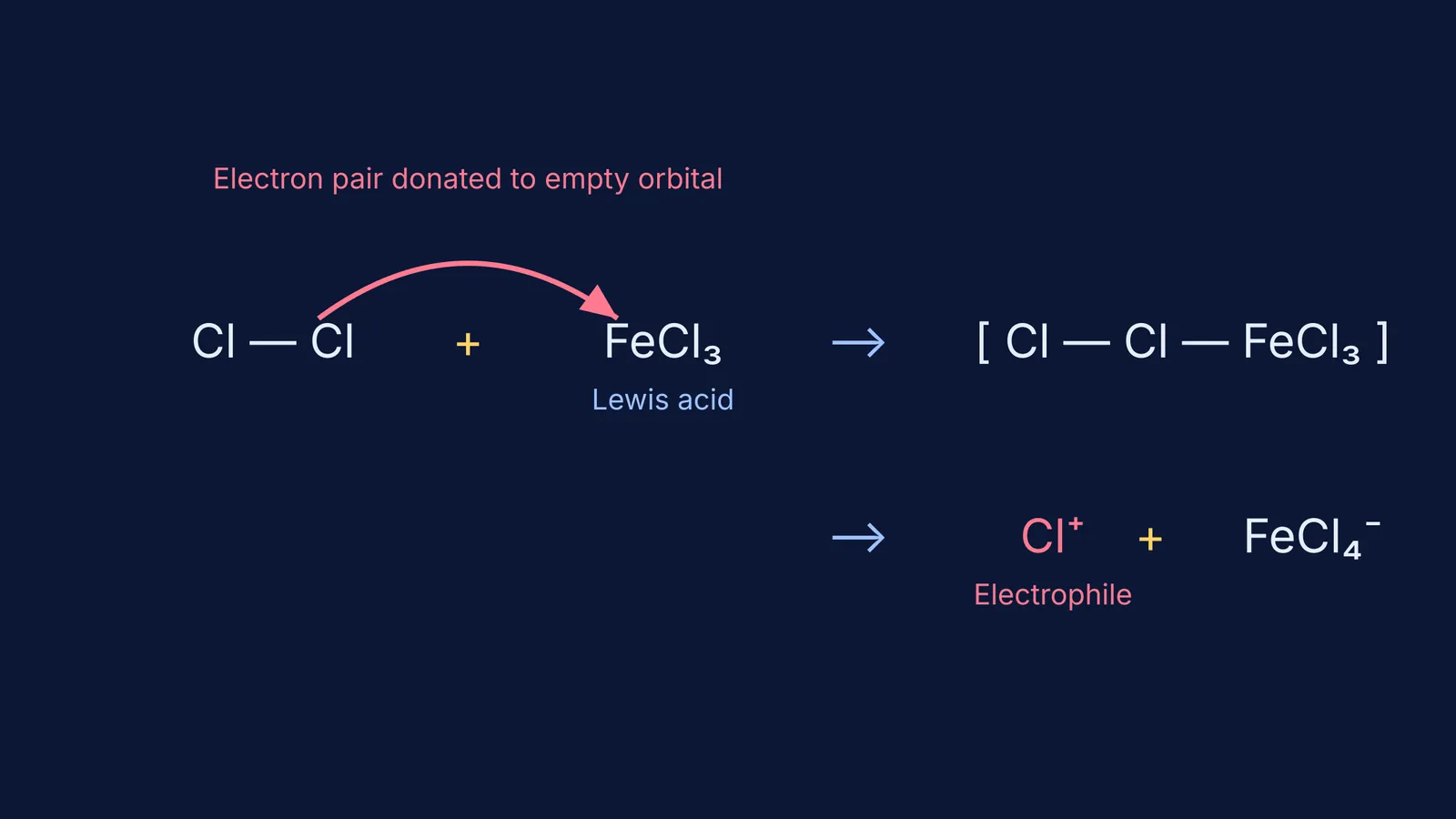
FeCl₃ acts as a Lewis acid, meaning it is an electron-pair acceptor. Much like the Lewis acidity of boron trihalides, the empty orbital in the metal atom allows it to accept electrons. When Cl₂ approaches FeCl₃, one of the chlorine atoms donates a lone pair of electrons into the empty orbital of the iron atom.
This polarises the Cl—Cl bond, drawing electron density away from the outer chlorine atom. The bond weakens and breaks, generating the highly reactive chloronium ion (Cl⁺).
Once this powerful electrophile is formed, the benzene ring's π electrons attack it, forming an unstable intermediate called a sigma complex (or arenium ion). This step is the slow, rate-determining step of the reaction because it destroys the aromaticity of the ring. The intermediate is a carbocation, but it is somewhat stabilised by resonance, as the positive charge is delocalised over the remaining five carbon atoms of the ring.
Finally, the FeCl₄⁻ ion acts as a base, removing a proton (H⁺) from the sp³-hybridised carbon atom on the ring to restore its stable aromaticity. This deprotonation is fast, leaving chlorobenzene and regenerating the FeCl₃ catalyst alongside hydrogen chloride (HCl) gas as a by-product.
Why must the catalyst be anhydrous?
A common mistake is using a catalyst that has been exposed to moisture. The reaction requires strictly anhydrous (water-free) conditions.
Water molecules have lone pairs of electrons on their oxygen atoms, making them excellent Lewis bases. If moisture is present, water will immediately donate its electrons to the vacant orbitals of the Lewis acid. This forms a stable hydrate complex or hydrolyses the catalyst completely (for instance, converting AlCl₃ to aluminium hydroxide and hydrogen chloride gas).
Once the empty orbitals of the catalyst are occupied by water, the catalyst is "killed". It can no longer accept electrons from chlorine, and the chlorination reaction fails to start.
Why does benzene not react with Cl2 alone in the dark?
In the dark, chlorine molecules lack the energy to undergo homolytic fission. Without a Lewis acid to polarise the bond, the Cl₂ molecules simply bounce off the stable benzene ring.
Conversely, if you expose a mixture of benzene and chlorine to sunlight or ultraviolet light without a catalyst, a completely different reaction takes place. Light provides enough energy to split the Cl—Cl bond into two highly reactive chlorine free radicals (Cl•). These radicals attack the π bonds of the benzene ring, adding chlorine atoms to all six carbons to form benzene hexachloride, entirely destroying the aromatic ring.
Keeping the reaction in the dark ensures that chlorine only reacts via the Lewis acid pathway, strictly leading to electrophilic ring substitution. (Note that highly activated rings, such as phenol, do not always need a Lewis acid, which is why the bromination of phenol proceeds readily with just bromine water).
How do you identify EAS reaction conditions?
When predicting the products of aromatic halogenation in exams, check these three constraints to avoid common traps:
Is there a Lewis acid? Look for anhydrous FeCl₃, FeBr₃ or AlCl₃ over the arrow. If present, it indicates electrophilic aromatic substitution (ring substitution).
Is there light or heat? If you see UV light (hν) or heat (Δ) and no catalyst, the reaction will go via free radicals, leading to addition (for benzene) or side-chain substitution (for alkylbenzenes like toluene).
Is the condition strictly anhydrous? If water or moisture is mentioned, the Lewis acid is destroyed and ring substitution will not happen.
Whether you are revising the halogenation of benzene or the Reimer-Tiemann and Kolbe reactions of phenol, keeping track of electron flow and conditions can be difficult. The Fermi Concept Library maps out these mechanisms so you can see the reasoning behind each step. When you are ready to test your knowledge, try working through related mechanism questions in the Fermi Problem Library. The AI tutor explains the reasoning rather than printing an answer.


