

On this page
Two numbers describe almost every fat or oil you meet in chemistry: the saponification value and the iodine value. They sound like lab trivia, but each one answers a clear question about a fat. The saponification value tells you how big the molecules are. The iodine value tells you how many C=C double bonds they carry. Once you see what each test actually does to a triglyceride, the formulas write themselves.
What does the saponification value of a fat measure?
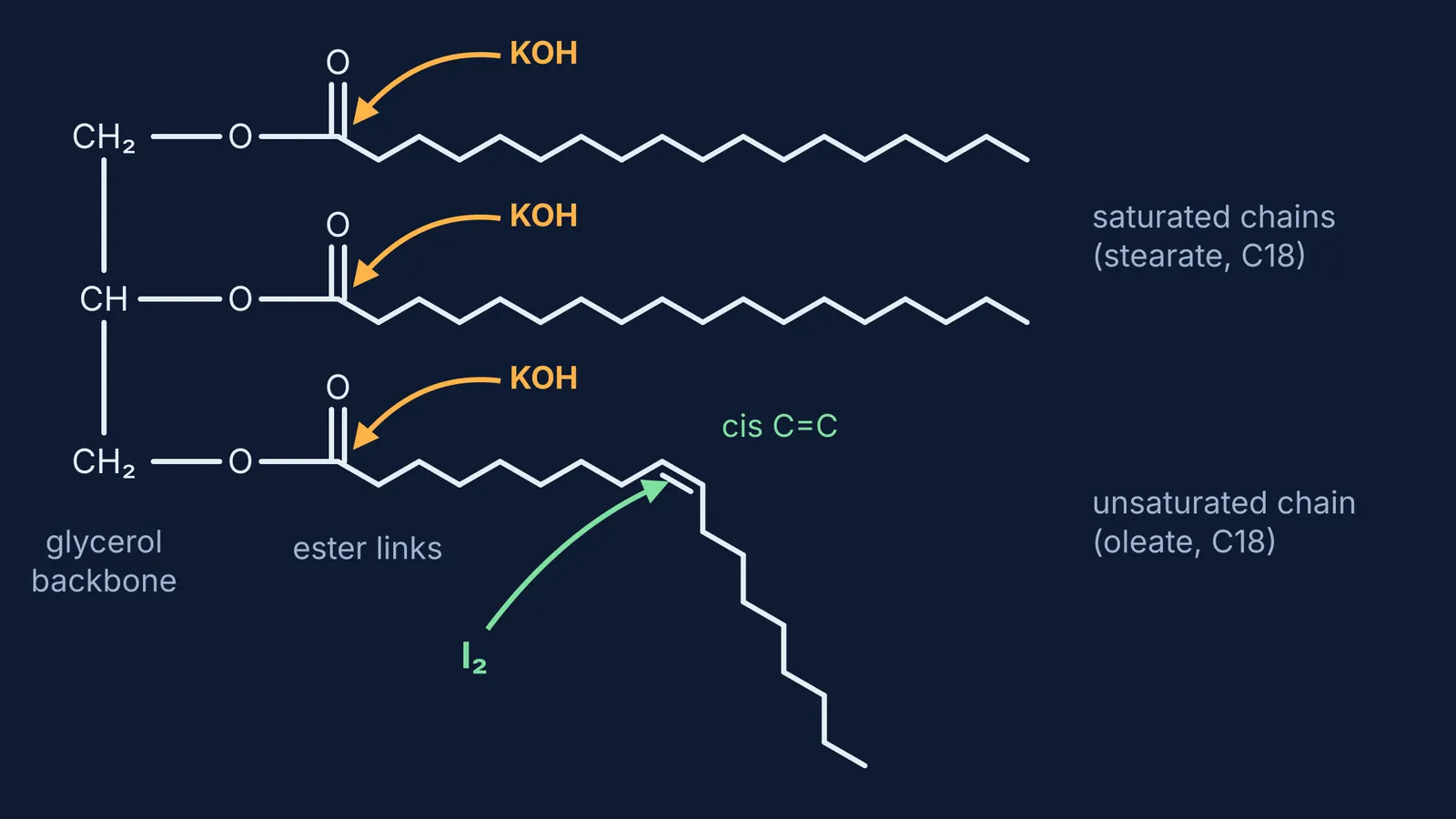
A fat or oil is mostly triglycerides: one glycerol molecule joined by ester links to three fatty-acid chains. Boil it with potassium hydroxide and each ester link is hydrolysed. That is saponification, the same reaction that makes soap.
Triglyceride + 3KOH → glycerol + 3RCOO⁻K⁺
The saponification value (SV) is the number of milligrams of KOH needed to saponify 1 g of the fat. Every triglyceride molecule, short-chained or long, has exactly three ester links, so it always uses 3 mol of KOH per mole. What changes from fat to fat is how many moles there are in 1 g, and that depends on the molar mass M.
SV = (3 × 56.1 × 1000) / M = 168300 / M
Here 56.1 g/mol is the molar mass of KOH and the factor 1000 converts grams to milligrams. A high SV means a small M, which means short fatty-acid chains. A low SV means long chains. If you want the ester chemistry behind this step in more detail, see our post on the difference between esterification and saponification.
What does the iodine value tell you?
Iodine (in practice a more reactive halogen reagent such as iodine monochloride, reported as iodine) adds across each C=C double bond in the fatty-acid chains. Saturated chains have no C=C, so they take up none.
The iodine value (IV) is the number of grams of I₂ absorbed by 100 g of the fat. One C=C takes one I₂ (molar mass 254 g/mol). For a pure triglyceride with n double bonds per molecule:
IV = (n × 254 × 100) / M
So IV measures the degree of unsaturation. More C=C per gram means a higher iodine value. Notice the different bases: SV is per 1 g in milligrams, IV is per 100 g in grams.
How do you calculate SV and IV for triolein and tristearin?
Here is the worked numerical. Take two pure triglycerides with the same chain length, 18 carbons.
Triolein: glyceryl trioleate, C₅₇H₁₀₄O₆, M ≈ 885.4 g/mol. Each oleate chain has one cis C=C, so n = 3.
Tristearin: glyceryl tristearate, C₅₇H₁₁₀O₆, M ≈ 891.5 g/mol. Stearate chains are saturated, so n = 0.
Step 1: saponification value of triolein.
1 mol triolein needs 3 mol KOH = 3 × 56.1 = 168.3 g KOH.
885.4 g triolein needs 168.3 g KOH.
1 g needs 168.3 / 885.4 = 0.1901 g = 190.1 mg KOH.
SV ≈ 190.
Step 2: iodine value of triolein.
1 mol triolein (885.4 g) adds 3 mol I₂ = 3 × 254 = 762 g I₂.
100 g triolein adds 762 × 100 / 885.4 = 86.1 g I₂.
IV ≈ 86.
Step 3: tristearin.
SV = 168300 / 891.5 = 188.8, so SV ≈ 189.
IV = 0, because there is no C=C to add to.
Look at what the numbers say. The two SVs are almost the same (190 and 189) because both fats have C18 chains and nearly the same molar mass. The IVs are completely different (86 and 0) because only triolein has double bonds. SV reads chain length; IV reads unsaturation.
Going backwards. Exam questions often give you the values and ask for the structure. Suppose a pure triglyceride has SV = 190 and IV = 86. Then M = 168300 / 190 ≈ 886 g/mol, and n = IV × M / (254 × 100) = 86 × 886 / 25400 ≈ 3.0. So each molecule carries three C=C bonds, which fits triolein.
For comparison, trilinolein (C₅₇H₉₈O₆, M ≈ 879.4, two C=C per chain, so n = 6) gives IV = 6 × 254 × 100 / 879.4 ≈ 173. Trilaurin, made of shorter C12 chains (M ≈ 639.0), gives SV = 168300 / 639.0 ≈ 263. That is why coconut oil, rich in lauric acid, has a higher saponification value than most cooking oils.
If these steps feel slippery, the Fermi Problem Library has worked problems with a step-by-step solver that explains the reasoning, so you can see where each factor of 1000 or 100 comes from.
Why do oils have a higher iodine value than ghee or butter?
Vegetable oils such as sunflower, groundnut and mustard oil are rich in unsaturated fatty acids like oleic and linoleic acid. Each cis C=C puts a kink in the chain. Kinked chains cannot pack tightly, so the attractions between molecules are weaker and the fat stays liquid at room temperature. Ghee and butter contain a larger share of saturated chains, which are straight, pack well and make the fat solid. Our post on why fats are solid and oils are liquid explains the packing in more detail.
More C=C per gram means more I₂ absorbed. So, as a rule, liquid oils have higher iodine values than solid fats, and the iodine value is a quick way to rank how unsaturated a fat is.
How are iodine value, hydrogenation and rancidity linked?
Hydrogenation. Bubbling H₂ through hot oil with a nickel catalyst adds hydrogen across the C=C bonds. Each C=C that reacts uses one H₂, exactly as it would have used one I₂. As the double bonds disappear, the iodine value falls and the oil turns into a soft solid. Partial hydrogenation of vegetable oil is how vanaspati is made. Read more in our post on why vegetable oils are hydrogenated to make vanaspati. The saponification value barely changes, because adding a few hydrogen atoms hardly changes the molar mass.
Rancidity. Oxygen in the air attacks fats at and near their double bonds, breaking the chains into smaller aldehydes and acids that smell and taste bad. That is oxidative rancidity. Oils with a high iodine value have more of these reactive sites, so they generally turn rancid faster than saturated fats like ghee. This is also why antioxidants are added to packaged oils and fried snacks, and why chips packets are flushed with nitrogen.
If you want to revise the parent ideas, the Concept Library covers lipids, esters and addition reactions concept by concept.
Quick checklist before the exam
SV = mg KOH to saponify 1 g fat. For a triglyceride, SV = 3 × 56.1 × 1000 / M.
Higher SV means lower molar mass and shorter chains.
IV = g I₂ absorbed by 100 g fat. IV = n × 254 × 100 / M, with n = number of C=C per molecule.
Higher IV means more unsaturation: oils above ghee and butter.
Triolein: SV ≈ 190, IV ≈ 86. Tristearin: SV ≈ 189, IV = 0.
Hydrogenation lowers IV and leaves SV almost unchanged.
Higher IV usually means faster oxidative rancidity.


