

On this page
If you have walked past the jars of preserved frogs and snakes in a school biology lab, you may have smelled formalin. It turns up in two places in your syllabus: in Class 12 chemistry, as a use of formaldehyde, the simplest aldehyde, and in biology, as the liquid that keeps specimens from rotting. This post links the two and adds a short dilution calculation that the textbook leaves out.
What is formalin made of?
Formalin is formaldehyde (IUPAC name methanal, formula HCHO) dissolved in water. At room temperature, pure formaldehyde is a colourless gas with a pungent smell (ATSDR ToxFAQs). Its boiling point is -6°F, about -21°C, and it is often used in a water solution (NIOSH Pocket Guide: formaldehyde).
The NCERT Class 12 chemistry textbook says formaldehyde "is well known as formalin (40%) solution" (NCERT, Aldehydes, Ketones and Carboxylic Acids, section 8.5).
The US National Institute for Occupational Safety and Health gives a slightly different figure: "Formalin is an aqueous solution that is 37% formaldehyde by weight; inhibited solutions usually contain 6-12% methyl alcohol" (NIOSH Pocket Guide: formalin).
The methanol is there for a reason. A review of fixation chemistry explains that undiluted commercial formaldehyde solutions contain 10% methanol "as a preservative to prevent the spontaneous condensation reaction" (Thavarajah et al., 2012, Journal of Oral and Maxillofacial Pathology).
Why is formalin used to preserve biological specimens?
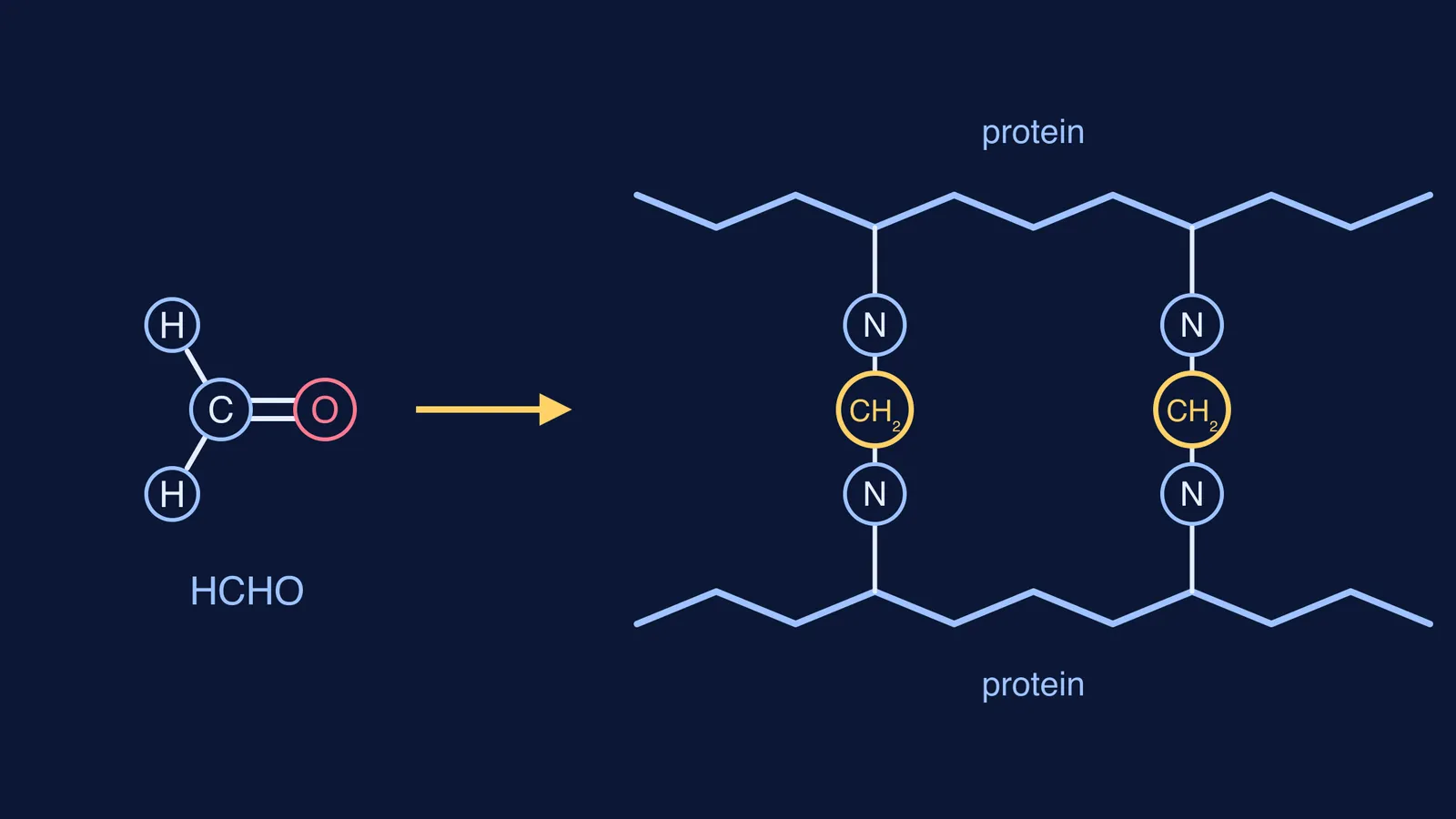
Formaldehyde fixes tissue by tying protein molecules to each other. The same 2012 review describes how formaldehyde first reacts with amine and amide groups on proteins, after which "the subsequent cross-linking occurs by formation of a cross-link of -CH2- called a methylene bridge" (Thavarajah et al., 2012). In collagen, the most frequent link joins the nitrogen at the end of a lysine side chain to the nitrogen of a peptide bond.
Once the proteins are locked together like this, the tissue holds its shape and resists breaking down, which is what a preserved specimen needs.
What does "10% formalin" actually contain?
Pathology labs do not use formalin straight from the bottle. The same review states that "the routinely used fixative is 10% formalin, which is 3.7% formaldehyde in water with 1% methanol" (Thavarajah et al., 2012). Here is roughly where those numbers come from, using C1V1 = C2V2:
Take 10 mL of stock formalin and add water to make 100 mL. This is "10% formalin": 10% of the volume is the stock solution.
Taking the stock as 37% formaldehyde (NIOSH), the diluted solution is about 37% × 10/100 = 3.7% formaldehyde.
The methanol is diluted by the same factor of 10, so the 10% methanol in the stock becomes about 1%.
With NCERT's 40% figure, the same step gives 4% formaldehyde.
The trap is that "10% formalin" does not mean 10% formaldehyde. The percentage is of the stock solution, not of the chemical.
If dilution numericals like this trip you up, the Fermi Problem Library has worked problems with a step-by-step solver that explains the reasoning rather than printing an answer.
What else is formalin used for?
NCERT lists formalin's other main job as making polymers: bakelite (a phenol-formaldehyde resin), urea-formaldehyde glues "and other polymeric products" (NCERT, section 8.5). You can read why one of those resins ends up on your kitchen stove in our post on why pressure cooker handles are made of Bakelite.
The US National Cancer Institute adds pressed-wood products such as particleboard, plywood and fiberboard, glues and adhesives, permanent-press fabrics, and uses as a fungicide, germicide and disinfectant (NCI fact sheet).
Is formalin dangerous?
Yes, which is why it stays in sealed jars and fume hoods. The International Agency for Research on Cancer classifies formaldehyde as a human carcinogen, and the US National Toxicology Program named it a known human carcinogen in 2011 (NCI fact sheet).
Nasal and eye irritation have been observed in people breathing 0.1 to 0.5 ppm of formaldehyde, and the US workplace limit set by OSHA is an average of 0.75 ppm over an 8-hour workday (ATSDR ToxFAQs).
In India, formalin also makes the news when it is added to fish. ICAR's Central Institute of Fisheries Technology has developed test kits with paper strips that show a colour change "within a span of 2-3 minutes" to detect formaldehyde or ammonia in fish (ICAR).
In a school lab, never sniff a specimen jar, wear gloves if you handle specimens, and tell your teacher straight away if any splashes on your skin or in your eyes. Our guide to chemistry lab safety rules for school practicals covers the rest.
How do you answer "What is formalin?" in an exam?
A good short answer covers four points. Use this checklist:
Definition: a 40% aqueous solution of formaldehyde (methanal, HCHO).
Use 1: preserving biological specimens.
Use 2: making bakelite and urea-formaldehyde resins and glues.
Why it preserves (for longer answers): it cross-links proteins through -CH2- methylene bridges.
If the chemistry of aldehydes still feels shaky, the Fermi Concept Library covers every concept in chemistry and biology, each with its own lesson, so you can see where formaldehyde fits before you revise its reactions.


