

On this page
Many practical mishaps start with the same few habits: water poured into acid, a test tube pointed at a friend, a deep sniff of a gas, a spill nobody reports. The rules below come from three references written for school labs: the NIOSH School Chemistry Laboratory Safety Guide from the US CDC, the CLEAPSS student safety sheets used in UK schools, and the UK Association for Science Education. The first-aid steps come from the NHS and the WHO. Your school's rules and your teacher's instructions always come first.
How should you handle acids in a school lab?
The NIOSH guide puts the main rule plainly: add concentrated acid to water slowly, and never add water to a concentrated acid. Mixing them gives off heat, so add the acid a little at a time.
The same NIOSH guide adds:
Wear chemical splash goggles in the lab.
Check the label, and take only as much as you need.
Never pour leftovers back into the original container.
Hold containers away from your body when you pour from one to another.
How do you heat a test tube safely?
CLEAPSS Student Safety Sheet 93 gives clear numbers.
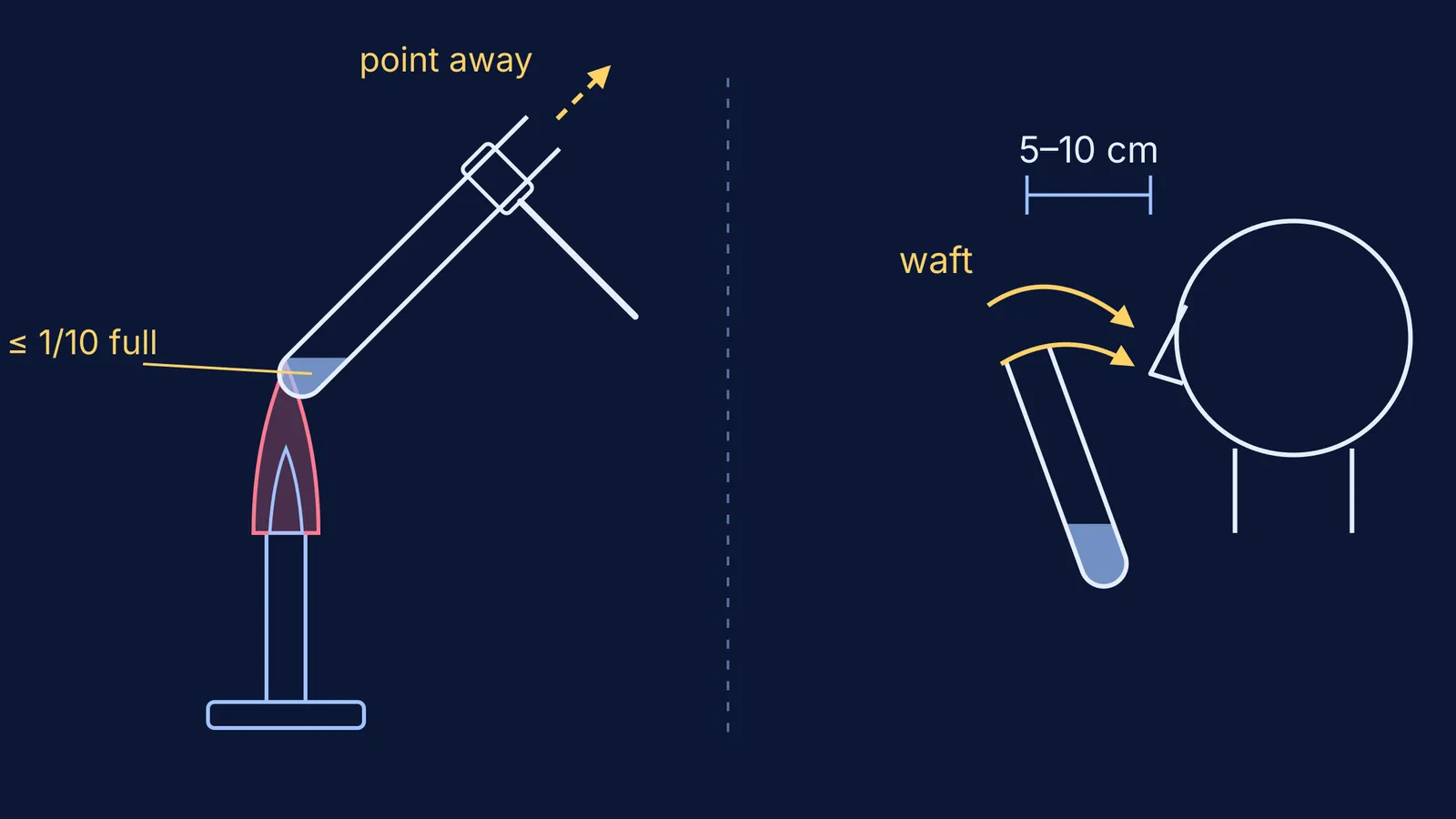
Fill a test tube no more than one-tenth full of liquid, or one-fifth full of solid.
Use a wide boiling tube if you can, and add an anti-bumping granule before you heat. Never add one to warm liquid; it can froth up.
Hold the tube with a test tube holder in good condition, not tongs.
Keep it at an angle, with the open end not pointing at you or anyone else.
Hold the bottom of the tube just at the tip of the flame, start with a gentle flame, and keep flicking your wrist gently so the liquid moves all the time.
The NIOSH guide adds two warnings: hot glassware looks just like cold glassware, and flammable liquids go in a hot water bath, never straight over a flame.
How do you smell a gas by wafting?
Never put a tube under your nose and breathe in. The Association for Science Education notes reported incidents of pupils told to smell a gas who breathed in dangerously large amounts, sometimes needing hospital treatment, and that chlorine has caused particular problems.
Its method: hold the test tube about 5 to 10 cm from your nose, pointing away from your face, and use your hand to waft the vapour towards you. Sniff gently, don't inhale deeply. If you smell nothing, move the tube a little closer, carefully. This matters in salt analysis, where some tests ask you to identify a gas by its smell.
Where does chemical waste go?
Not down the sink. The NIOSH guide says never pour chemical waste into sink drains or wastebaskets; use labelled waste containers, and put broken glass straight into its own container.
What should you do after a spill or burn?
Tell your teacher straight away. The NIOSH guide asks students to report every spill, accident and injury immediately.
Chemical on your skin: flush with plenty of cold water for at least 5 minutes, NIOSH says. If it soaked your clothes, take that clothing off the skin first. Then get it seen by medical staff.
Chemical in your eye: NIOSH says flush it with water immediately, holding the eye open, and take out contact lenses. The NHS advises running water over the eyeball for at least 20 minutes and getting medical help for a chemical in the eye. Take the container with you, because its label helps with treatment.
A burn from a flame or hot glass: the WHO says about 20 minutes under cool running water is commonly advised for smaller burns, along with taking off rings and watches early and covering the burn with a clean cloth. Never use ice, butter, oil, toothpaste or traditional pastes, and don't burst blisters.
A spill on the bench: step back and let your teacher deal with it. The NIOSH guide describes neutralising acid spills with sodium hydrogen carbonate (baking soda) before cleaning up.
A 60-second check before every practical
Goggles on, long hair tied back, closed shoes, bag in its proper place and off the bench.
Find the eyewash, the fire blanket and the first-aid kit (the NIOSH guide asks students to know where these are).
Find the waste container and the broken-glass bin.
Check the test tube holder grips firmly before you use it.
Read every label, and know which way the open end of your tube will point.
Practise one line so embarrassment doesn't slow you down: "Ma'am, I've splashed acid on my hand, I'm going to the tap." Say it, then go.
The reasons behind these rules come up in viva questions. The Fermi Concept Library has a lesson for every chemistry concept, and for the calculations after a practical, the Fermi Problem Library works through problems step by step, explaining the reasoning rather than printing an answer.
See these habits in a full experiment in our guides to the KMnO4 and oxalic acid titration and to preparing acetanilide, iodoform and aniline yellow.


