

On this page
If you have ever lifted a hot pressure cooker off the stove, you relied on its dark, rigid handle to protect your hand. That handle is almost always made of a material called Bakelite. But why use this specific plastic when others would simply melt?
Why are pressure cooker handles made of Bakelite?
Pressure cooker handles are made of Bakelite because it is a thermosetting plastic that does not soften or melt when heated. It also acts as an excellent thermal insulator.
When a pressure cooker is on a stove, the metal body gets extremely hot to cook the food quickly under pressure. You need a handle that can withstand that high heat environment without passing the temperature to your hand or losing its structural integrity. Bakelite solves both of these problems perfectly, making it the standard material for cookware handles around the world.
What makes Bakelite a good insulator?
Heat travels through solid materials by a process called conduction. Metals, which are used to build the body of the cooker, are excellent conductors of heat. The thermal conductivity of aluminium is 237 W/(m·K). This allows the pot to absorb heat from the burner efficiently and transfer it to your food.
Bakelite, however, restricts the flow of thermal energy. The thermal conductivity of Bakelite is approximately 0.2 W/(m·K). This huge difference means that while the aluminium body heats up rapidly, the Bakelite handle stays cool enough to touch safely. The heat simply cannot travel efficiently through the plastic to reach your hand. (Read more about how these properties are used in our guide to conductors, semiconductors and insulators compared).
Why doesn't the handle melt on the stove?
Most everyday plastics, like the ones used for water bottles or food storage containers, are known as thermoplastics. When you heat a thermoplastic, it softens and eventually melts. If you made a cookware handle out of a thermoplastic, it would droop and deform the moment the pot got hot.
Bakelite behaves entirely differently because it is a thermosetting plastic. Bakelite was invented in 1907 by the chemist Leo Baekeland. It was the world's first synthetic thermosetting plastic. (You can read more about his life in our post on Leo Baekeland and Bakelite).
During the manufacturing of a thermosetting plastic, a chemical reaction permanently bonds the polymer chains together in a rigid, three-dimensional network. This process is called curing. Once the resin is cured, the plastic becomes infusible and insoluble, meaning it cannot be melted or reshaped by further heating. If exposed to extreme, direct flames, Bakelite will eventually char or crack, but it will never melt into a liquid.
The chemistry of cross-linking
The secret to Bakelite's heat resistance lies deep within its molecular structure. Bakelite is formally a phenol-formaldehyde resin. When phenol and formaldehyde react under heat and pressure, they form strong covalent bonds between adjacent polymer chains.
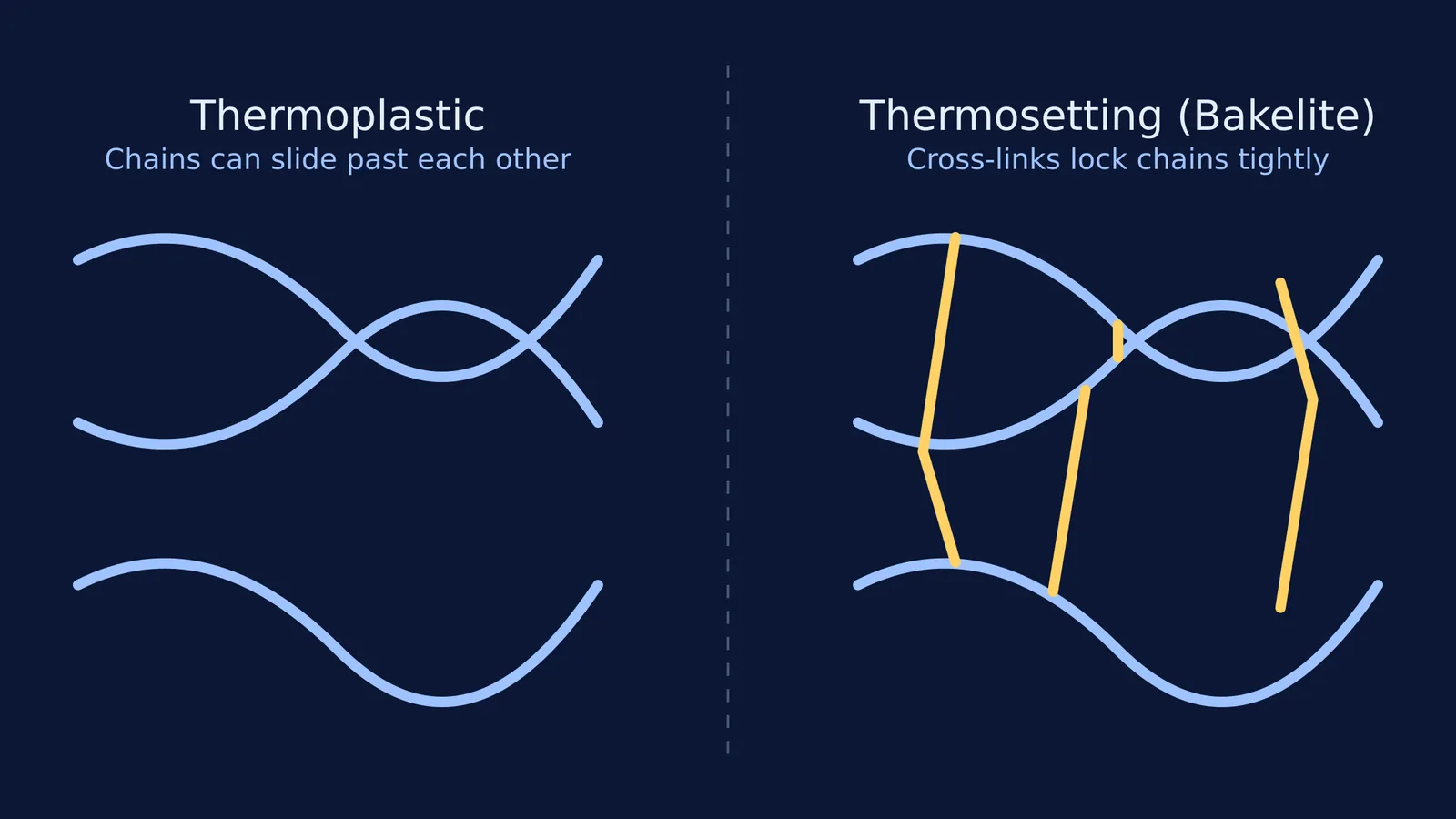
These molecular connections are known as cross-links. In a thermoplastic, the long polymer chains are separate; when thermal energy is added, they can easily slide past each other. In a cross-linked thermosetting plastic, those chains are locked tightly in place. The network holds its shape even as the temperature rises, which is exactly what you need when lifting a heavy, boiling pot.
If the difference between a simple polymer chain and a cross-linked network is hard to picture, you can explore molecular structures in the Fermi Simulation Lab, which provides interactive simulations for the ideas that are easier to see than to read.
How to care for Bakelite handles
Because Bakelite is a thermosetting plastic, it is highly durable, but it is not indestructible. Here is a simple checklist for maintaining your pressure cooker handles and ensuring they stay safe to use:
Avoid direct flames: Keep the handle away from the open flame of a gas burner. While it won't melt, extreme direct heat can scorch the surface, causing it to dull and eventually become brittle.
Wash by hand: The harsh detergents and high water temperatures in a modern dishwasher can degrade the finish of Bakelite over time, making it look grey and chalky.
Check for cracks: Since it is a rigid cross-linked polymer rather than a flexible one, Bakelite can crack or shatter if dropped heavily on a hard kitchen floor. Inspect the handles occasionally to ensure they are securely attached and completely undamaged.


