On this page
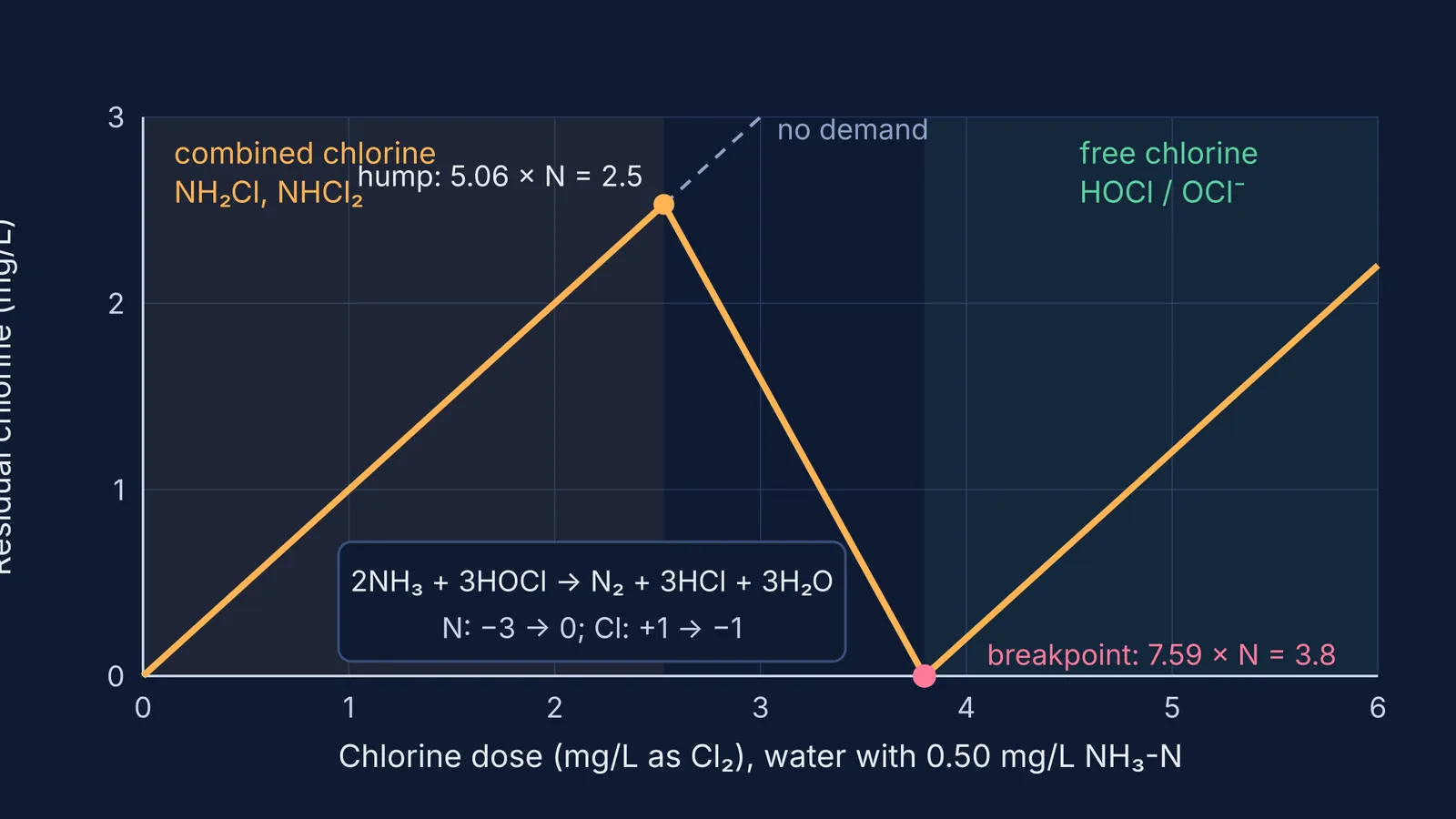
Add a little chlorine to water that holds a trace of ammonia and the chlorine reading goes up. Add more and, oddly, the reading goes down. Keep going and it falls almost to nothing, then starts to climb again. The low point is called the breakpoint, and water engineers use it on purpose. Behind the strange curve is a redox reaction you can balance with Class 11 oxidation numbers, and one mass ratio, 7.6 to 1, that you can work out in three lines.
What is breakpoint chlorination?
Chlorine in water is mostly hypochlorous acid, HOCl, together with its anion OCl⁻. Chemists call these two free chlorine. If the water contains ammonia, HOCl reacts with it to form chloramines: monochloramine NH₂Cl, then dichloramine NHCl₂, and a little nitrogen trichloride NCl₃. Chloramines still count as chlorine on most test kits, but they are weaker disinfectants and are called combined chlorine. Our post on why swimming pool water turns your eyes red explains where the ammonia comes from and what chloramines do to your eyes.
Breakpoint chlorination means adding enough chlorine to oxidise the ammonia and chloramines all the way to nitrogen gas. Only after that point does any extra chlorine stay in the water as free chlorine.
Why does the chlorine reading rise, fall and rise again?
Picture adding chlorine slowly to water with a fixed amount of ammonia. There are three zones.
Rising zone. Each HOCl turns one NH₃ into NH₂Cl: NH₃ + HOCl → NH₂Cl + H₂O. The chlorine is still measurable, now as combined chlorine, so the reading rises almost as fast as you add it.
Falling zone. Once most of the nitrogen is NH₂Cl, extra HOCl starts to make NHCl₂, and the chloramines begin to destroy one another. Nitrogen leaves as N₂ gas and the chlorine ends up as chloride, Cl⁻, which test kits do not read. So the reading drops even though you are still adding chlorine.
Rising again. When the ammonia nitrogen is used up, nothing is left to react with. Every extra milligram stays as free chlorine, and the curve climbs with a slope of about 1.
The US EPA guidance manual on chloramines (chapter 6) describes the same curve: monochloramine dominates below a chlorine to ammonia-nitrogen ratio of about 5:1 by weight, the breakpoint reaction happens between about 5:1 and 7.6:1, and above 7.6:1 free chlorine is present.
How do you balance 2NH₃ + 3HOCl → N₂ + 3HCl + 3H₂O?
The overall breakpoint reaction is a textbook redox problem.
Nitrogen goes from −3 in NH₃ to 0 in N₂. Two nitrogen atoms lose 3 electrons each: 6 electrons.
Chlorine goes from +1 in HOCl to −1 in Cl⁻. Each HOCl gains 2 electrons.
To balance 6 electrons lost, you need 3 HOCl.
By the ion-electron method:
Oxidation: 2NH₃ → N₂ + 6H⁺ + 6e⁻
Reduction (×3): HOCl + H⁺ + 2e⁻ → Cl⁻ + H₂O
Add them and cancel 3H⁺: 2NH₃ + 3HOCl → N₂ + 3H⁺ + 3Cl⁻ + 3H₂O
Writing 3H⁺ + 3Cl⁻ as 3HCl gives the usual form. Check it: N 2 = 2; H 6 + 3 = 9 on the left and 3 + 6 = 9 on the right; O 3 = 3; Cl 3 = 3; charge 0 = 0.
Where does the 7.6 to 1 ratio come from?
Water engineers express the chlorine dose as mg of Cl₂ and the ammonia as mg of nitrogen (written NH₃-N). One Cl₂ added to water gives one HOCl, so 3 HOCl means 3 Cl₂.
Worked example
Water contains 0.50 mg/L of ammonia nitrogen. How much chlorine must be added, in theory, to reach the breakpoint, and then to leave 0.5 mg/L of free chlorine?
Molar masses: Cl₂ = 70.90 g/mol, N = 14.007 g/mol.
From the equation, 2 mol N needs 3 mol Cl₂. Mass ratio = (3 × 70.90) ÷ (2 × 14.007) = 212.7 ÷ 28.01 = 7.59 mg Cl₂ per mg N.
Breakpoint dose = 7.59 × 0.50 = 3.8 mg/L of Cl₂.
Add the free chlorine you want left over: 3.8 + 0.5 = 4.3 mg/L, before any other chlorine demand.
The same reasoning explains the hump. Monochloramine needs one Cl₂ per N, so the peak sits at 70.90 ÷ 14.007 = 5.06 mg Cl₂ per mg N. For our water that is 2.5 mg/L. Up to that dose the reading rises; between 2.5 and 3.8 mg/L it falls.
If you want to practise more ratios like this, the Fermi Problem Library has worked redox and stoichiometry problems with a step-by-step solver that explains the reasoning.
Why does a real breakpoint need more chlorine than 7.6 to 1?
The 7.6 figure is theoretical. Real water differs in three ways.
Other reducing substances use chlorine first. Fe²⁺, Mn²⁺, sulphide and organic matter all react with HOCl. This chlorine demand has to be met on top of the ammonia.
Not all the nitrogen becomes N₂. The EPA manual notes that breakpoint chlorination also forms nitrate and nitrogen trichloride. Turning N into nitrate (+5) takes 8 electrons per N, far more than the 3 needed for N₂, so any nitrate pushes the dose up.
The minimum is not zero. Some chloramines and NCl₃ survive, so the bottom of the dip still shows a small residual.
pH, temperature and contact time change the shape of the curve as well. That is why treatment plants find their own breakpoint by measuring residual chlorine at several doses, rather than by trusting the equation alone. The residual itself is often measured by liberating iodine and titrating it, the method in our post on iodometric and iodimetric titrations.
Are chloramines always bad?
No. Monochloramine is a weaker disinfectant than HOCl, but it lasts longer in pipes. Some water utilities add ammonia on purpose, keeping the ratio below the breakpoint (the EPA manual suggests about 3:1 to 5:1 by weight), so that a chloramine residual survives to the far end of the network. This is called chloramination. Breakpoint chlorination is used when the goal is the opposite: to remove ammonia and leave free chlorine. The WHO guidance on treatment describes free chlorine targets for drinking water; health limits and dosing are decisions for trained operators, not something to try at home.
This also answers a common puzzle. A pool that smells strongly of chlorine usually has too much combined chlorine, not too much free chlorine, and the chemistry above shows why operators remove it by oxidising past the breakpoint. Never make chloramines yourself by mixing bleach with ammonia-based cleaners; for why mixing household cleaners is dangerous, see why you should never mix bleach and toilet cleaner.
Quick checklist
Free chlorine is HOCl + OCl⁻; combined chlorine is the chloramines.
The reading rises, dips to a minimum at the breakpoint, then rises again as free chlorine.
Overall equation: 2NH₃ + 3HOCl → N₂ + 3HCl + 3H₂O; N goes −3 → 0, Cl goes +1 → −1.
Hump at about 5.1 mg Cl₂ per mg N; breakpoint at 7.6 mg Cl₂ per mg N, in theory.
Real doses are higher because of other reductants, nitrate and NCl₃.