On this page
In the 1940s, researchers set off a small explosive charge deep in the Atlantic and heard it on a hydrophone about 900 miles away (NOAA Ocean Service). Whales use the same trick: their low calls can be heard across an ocean basin. Sound does not usually go that far. It spreads out and fades. In the deep sea it is caught in a layer called the SOFAR channel (SOund Fixing And Ranging), a natural waveguide built by refraction. This post works out why the layer exists, which rays it traps, and how many decibels it saves.
What is the SOFAR channel?
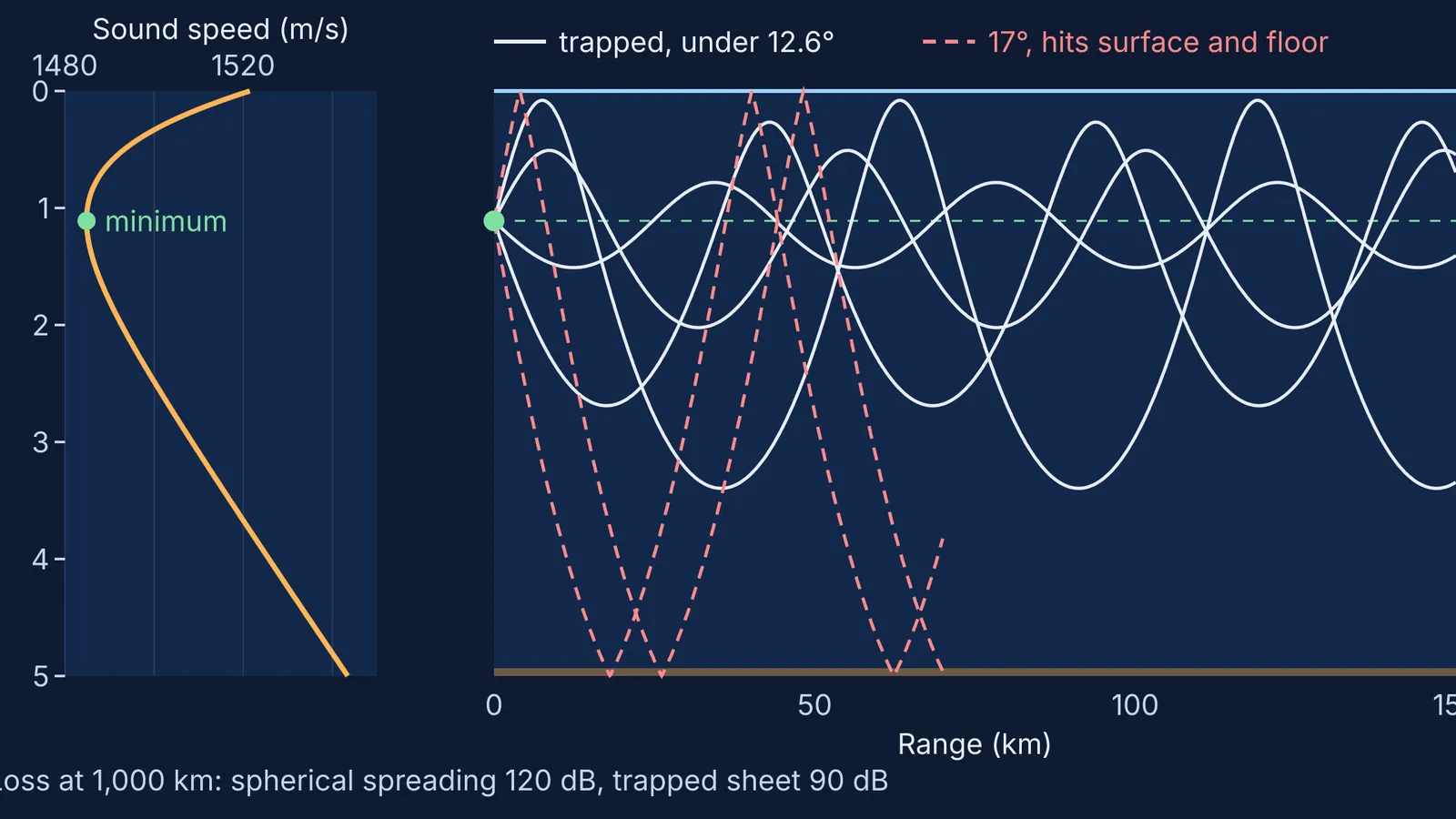
The SOFAR channel is a layer of the ocean where sound travels most slowly. NOAA describes it as a channel that lets low-frequency sound carry hundreds or even thousands of miles, so that hydrophones placed at its axis can record whale calls, earthquakes and ship noise from far away (NOAA Ocean Service). A NOAA PMEL presentation describes it as a low sound velocity zone, typically about 1 km deep, that refracts sound toward the minimum speed and acts as a waveguide (NOAA PMEL ocean acoustics slides).
The depth is not fixed. It depends on the local temperature and salinity. Poleward of about 40° latitude the ocean is cold from top to bottom, and the minimum sits at or near the surface (DOSITS, University of Rhode Island).
Why is sound slowest about 1 km below the surface?
The speed of sound in seawater depends on temperature, pressure and salinity. Two of them pull in opposite directions as you go down.
Temperature. Near 10 °C, each 1 °C of cooling lowers the speed by about 3.6 m/s. In the top kilometre of a warm sea the water cools fast, so the speed drops.
Pressure. Each 100 m of depth raises the speed by about 1.6 m/s. Below about 1 km the water is already near 2–4 °C and barely cools further, so pressure wins and the speed rises again.
The minimum lies where the two effects balance. To get numbers, ocean scientists use fitted formulas such as the nine-term Mackenzie equation (Mackenzie, 1981, J. Acoust. Soc. Am.). With salinity 35 and an illustrative temperature profile of 20 °C at the surface, 4.5 °C at 1,000 m and 2.0 °C at 4,000 m, it gives:
surface: 1,521.5 m/s
1,000 m: 1,485.0 m/s
4,000 m: 1,525.7 m/s
So the speed falls by about 36 m/s in the first kilometre and climbs back above its surface value by 4 km. These depths come from one made-up but typical profile; real profiles vary from place to place. The single 1,500 m/s used in how sonar measures sea depth is fine for an echo time, but it hides this structure.
How does refraction trap sound in the channel?
Refraction follows Snell's law. For sound crossing layers of different speed it reads sin i / c = constant, where i is measured from the vertical. Measuring the angle θ from the horizontal instead, sin i = cos θ, so:
cos θ / c = constant along a ray
As a ray climbs into faster water, c grows, so cos θ must grow too. The ray flattens. When cos θ reaches 1 the ray is horizontal, and then it bends back. Sound bends toward the slower water. That is why it keeps returning to the slowest layer. The same rule explains why distant trains sound clearer at night, where cool air near the ground plays the part of the slow layer.
This is refraction, not reflection. A trapped ray turns smoothly in the water and never touches the surface or the sea floor. Only the steeper rays reach them, and each bounce there loses energy.
Which rays stay trapped, and how far do they go?
Worked example. A source sits on the axis at 1,000 m, where c₀ = 1,485.0 m/s. The surface speed is 1,521.5 m/s and the floor is deep enough that the water there is faster still.
Write the invariant. At the source, cos θ₀ / c₀. At the turning point, θ = 0, so cos 0 / c_turn = 1/c_turn.
Find the turning speed. c_turn = c₀ / cos θ₀.
Condition for trapping. The ray must turn before reaching the surface, so c_turn < 1,521.5 m/s. That gives cos θ₀ > 1,485.0/1,521.5 = 0.9760.
Solve. θ₀ < cos⁻¹(0.9760) = 12.6°. Rays leaving within about 12.6° of horizontal, up or down, stay in the channel.
Check one ray. A ray at 10° turns where c = 1,485.0/cos 10° = 1,507.9 m/s. In the profile in the image above, that is about 190 m below the surface and about 3,000 m deep, so it swings between those two depths.
Now the payoff. Sound from a point spreads over a sphere, so its intensity falls as 1/r², a loss of 20 log₁₀ r decibels (r in metres, measured from 1 m). A trapped sound spreads in a flat sheet once it fills the channel, so beyond that its intensity falls only as 1/r, a loss of 10 log₁₀ r.
Spherical spreading to 1,000 km. 20 log₁₀(10⁶) = 120 dB.
Sheet spreading. Take spherical spreading for the first 1 km (60 dB), then cylindrical: 10 log₁₀(10⁶/10³) = 30 dB. Total 90 dB.
Compare. 120 − 90 = 30 dB, which is a factor of 10³ = 1,000 in intensity.
Travel time. Across 3,000 km at about 1,485 m/s: 3 × 10⁶/1,485 = 2,020 s, about 34 minutes.
These are spreading losses only. Seawater also absorbs sound, much more at high frequency than at low, which is one reason long-range signals and whale calls that carry far are low-pitched. The uses of infrasonic and ultrasonic sound covers the frequency ranges themselves.
What is the SOFAR channel used for?
Listening for whales. Large whales call at low frequencies, and hydrophones at the axis can pick them up from very far away (NOAA, linked above).
Locating events. The original idea, sound fixing and ranging, was to locate a sound source from arrival times at several listening stations, using a known speed.
Monitoring the ocean. Because sound speed depends on temperature, a change in travel time over a long fixed path tells you about the average temperature of the water along it.
To see refraction and wavefronts move rather than read about them, the Simulation Lab has interactive simulations for ideas that are easier to see than read.
Quick checklist
Sound speed in the sea falls with cooling and rises with pressure, so it has a minimum, typically near 1 km in warm and temperate oceans.
Snell's law for sound: cos θ / c = constant, with θ from the horizontal.
Sound bends toward slower water; trapped rays turn by refraction, not reflection.
With 1,485.0 m/s on the axis and 1,521.5 m/s at the surface, rays within 12.6° are trapped.
Sheet spreading instead of sphere saves 30 dB, a factor of 1,000, at 1,000 km.
A pulse needs about 34 minutes to cross 3,000 km.