On this page
Some exit signs glow green or red with no battery, no wiring and no daylight to charge them. They keep glowing for years, and then they carry an expiry date. Inside is a small amount of tritium, the radioactive isotope of hydrogen. Its beta decay powers the light. This makes the sign a neat Class 12 radioactivity problem: from the half-life you can work out the activity, the power and how dim the sign gets over time.
How does a tritium exit sign make light?
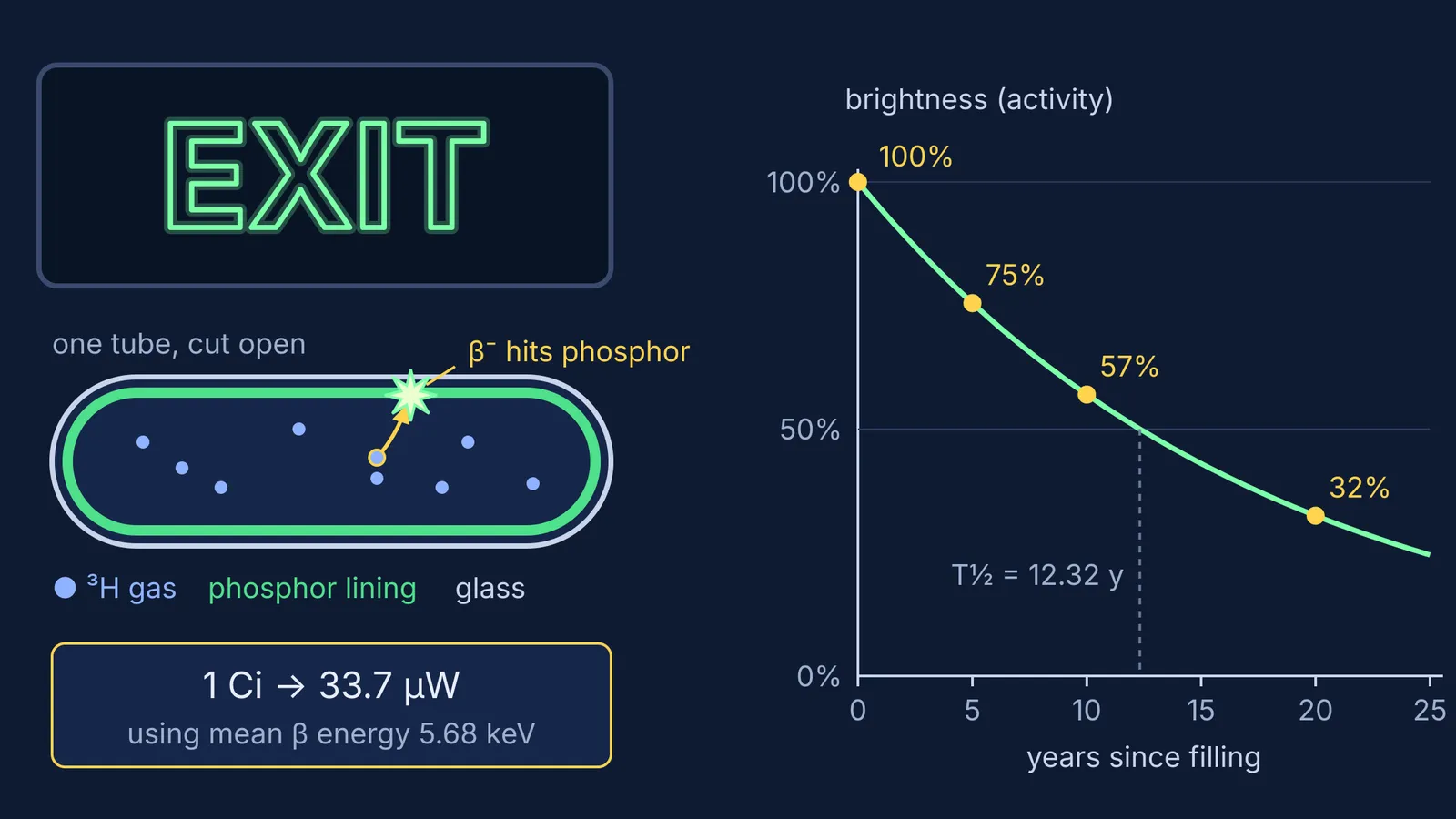
The letters are made of small sealed glass tubes. Each tube is coated inside with a phosphor and filled with tritium gas. When a tritium nucleus decays, it emits a beta particle (an electron). The electron hits the phosphor coating, and the phosphor turns part of the electron's energy into visible light. The colour depends on the phosphor, not on the tritium. A New Jersey environmental protection fact sheet, based on US Nuclear Regulatory Commission guidance, describes exactly this design.
This is different from the glow-in-the-dark stars on a bedroom ceiling. Those phosphors store energy from light and release it slowly, so they fade within hours and need charging again; see why glow-in-the-dark stars keep glowing. A tritium sign is charged continuously by its own radioactivity. It is also different from the old radium paint on watch dials: radium gives off penetrating gamma rays, while tritium gives off only weak betas.
The decay is ³H → ³He + e⁻ + antineutrino. Its Q value is about 18.6 keV, worked out from atomic masses in the Q value of beta decay post.
What are tritium's half-life and beta energy?
The NNDC NuDat decay data for ³H give:
Half-life: 12.32 years.
Maximum (endpoint) beta energy: 18.59 keV.
Mean beta energy: 5.68 keV.
The mean is only about a third of the maximum. In beta decay the energy is shared between the electron and the antineutrino, so most electrons come out with much less than 18.6 keV. The antineutrino escapes through everything and deposits nothing. For the power delivered to the phosphor you must use the mean electron energy, not the maximum.
How much power does a tritium sign get? A worked example
The New Jersey fact sheet says typical signs start with about 25 curies of tritium. Let us find the mass of tritium and the power reaching the phosphor. The chain A = λN is the one used for radium in activity in becquerel and curie.
Decay constant. T½ = 12.32 years = 12.32 × 3.156 × 10⁷ s = 3.888 × 10⁸ s. So λ = 0.693 ÷ (3.888 × 10⁸ s) = 1.78 × 10⁻⁹ s⁻¹.
Atoms in one gram. The molar mass of tritium atoms is about 3.016 g mol⁻¹. N = 6.022 × 10²³ ÷ 3.016 = 2.00 × 10²³ atoms.
Activity of one gram. A = λN = 1.78 × 10⁻⁹ × 2.00 × 10²³ = 3.56 × 10¹⁴ Bq. Since 1 Ci = 3.7 × 10¹⁰ Bq, that is about 9,620 Ci per gram.
Mass in a 25 Ci sign. m = 25 ÷ 9,620 g = 2.6 × 10⁻³ g, about 2.6 mg. The whole sign runs on a few milligrams of gas.
Power per curie. Each decay gives the electron 5.68 keV on average = 5.68 × 10³ × 1.602 × 10⁻¹⁹ J = 9.10 × 10⁻¹⁶ J. Power = 3.7 × 10¹⁰ s⁻¹ × 9.10 × 10⁻¹⁶ J = 3.37 × 10⁻⁵ W, or about 33.7 µW per curie.
Power for the sign. 25 Ci × 33.7 µW = 842 µW, under 1 milliwatt.
Check units: s⁻¹ × J gives J s⁻¹, which is watts. The power is tiny, and only part of it becomes light, which is why these signs look bright only in the dark. If you used the 18.6 keV maximum instead, you would overestimate the power by a factor of about 3.3.
Why do tritium signs have an expiry date?
The brightness follows the activity, and the activity falls as A = A₀ × 2^(−t/T½). With T½ = 12.32 years:
After 5 years: 2^(−5/12.32) = 0.75, so 75% of the first brightness.
After 10 years: 2^(−10/12.32) = 0.57, so 57%.
After 12.32 years: 50%, by definition.
After 20 years: 2^(−20/12.32) = 0.32, so 32%.
A sign must stay bright enough to meet fire codes, so it is rated for a fixed number of years and labelled with an expiry date. The phosphor itself also slowly degrades under constant electron bombardment, so real signs dim a little faster than the activity alone predicts. Treat these percentages as the upper limit set by the physics.
If the exponential decay curve still feels abstract, the Fermi Simulation Lab has interactive simulations for ideas that are easier to see than read.
Is a tritium exit sign dangerous?
A sealed sign gives almost no dose outside it. The betas are so weak that they stop in about 6 mm of air at most, according to the Health Physics Society tritium fact sheet, and they cannot get through the glass tube. The US NRC notes that this radiation cannot penetrate a sheet of paper or clothing (NRC backgrounder on tritium exit signs).
The concern is a broken sign, which could release tritium gas or leave tritium on surfaces. If you ever find a damaged sign, do not open it or move it around; report it to whoever runs the building. Disposal is handled by licensed bodies, not ordinary waste. In India, gaseous tritium light sources are consumer products regulated by the Atomic Energy Regulatory Board (AERB).
Quick checklist
A tritium sign is glass tubes of tritium gas lined with phosphor; each beta makes the phosphor glow.
T½ = 12.32 years, λ = 1.78 × 10⁻⁹ s⁻¹, about 9,620 Ci per gram.
Use the mean beta energy (5.68 keV) for power: about 33.7 µW per curie.
A 25 Ci sign holds about 2.6 mg of tritium and receives about 0.84 mW.
Brightness falls to 75%, 57% and 32% after 5, 10 and 20 years, a little faster in practice.
The betas stop in millimetres of air; a broken sign should be reported, not opened.