

On this page
Mass tables list the masses of neutral atoms, not bare nuclei. That one fact decides whether electron masses vanish from your Q-value formula or leave a two-electron-mass hole in your answer. Below is the bookkeeping for both kinds of beta decay, then two full calculations with real data.
What is the Q value of a beta decay?
The Q value is the energy released in a decay: the mass of everything before minus the mass of everything after, multiplied by c². Our guide on how to calculate the Q value of a nuclear reaction covers the general method.
In beta decay, Q is shared between the emitted electron or positron, the neutrino and the recoiling nucleus, which is why beta particles come out with a range of energies up to a maximum. Our explainer on why beta particles have a continuous energy spectrum shows how that sharing works.
Two conversion numbers do all the work here. One atomic mass unit is equivalent to 931.494 MeV (NIST CODATA). The electron mass is 0.000548580 u, or 0.510999 MeV/c² (NIST, in u; NIST, in MeV).
Why do electron masses cancel in β⁻ decay?
Write the decay for nuclei: a parent nucleus with atomic number Z becomes a daughter with Z + 1, plus an electron and an antineutrino. With nuclear masses, Q = [m(parent nucleus) − m(daughter nucleus) − mₑ]c².
Now switch to atomic masses M. A neutral atom is its nucleus plus Z electrons, so m(parent nucleus) = M(parent) − Zmₑ and m(daughter nucleus) = M(daughter) − (Z + 1)mₑ. Substitute and count the electrons: −Zmₑ + (Z + 1)mₑ − mₑ = 0.
So for β⁻ decay, Q = [M(parent) − M(daughter)]c². The daughter atom's extra orbital electron already accounts for the emitted electron. LibreTexts' modern physics text derives the same result. Like most textbook treatments, this bookkeeping ignores the neutrino's tiny mass and the small differences in electron binding energy.
Why does 2mₑ stay in β⁺ decay?
In β⁺ decay the daughter has Z − 1 protons, and a positron (mass mₑ) leaves. With nuclear masses, Q = [m(parent nucleus) − m(daughter nucleus) − mₑ]c² again.
Substitute atomic masses: m(daughter nucleus) = M(daughter) − (Z − 1)mₑ. The electron terms now add up to −Zmₑ + (Z − 1)mₑ − mₑ = −2mₑ.
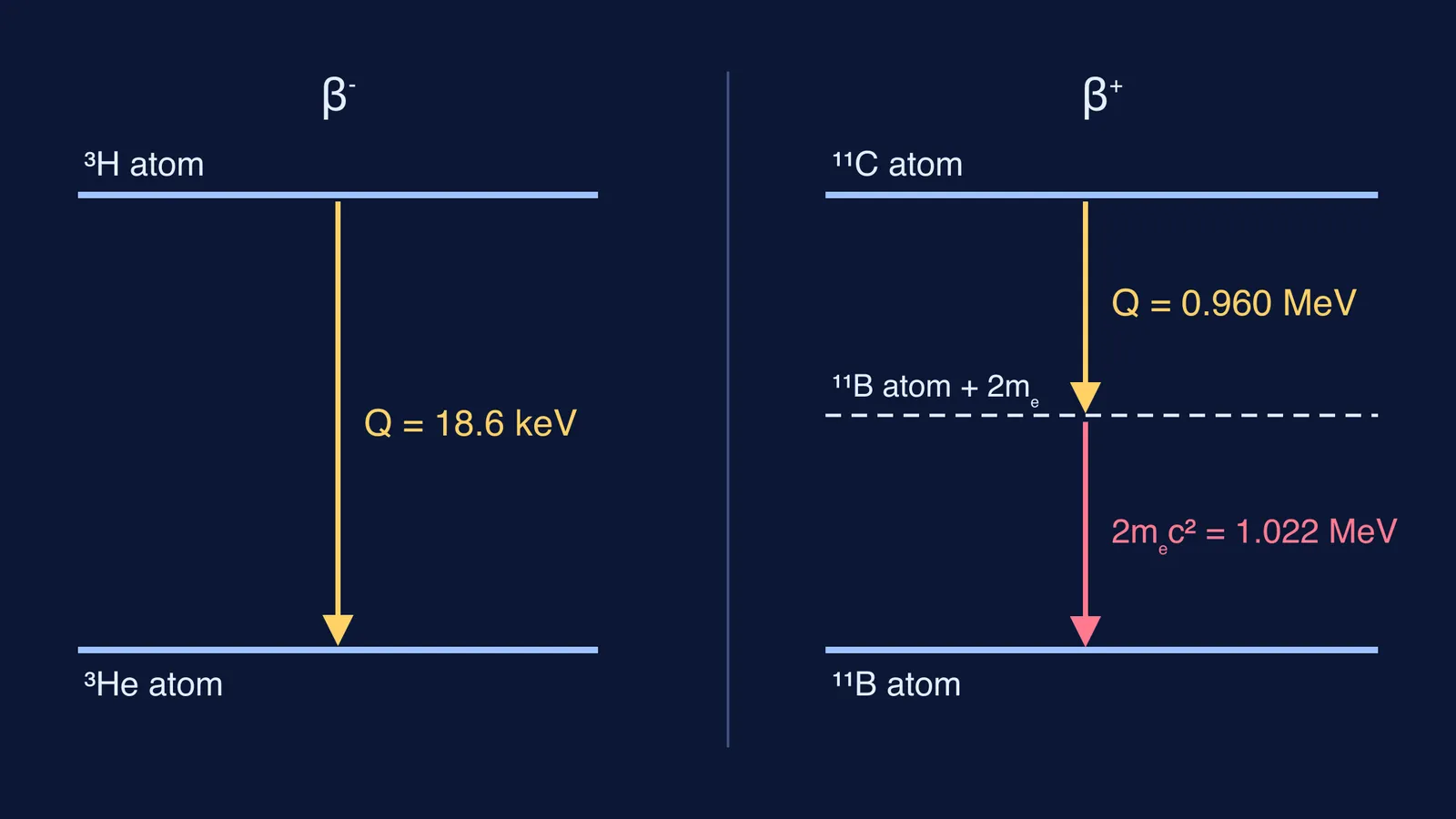
So for β⁺ decay, Q = [M(parent) − M(daughter) − 2mₑ]c², as the same LibreTexts section gives. One mₑ is the positron itself; the other is the orbital electron the parent atom has but the daughter atom does not. With the electron's rest energy of 0.510999 MeV (NIST CODATA), 2mₑc² is about 1.022 MeV.
That last point is why some proton-rich nuclei decay only by electron capture, which needs no positron. Our post on positron emission and electron capture compares the two.
Worked example 1: tritium (β⁻)
Tritium (³H) decays to helium-3. NIST lists the atomic mass of ³H as 3.0160492779 u (NIST hydrogen isotopes) and ³He as 3.0160293201 u (NIST helium isotopes).
Mass difference: 3.0160492779 − 3.0160293201 = 0.0000199578 u.
Electron masses: they cancel, so nothing to add or subtract.
Convert with 1 u = 931.494 MeV: 0.0000199578 × 931.494 MeV = 0.01859 MeV.
Answer: Q ≈ 18.6 keV.
Notice how small this is. If you had wrongly subtracted one electron mass (0.511 MeV), you would get a negative Q and conclude that tritium is stable, which it is not.
Worked example 2: carbon-11 (β⁺)
Carbon-11 decays to boron-11. NIST gives 11.0114336 u for ¹¹C (NIST carbon isotopes) and 11.00930536 u for ¹¹B (NIST boron isotopes).
Mass difference: 11.0114336 − 11.00930536 = 0.00212824 u, which is 1.9824 MeV.
Subtract 2mₑc²: 2 × 0.510999 = 1.0220 MeV.
Answer: Q = 1.9824 − 1.0220 ≈ 0.960 MeV.
That matches measurement. A 2016 review in EJNMMI Physics by Conti and Eriksson reports that carbon-11 decays 99.8% by β⁺ with a maximum positron energy of 0.960 MeV. Forget the 2mₑ and you would claim 1.98 MeV, more than double the true value.
How do you avoid the electron-mass trap in exams?
Run this check before you touch a calculator:
Ask what the table gives. Atomic masses (the usual case in textbook and exam data) or nuclear masses?
Write the decay and the change in Z. Z goes up for β⁻ and down for β⁺.
Count electrons on each side, including the emitted particle, rather than recalling a formula.
Sanity-check the sign. A negative Q means the decay cannot happen as written.
If you want more practice, the Fermi Problem Library has worked problems with a step-by-step solver that explains the reasoning rather than printing an answer, so you can see exactly where the electron count goes. If the idea of atomic versus nuclear mass is still shaky, start with the lesson in the Fermi Concept Library.
Next time you see a β⁺ question, write −2mₑ before anything else.


