

On this page
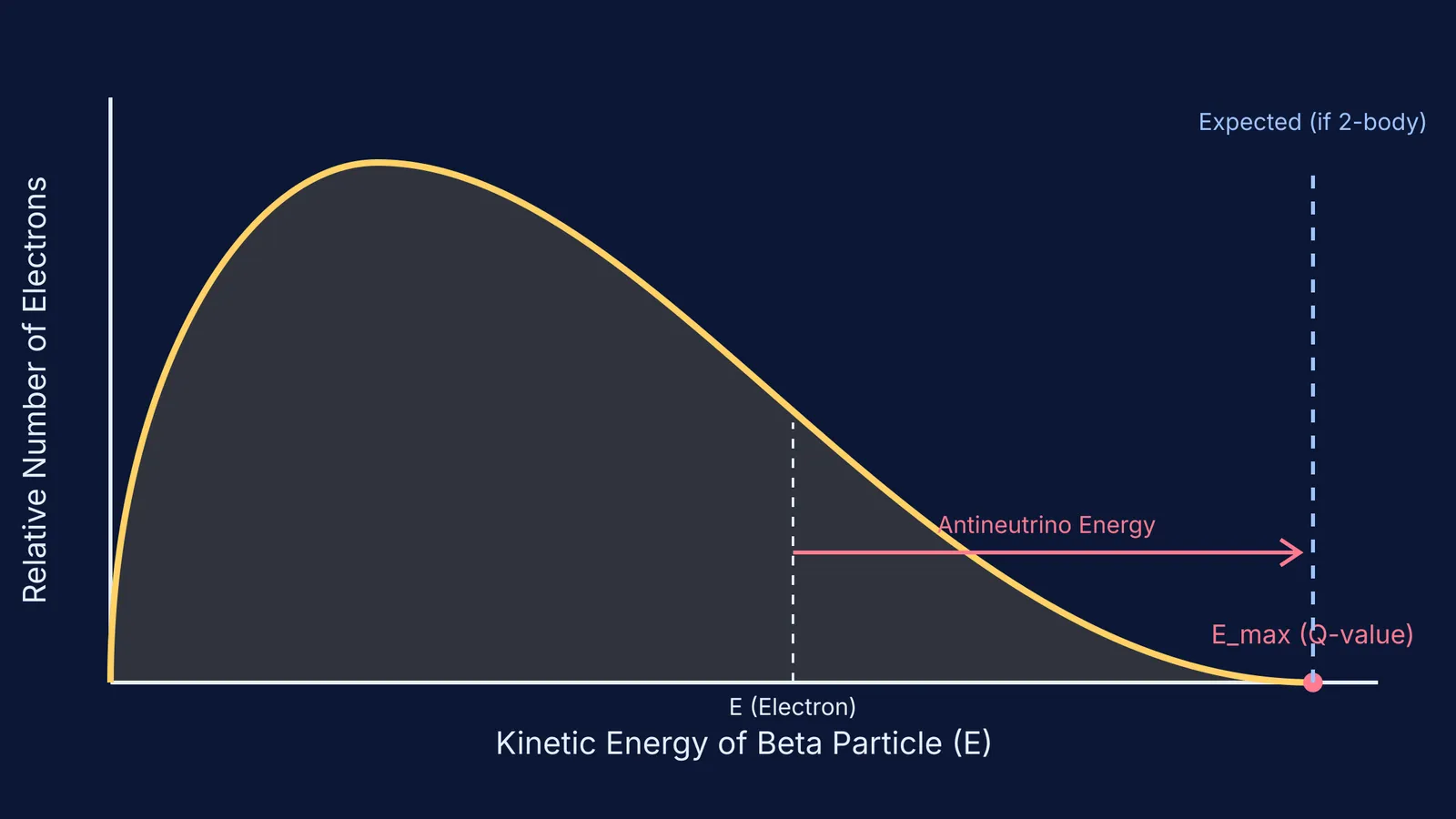
When physicists first began studying radioactivity, they found something deeply troubling. In alpha decay, particles flew out of the nucleus with a single, sharp energy. You can see this predictable behaviour when calculating the recoil of the daughter nucleus in alpha decay exactly between two bodies. But in beta decay, the electrons emerged with a continuous range of energies—from near zero up to a maximum limit.
This observation, confirmed by James Chadwick in 1914, sparked a crisis in physics. If the parent nucleus always started with the same mass and the daughter nucleus always ended with the same mass, where was the rest of the energy going? Some scientists even considered that the fundamental law of conservation of energy might be wrong.
What is the difference between a continuous and discrete spectrum?
To understand the problem, we have to look at how energy is released. The total energy released in a decay event is called the Q-value.
Two-body decay is discrete: In alpha decay, the parent nucleus splits into exactly two pieces: a daughter nucleus and an alpha particle. To conserve both momentum and energy, the alpha particle must take a fixed, specific share of the Q-value. This creates a discrete energy spectrum.
The beta decay problem: If beta decay were just a neutron turning into a proton and emitting an electron, the electron should always shoot out with the exact same maximum energy.
Why did the continuous spectrum cause a crisis in physics?
The continuous spectrum showed that electrons were missing varying amounts of energy. For instance, when carbon-14 decays to nitrogen-14, the Q-value is 156.475 keV. Yet, the emitted beta particles almost never carry all of that energy.
If the energy was not going to the electron or the recoiling nucleus, it seemed to violate the First Law of Thermodynamics.
How did the neutrino hypothesis solve the problem?
In December 1930, physicist Wolfgang Pauli proposed a radical "desperate remedy" to save the conservation laws. He suggested that beta decay was not a two-body process, but a three-body process.
Pauli hypothesized that a third, previously undetected particle was emitted alongside the electron. This particle had to be electrically neutral and extremely light so that it could escape without leaving a trace in the detectors of the era.
In 1934, Enrico Fermi incorporated this particle into a formal mathematical theory of beta decay and named it the neutrino (specifically, an electron antineutrino). The introduction of this third particle perfectly explained the continuous energy spectrum and saved the laws of conservation of energy, linear momentum, and angular momentum. If you are learning the rules of particle physics, the Fermi Concept Library gives each concept its own lesson and its place in the map, so you can trace how conservation laws apply across all nuclear reactions.
How is energy shared in a three-body decay?
Because three particles (the daughter nucleus, the electron, and the antineutrino) are involved, the available kinetic energy can be divided among them in infinitely many ways.
If the antineutrino carries away almost all the energy, the electron emerges with very little.
If the antineutrino takes almost no energy, the electron shoots out with the maximum possible energy.
Most of the time, they share the energy somewhere in the middle, creating the characteristic bell-like curve of the continuous beta spectrum. For the ideas that are easier to see than to read, the Fermi Simulation Lab offers interactive simulations, letting you watch how a three-body system distributes energy differently than a two-body one.
A checklist for predicting decay energy
When you encounter a new decay process—whether looking at a single event or counting alpha and beta decays in a radioactive decay series—use this mental model to predict the energy spectrum:
Count the products: Does the parent decay into two particles or more?
Two-body means discrete: A two-body final state always results in discrete energy peaks because momentum and energy conservation lock the velocities into a single mathematical solution.
Three-body means continuous: Three or more particles in the final state mean the energy is shared, creating a continuous spectrum.
By tracing the energy and counting the particles, just as Harriet Brooks did when investigating the recoil of radioactive atoms, you can reconstruct the missing pieces of any reaction.


