On this page
Most nuclear decay questions come down to one bookkeeping skill: tracking Z (protons) and A (protons plus neutrons) on both sides of an arrow. Positron emission and electron capture can feel confusing at first, because a proton disappears and nothing obvious seems to leave. Here is what happens, how to balance each equation, and why the two routes are not always interchangeable.
What happens in positron emission (β+ decay)?
In positron emission, a proton inside the nucleus turns into a neutron, and the nucleus emits a positron and an electron neutrino (Wikipedia: Positron emission). At the level of a single nucleon you can write it as p → n + e⁺ + νₑ.
A positron is identical to an electron except that its charge is positive, not negative (LibreTexts, ChemPRIME 19.7/19%3A_Nuclear_Chemistry/19.07%3A_Further_Modes_of_Decay_-_Positron_Emission_and_Electron_Capture)). The same source gives carbon-11 as an example: ¹¹₆C → ¹¹₅B + ⁰₊₁e. Carbon-11 and fluorine-18 are among the short-lived positron emitters used in PET scans (Wikipedia: Positron emission).
Note what changed. Z fell from 6 to 5, so the element changed from carbon to boron. A stayed at 11, because a proton was swapped for a neutron and the total number of nucleons did not move.
What is electron capture?
In electron capture, the nucleus absorbs one of the atom's own inner electrons, usually from the K or L shell, and that electron combines with a proton to make a neutron and a neutrino: p + e⁻ → n + νₑ (Wikipedia: Electron capture). When the electron comes from the K shell, the process is called K-capture.
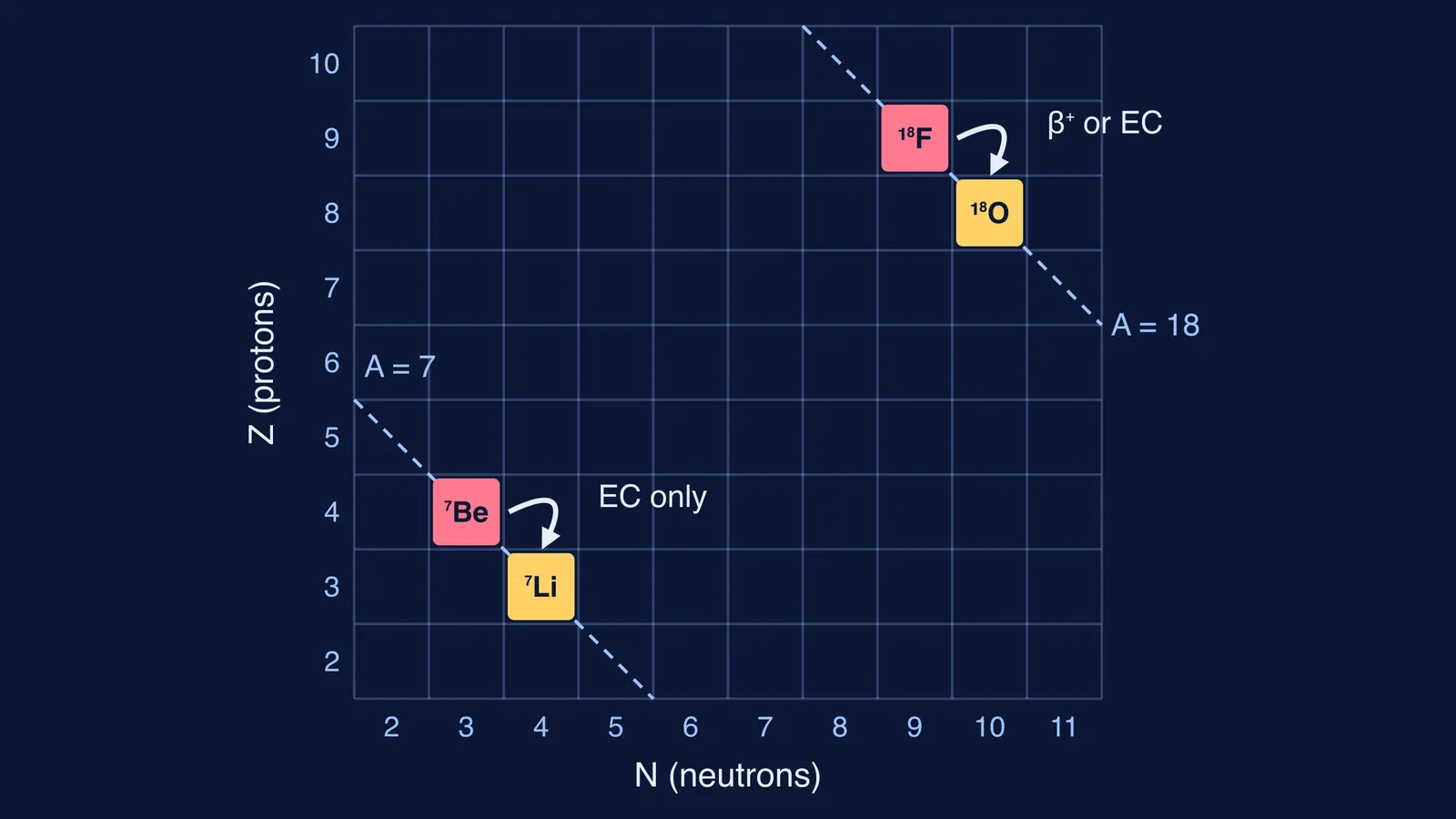
The LibreTexts example is beryllium-7: ⁷₄Be + ⁰₋₁e → ⁷₃Li (LibreTexts, ChemPRIME 19.7/19%3A_Nuclear_Chemistry/19.07%3A_Further_Modes_of_Decay_-_Positron_Emission_and_Electron_Capture)). Z drops from 4 to 3 and A stays at 7: the same change as positron emission. After the capture, an outer electron falls into the empty inner slot and the atom gives off characteristic X-rays (Wikipedia: Electron capture).
How do you balance a β+ or electron capture equation?
Use this four-step check. Here it is on fluorine-18, which decays to oxygen-18 (LNHB nuclide table, F-18).
Write each particle with its mass number on top and its charge (or Z) below: positron ⁰₊₁e, electron ⁰₋₁e, neutrino with 0 and 0.
Make the top numbers add up on both sides. For β+: 18 = 18 + 0.
Make the bottom numbers add up. For β+: 9 = Z + 1, so Z = 8, which is oxygen. For capture, the electron goes on the left: 9 + (−1) = 8, the same answer.
Name the daughter from Z, not from A. Z = 8 is oxygen whatever the mass number.
That gives two balanced equations for the same nucleus:
β+: ¹⁸₉F → ¹⁸₈O + ⁰₊₁e + νₑ
Electron capture: ¹⁸₉F + ⁰₋₁e → ¹⁸₈O + νₑ
Fluorine-18 does both. The LNHB/CEA table of radionuclides lists 96.86% of decays as β+ and 3.14% as electron capture, with a half-life of 1.83 hours (LNHB nuclide table, F-18).
Why can beryllium-7 decay only by electron capture?
Positron emission needs the parent atom to outweigh the daughter atom by at least two electron masses, which is 1.022 MeV of energy (Wikipedia: Positron emission). One electron mass is equivalent to 0.511 MeV (NIST CODATA). If the energy difference is smaller than 1.022 MeV, positron emission is forbidden and electron capture is the only way the decay can go (Wikipedia: Electron capture).
Now check the numbers yourself:
Fluorine-18 has a decay energy of 1655.9 keV, and its positrons come out with at most 633.9 keV (LNHB, F-18). The gap, 1655.9 − 633.9 = 1022.0 keV, is two electron masses. That is the energy the β+ route spends before the positron gets any kinetic energy.
Beryllium-7 has a decay energy of only 861.8 keV and a half-life of 53.22 days (LNHB nuclide table, Be-7). That is below 1022 keV, so β+ is closed, and the table lists electron capture as its only mode.
What mistakes should you avoid in decay equations?
Writing the positron as ⁰₋₁e. The positron carries +1; the electron carries −1.
Putting the captured electron on the product side. In capture, it goes in with the parent.
Changing A. Neither decay changes the mass number.
Leaving out the neutrino. It carries no charge or mass number, but a complete equation includes it.
If the bookkeeping feels shaky, the Fermi Concept Library has a lesson for every concept in physics and chemistry, each with its place in the map, so you can go back to nuclear notation before tackling decay. When you are ready to practise, the Fermi Problem Library has worked problems with a step-by-step solver that explains the reasoning rather than printing an answer.
Try it now: write both decay routes for sodium-22 (Z = 11) and check that each one lands on neon-22.