On this page
A single-layer Blu-ray disc holds 25 GB. A single-layer DVD of exactly the same size holds 4.7 GB. The discs are both 12 cm across and both read by a laser, so where does a factor of about five come from? Mostly from one formula you already know from the resolving power chapter. A lens cannot focus light to a point, and the smallest spot it can make shrinks with the wavelength and grows as the lens's numerical aperture falls. Blu-ray cut the wavelength and raised the numerical aperture, and the spot area fell by a factor of about five.
Why can't a laser be focused to a point?
Light passing through a circular lens diffracts. Instead of a point, the focus is an Airy pattern: a bright central disc surrounded by faint rings. The diameter of the central disc, measured to the first dark ring, is:
d = 1.22 λ / NA
Here λ is the wavelength and NA is the numerical aperture of the objective lens. NA = n sin θ, where θ is the half-angle of the cone of light converging on the spot and n is the refractive index of the medium the cone is in. In air n = 1, so NA can never exceed 1. A larger NA means a wider, more steeply converging cone and a smaller spot.
This is the same diffraction limit that sets the resolving power of a microscope objective, explained in resolving power of microscope and telescope. In a microscope it decides the smallest detail you can see. In a disc drive it decides the smallest mark you can read.
Be clear about which definition you use. The 1.22 λ/NA figure is the diameter to the first dark ring. The full width at half maximum of the bright disc is smaller, about 0.51 λ/NA. Ratios between formats come out the same either way, but the absolute sizes do not.
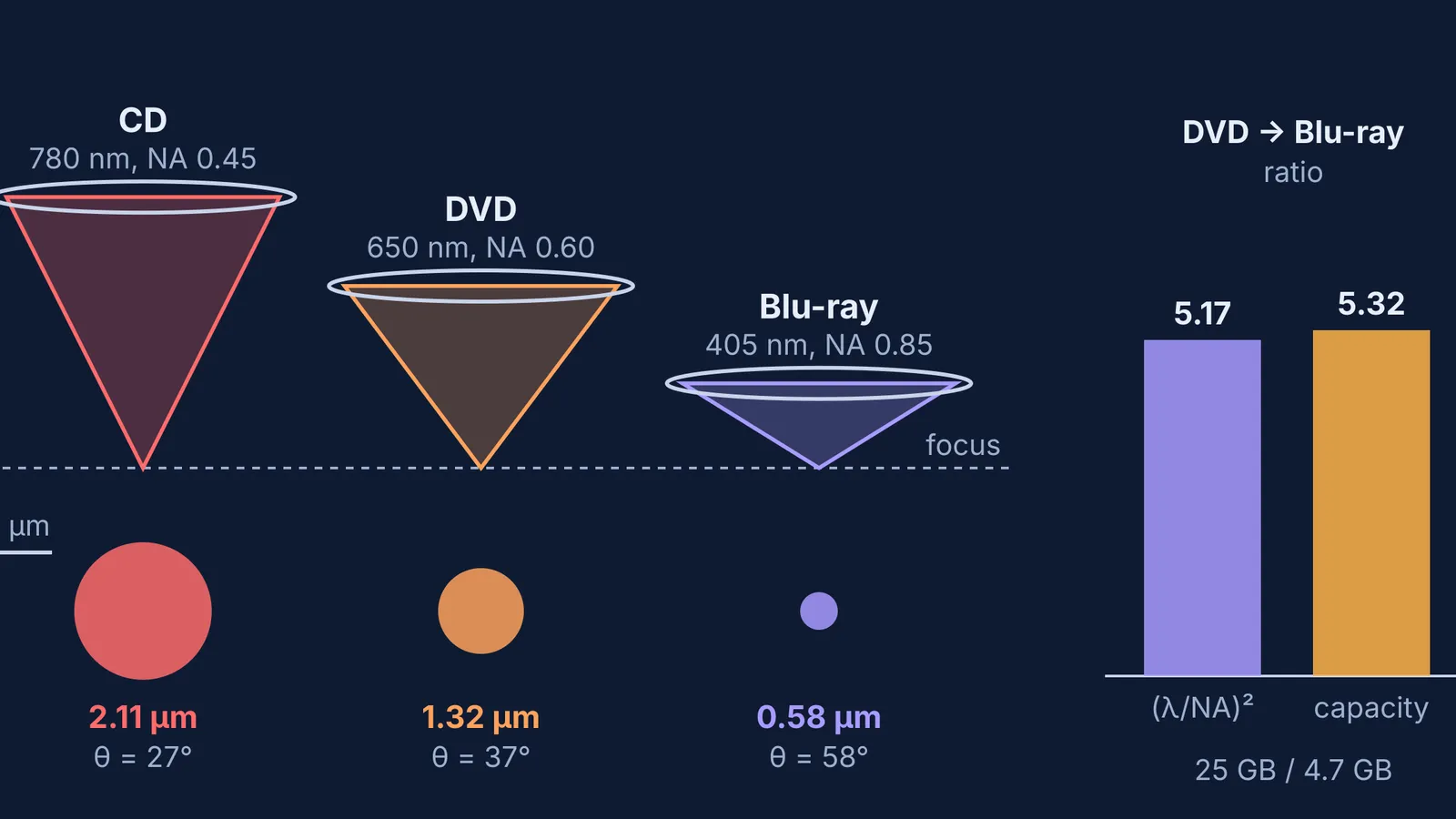
What are the wavelength and NA for CD, DVD and Blu-ray?
The values come from the format standards:
CD: λ = 780 nm, NA = 0.45, from the ECMA-130 CD-ROM standard.
DVD: λ = 650 nm, NA = 0.60, from the ECMA-267 DVD-ROM standard, which also gives 4.7 GB for a single-sided, single-layer disc.
Blu-ray: λ = 405 nm, NA = 0.85, with a 0.1 mm cover layer and 25 GB per layer, from the Blu-ray Disc Association's format white paper.
The NA values correspond to cone half-angles of about 27°, 37° and 58° in air.
How much smaller is the Blu-ray laser spot?
Work it through with d = 1.22 λ/NA.
CD. d = 1.22 × 780 nm / 0.45 = 2,115 nm ≈ 2.11 µm.
DVD. d = 1.22 × 650 nm / 0.60 = 1,322 nm ≈ 1.32 µm.
Blu-ray. d = 1.22 × 405 nm / 0.85 = 581 nm ≈ 0.58 µm.
Area ratio, DVD to Blu-ray. Data density goes roughly as 1/(spot area), and spot area goes as d², so as (λ/NA)². The ratio is (650/0.60)² / (405/0.85)² = 1,083² / 476.5² = 5.17.
Capacity ratio. 25 GB / 4.7 GB = 5.32.
Compare. The optics predicts 5.17 and the real capacity ratio is 5.32, within 3%.
Split the gain. The shorter wavelength alone gives (650/405)² = 2.58. The higher NA alone gives (0.85/0.60)² = 2.01. Multiply them: 2.58 × 2.01 = 5.17.
The Blu-ray Disc Association's white paper makes the same point in words: the beam-spot area for NA 0.6 is almost double that for NA 0.85.
Does the formula explain CD to DVD as well?
Only partly. The optics ratio from CD to DVD is (780/0.45)² / (650/0.60)² = 2.56. But a CD holds only about 0.65 to 0.8 GB, depending on how you count (the Blu-ray white paper quotes about 800 MB for 74 minutes of CD audio), so the capacity ratio is between 4.7/0.8 = 5.9 and 4.7/0.65 = 7.2. The rest came from engineering, not optics. DVD also changed its modulation code, its error correction and its formatting overhead, so it packed more user data into each square micrometre of marks. Optics sets the scale of the marks; coding sets how efficiently they are used. That is why the λ/NA rule matches DVD to Blu-ray closely but not CD to DVD.
The track pitch also shrank, from 1.6 µm on a CD to 0.74 µm on a DVD (both from the ECMA standards) and 0.32 µm on a Blu-ray (from the white paper). Those regular tracks act as a diffraction grating, which is why a disc shows rainbow colours. That separate effect is worked out in why a CD shows rainbow colours.
Why did Blu-ray need a violet laser and a thin cover layer?
The laser. A 405 nm photon carries E = hc/λ = (6.626 × 10⁻³⁴ × 2.998 × 10⁸) / (405 × 10⁻⁹) J = 4.91 × 10⁻¹⁹ J = 3.06 eV. A DVD's 650 nm photon carries 1.91 eV. A semiconductor laser emits photons with energy close to its band gap, so the violet laser needed a wide-gap material. That came from gallium nitride, the same work behind the blue LED of Akasaki, Amano and Nakamura.
The cover layer. The laser focuses through a layer of clear plastic before it reaches the data. If the disc tilts slightly, that plastic adds an aberration (coma) that blurs the spot. As a rule of thumb, this blur grows roughly as t × NA³/λ, where t is the layer thickness. The Blu-ray white paper confirms the NA³ and 1/λ dependence.
Compare Blu-ray with DVD at the same thickness. NA³ rises by (0.85/0.60)³ = 2.84, and 1/λ rises by 650/405 = 1.60. Together the blur would be 2.84 × 1.60 = 4.56 times worse. To keep the same tilt tolerance as DVD's 0.6 mm layer, t must shrink to about 0.6/4.56 = 0.13 mm. Blu-ray chose 0.1 mm. The white paper reports a tilt margin of ±0.75° for 25 GB, nearly equal to DVD's.
A steep cone of light is the right picture to have in your head here. The Fermi Simulation Lab has interactive simulations of diffraction and lenses you can adjust and watch.
Quick checklist
Smallest spot diameter, to the first dark ring: d = 1.22 λ/NA, with NA = n sin θ ≤ 1 in air.
CD 2.11 µm, DVD 1.32 µm, Blu-ray 0.58 µm.
Capacity scales as (NA/λ)²: DVD to Blu-ray gives 5.17, close to the real 5.32.
CD to DVD gives only 2.56 from optics; the rest came from better coding.
405 nm photons carry 3.06 eV, which needed gallium nitride lasers.
Tilt blur grows as roughly t × NA³/λ, so high NA forced Blu-ray's 0.1 mm cover layer.