On this page
No material can touch a gas at 150 million °C. Yet the ITER tokamak being built in France is designed to hold deuterium and tritium plasma at that temperature inside a steel vessel. The walls are protected by a magnetic field of 5.3 T. The reason it works is a formula from your magnetism chapter, r = mv/qB. Put in fusion numbers and you find that each deuteron circles in a loop about 4 mm across, so the plasma stays in a thin magnetic cage far from the wall. This post works those numbers and checks the field against the plasma's pressure.
Why can't a fusion plasma touch a wall?
You need very high temperatures for nuclei to get close enough to fuse; why is covered in why fusion needs very high temperatures. The problem here is the opposite one: keeping that heat in. If hot plasma reached the wall, two things would happen. The plasma would cool at once, and the eroded wall would put heavy atoms into the plasma that radiate energy away.
Without a field, a deuteron at these temperatures moves at about 1.1 × 10⁶ m/s, so it would cross the 2 m from the centre to the wall in under 2 µs. A gas container is useless. A magnetic one is not.
How does a magnetic field confine charged particles?
The magnetic force F = qv × B is always perpendicular to the velocity. It cannot speed a particle up or slow it down; it only bends its path. For the part of the velocity perpendicular to B, the force supplies the centripetal force:
qv⊥B = mv⊥²/r, so r = mv⊥/(qB)
The velocity along B is unaffected, so every charged particle follows a helix wound around a field line. The general helix, with its pitch and radius, is worked in charged particles in a magnetic field. What matters for fusion is the size of r. If it is tiny compared with the vessel, particles cannot move sideways across the field to the wall.
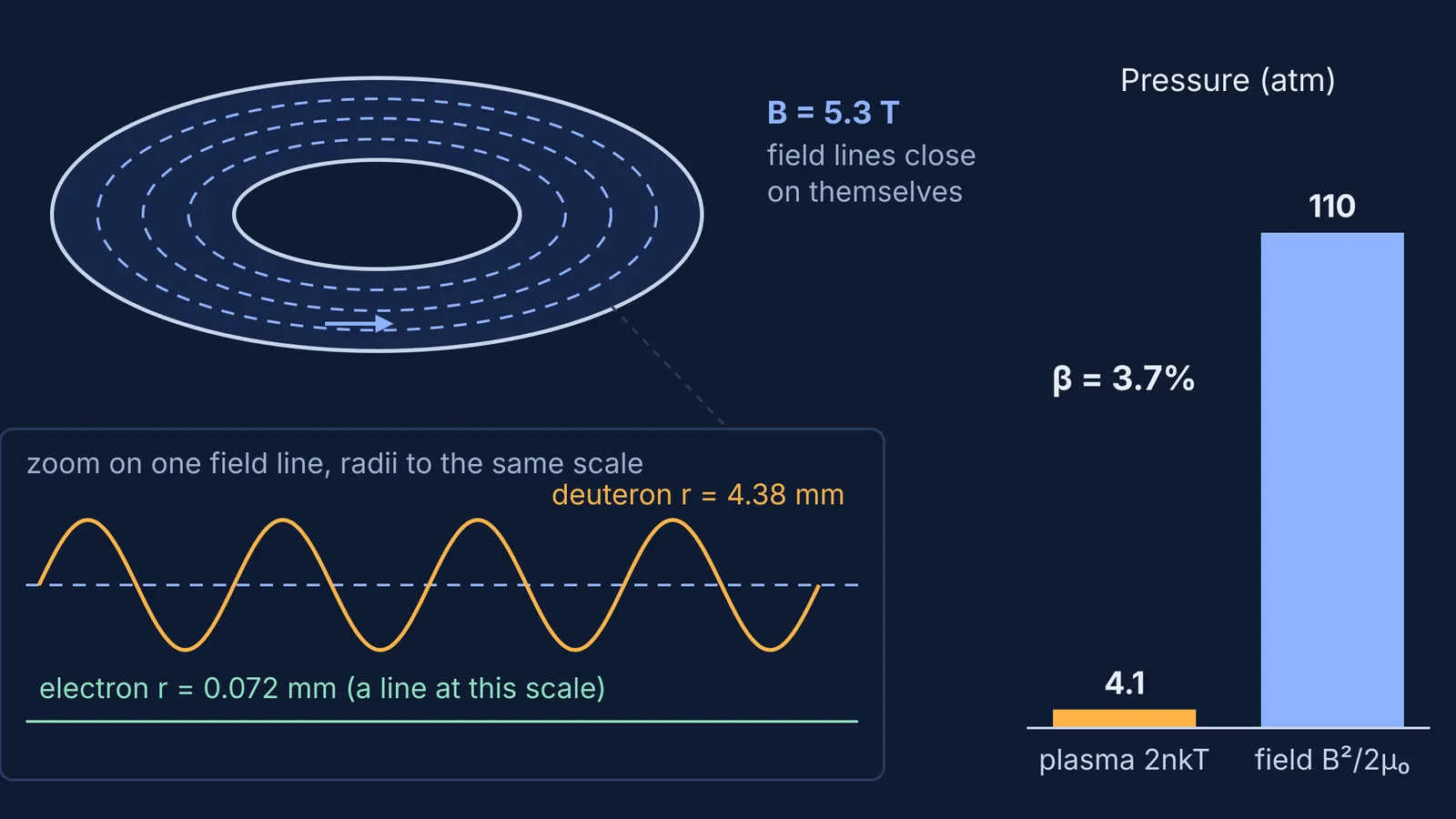
That leaves the motion along the field lines. A straight tube of field would just leak plasma out of both ends. So a tokamak bends the field into a closed ring, a torus, where the field lines go round and round and never end. Particles can run along them forever without hitting anything.
Worked example: how big are the circles in ITER?
Data, from ITER's design figures: toroidal field B = 5.3 T at the plasma centre, minor radius (centre of the plasma to its edge) a = 2.0 m, and density about 10²⁰ particles per m³ (ITER design parameters, F. Wagner, ITER summer school). Temperature T = 150 million °C, which is 1.5 × 10⁸ K to the accuracy we need (ITER facts and figures).
Constants: k = 1.381 × 10⁻²³ J/K, e = 1.602 × 10⁻¹⁹ C, deuteron mass m_d = 3.344 × 10⁻²⁷ kg, electron mass m_e = 9.109 × 10⁻³¹ kg.
Thermal energy. kT = 1.381 × 10⁻²³ × 1.5 × 10⁸ = 2.07 × 10⁻¹⁵ J, or 12.9 keV.
Deuteron speed across the field. For motion in the two directions perpendicular to B, the average kinetic energy is kT, so ½m v⊥² = kT and v⊥ = √(2kT/m) = √(2 × 2.07 × 10⁻¹⁵ / 3.344 × 10⁻²⁷) = 1.11 × 10⁶ m/s.
Deuteron radius. r = m v⊥/(eB) = 3.344 × 10⁻²⁷ × 1.11 × 10⁶ / (1.602 × 10⁻¹⁹ × 5.3) = 4.38 × 10⁻³ m, or 4.38 mm.
Compare with the plasma. a/r = 2.0 / 0.00438 = 456. The plasma's minor radius is about 456 deuteron orbits.
Deuteron frequency. f = eB/(2πm) = 40.4 MHz, independent of speed.
Electron. v⊥ = √(2kT/m_e) = 6.74 × 10⁷ m/s, which is 0.22c. Its radius is m_e v⊥/(eB) = 7.2 × 10⁻⁵ m, or 0.072 mm, and its frequency is 148 GHz.
The electron moves 60 times faster than the deuteron but circles in a loop 60 times smaller, because it is 3,670 times lighter. Check: r ∝ m v ∝ √(mkT), so the ratio of radii is √(3,670) ≈ 61.
At 0.22c the electron needs a small relativistic correction: γ ≈ 1.03, which makes its true radius and frequency about 3% different. Treat the electron figures as approximate.
Do these frequencies show up in a real machine?
Yes. ITER heats the plasma with radio waves at 40–55 MHz and microwaves at 170 GHz (ITER external heating systems). These sit in the same range as the ion and electron gyration frequencies, because waves near these frequencies are absorbed by the circling particles. The field in a tokamak is stronger on the inner side of the ring, so 170 GHz matches electrons a little inside the centre.
Is 5.3 T strong enough to hold the plasma?
Hot plasma pushes outwards with pressure. With electrons and ions both at density n and temperature T, the pressure is p = 2nkT. The field can hold back a pressure up to about its magnetic pressure, B²/2μ₀. That quantity is also the energy stored per cubic metre of field; both readings are correct.
Plasma pressure. p = 2 × 10²⁰ × 2.07 × 10⁻¹⁵ = 4.14 × 10⁵ Pa, about 4.1 atm.
Magnetic pressure. B²/2μ₀ = 5.3² / (2 × 4π × 10⁻⁷) = 1.12 × 10⁷ Pa, about 110 atm.
Ratio, called beta. β = 4.14 × 10⁵ / 1.12 × 10⁷ = 0.037, or 3.7%.
The plasma pushes with only a few per cent of what the field can resist. These figures use the central temperature everywhere, so the real average beta is lower, but the field is comfortably strong enough.
A gas at 150 million °C exerts only about 4 atm because it is thin: about 250,000 times less dense than air.
Why is confinement still not perfect?
Gyration stops particles from moving straight across the field, but three effects let them leak out slowly.
Collisions. Each collision shifts a particle onto a neighbouring field line, by about one gyroradius. Many collisions make a slow random walk outwards.
Drifts. In a curved field that is stronger on the inside, particles drift up or down. Tokamaks drive a large current in the plasma to twist the field lines into a helix, which cancels this drift on average.
Turbulence. Small swirls in the plasma carry heat out faster than collisions alone, which is one reason fusion machines have to be large.
The field does not seal the plasma perfectly; it slows the escape enough for heating to keep up. Who works on these problems is covered in a career in plasma physics and fusion.
If you want to see how the radius changes as you vary B, v and the mass, try the Simulation Lab, which has interactive simulations for ideas that are easier to see than read.
Quick checklist
r = mv⊥/(qB): a strong field keeps orbits tiny.
At 150 million °C, kT = 12.9 keV.
In 5.3 T, a deuteron circles in 4.38 mm at 40.4 MHz; an electron in about 0.072 mm at about 148 GHz.
Field lines close on themselves in a torus, so motion along B never reaches a wall.
Plasma pressure 2nkT ≈ 4.1 atm against magnetic pressure B²/2μ₀ ≈ 110 atm: β ≈ 3.7%.
Collisions, drifts and turbulence still let heat leak out slowly.