On this page
In 1836 James Marsh, a chemist at the Royal Arsenal in Woolwich, published a test that could find a trace of arsenic in a stomach or a cup of coffee and leave a visible, lasting proof: a black, shiny film of arsenic metal. The test works because of a trend you learn in Group 15. The hydrides get less thermally stable from NH₃ to BiH₃, and arsine, AsH₃, falls apart easily on hot glass.
Arsine is a highly toxic gas. The Marsh test is history and chemistry for you to understand, not something to try. Arsine is handled only in specialised laboratories with proper gas containment.
Why did courts need a better arsenic test?
Before Marsh, the standard test precipitated arsenic as yellow As₂S₃. In 1832 Marsh gave evidence at the trial of John Bodle, accused of putting arsenic in his grandfather's coffee. Marsh found arsenic, but his precipitate deteriorated by the time of the trial, the jury was not convinced and Bodle was acquitted. He later confessed. So says William B. Jensen's note on the Marsh test from the Oesper Collections, University of Cincinnati.
Marsh's answer was to pull the arsenic out of the sample as a gas, so nothing else could mask it. He published the method in 1836 in the Edinburgh New Philosophical Journal.
What is the chemistry of the Marsh test?
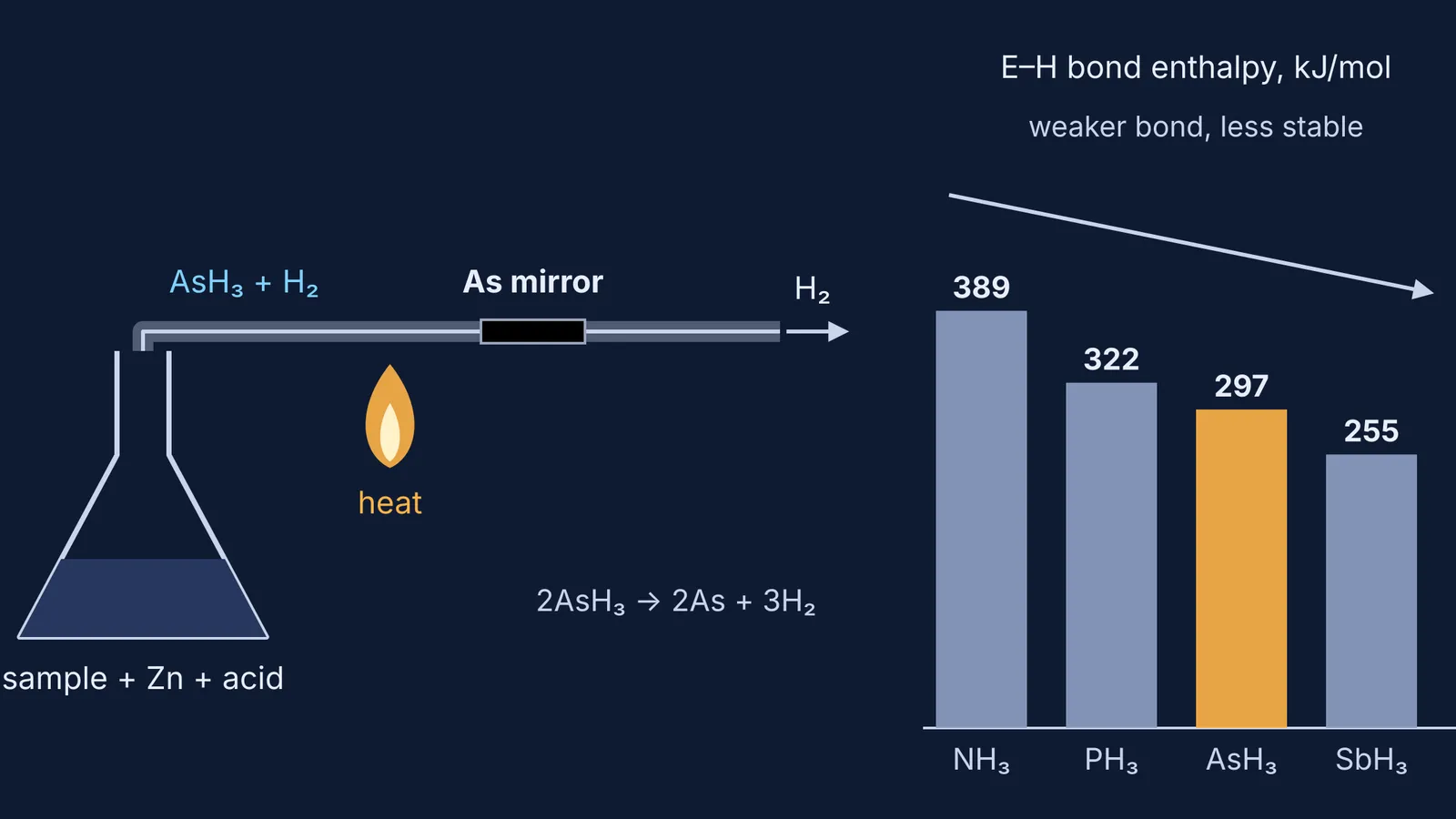
The sample is added to zinc and dilute acid. Any arsenic compound present is reduced to arsine:
As₂O₃ + 6Zn + 12H⁺ → 2AsH₃ + 6Zn²⁺ + 3H₂O
It balances: 2 As, 6 Zn, 3 O and 12 H on each side, and a charge of +12 on both. Arsenic goes from +3 in As₂O₃ to −3 in AsH₃, a gain of 6 electrons per As, or 12 per As₂O₃. Each Zn goes from 0 to +2 and gives 2 electrons, so 6 Zn supply exactly 12.
Older textbooks said "nascent hydrogen" from Zn + acid did the reducing. Jensen points out that hydrogen gas cannot reduce As₂O₃ to arsine (the free energy change is positive), while the reduction by zinc itself is strongly favourable. So the better picture is that zinc is the reducing agent, and the H₂ that also forms (Zn + 2H⁺ → Zn²⁺ + H₂) is a side reaction that carries the arsine along.
Why does arsine leave a mirror on hot glass?
Heat breaks arsine into its elements:
2AsH₃ → 2As + 3H₂
The arsenic deposits as a black, metallic film, the "arsenic mirror". This is the Group 15 trend at work. Older NCERT Class 12 editions list approximate E–H bond dissociation enthalpies of 389 kJ/mol for NH₃, 322 for PH₃, 297 for AsH₃ and 255 for SbH₃. The weaker the bond, the lower the temperature at which the hydride breaks up.
NH₃ passes through a hot tube unchanged at these temperatures.
PH₃ needs much stronger heating to decompose.
SbH₃ is even less stable and also leaves a dark deposit. That is the main false positive.
There is a subtler point. Jensen notes that the decomposition of arsine is already downhill (ΔG negative) at room temperature. Arsine exists only because it breaks up slowly. The heat supplies the activation energy. So "thermal stability" in the NCERT sense is partly about rate, not just about which side is lower in energy. The same bond-strength argument runs down Group 16, as covered in acidic strength and thermal stability of H₂O to H₂Te, and the falling basicity of these same Group 15 hydrides is explained in why basicity decreases from NH₃ to BiH₃.
Marsh's own version burned the gas at a jet and let the flame touch cold porcelain, where the arsenic deposited. In 1837 Berzelius passed the gas through a glass tube heated at one point, and the mirror formed just beyond the hot zone. Weighing the tube before and after gave a rough amount of arsenic, according to Jensen.
How did chemists tell arsenic from antimony?
Antimony forms stibine, SbH₃, which also gives a dark deposit. The standard check is sodium hypochlorite solution: the arsenic deposit dissolves in it and the antimony deposit does not (Marsh test, Wikipedia).
How did the Marsh test change forensic science?
In 1840 Marie Lafarge was tried in France for poisoning her husband Charles with arsenic. The first local analyses did not find arsenic in the body. Mathieu Orfila, the most famous toxicologist of the day, repeated the Marsh test on samples from the body and from the surrounding soil, found arsenic in the body and showed it had not come from the soil. Lafarge was convicted, though critics such as François Raspail argued that the analysis was flawed (US National Library of Medicine, Visible Proofs exhibition).
Worked example: how much arsenic makes a mirror?
Suppose a sample contains 1.0 mg of As₂O₃, and all of it ends up as arsenic metal on the glass.
Molar mass of As₂O₃: 2 × 74.92 + 3 × 16.00 = 197.8 g/mol.
Moles of As₂O₃: 1.0 × 10⁻³ g ÷ 197.8 g/mol = 5.06 × 10⁻⁶ mol.
Moles of AsH₃ (and of As): 2 per As₂O₃, so 1.01 × 10⁻⁵ mol.
Electrons transferred: 6 per As, so 6.07 × 10⁻⁵ mol of electrons.
Mass of the mirror: 1.01 × 10⁻⁵ mol × 74.92 g/mol = 0.757 mg. As a shortcut, 1.0 mg × (149.8 ÷ 197.8) = 0.757 mg.
Now compare this with drinking water. The WHO provisional guideline for arsenic in drinking water is 10 µg/L (WHO arsenic fact sheet). Water exactly at that limit would need 0.757 mg ÷ 0.010 mg/L = 75.7 L, about 76 litres, to hold as much arsenic as that one mirror. To convert between µg/L, ppm and ppb, see how to calculate ppm. Water testing needed far more sensitive methods.
Why was the Marsh test replaced?
The Marsh test stayed in forensic use, with improvements, until about the 1970s (Wikipedia). Its limits:
It needed skilled hands and blank runs to prove the reagents were arsenic-free.
Antimony and bismuth could give false mirrors, so extra checks were needed.
Judging the amount from a mirror was only rough.
It generated a highly toxic gas.
The Gutzeit test simplified the detection step: instead of a mirror, arsine stains a paper treated with a mercury salt, and the colour is compared with standards. Modern laboratories use instruments. Hydride generation, now usually with sodium borohydride, still turns arsenic into a volatile hydride, but in a closed system that feeds an atomic absorption, atomic fluorescence or mass spectrometer detector (review in Molecules, 2020). The Marsh idea of separating arsenic as a gas survived; the open flask and the hand-read mirror did not.
If you want to practise redox balancing and mole conversions like the ones above, the Fermi Problem Library has a step-by-step solver that explains the reasoning rather than printing an answer.
Quick checklist
Zinc and acid reduce arsenic compounds to AsH₃: As goes from +3 to −3, 6 electrons per As.
Heat breaks AsH₃ into As (the black mirror) and H₂.
Thermal stability of Group 15 hydrides falls from NH₃ to SbH₃ as the E–H bond weakens.
Stibine also gives a mirror; the arsenic mirror dissolves in hypochlorite, the antimony one does not.
Marsh published in 1836; the Lafarge trial was in 1840.
Arsine is highly toxic; this is a test to understand, not to perform.