

On this page
The Group 16 elements—oxygen, sulfur, selenium, and tellurium—are also known as the chalcogens. When these elements react with hydrogen, they form a series of molecules known as the dihydrogen chalcogenides, or simply Group 16 hydrides (H₂O, H₂S, H₂Se, H₂Te). The chemical properties of these molecules are entirely determined by the strength of the bond between the central chalcogen atom (E) and the hydrogen atom (H).
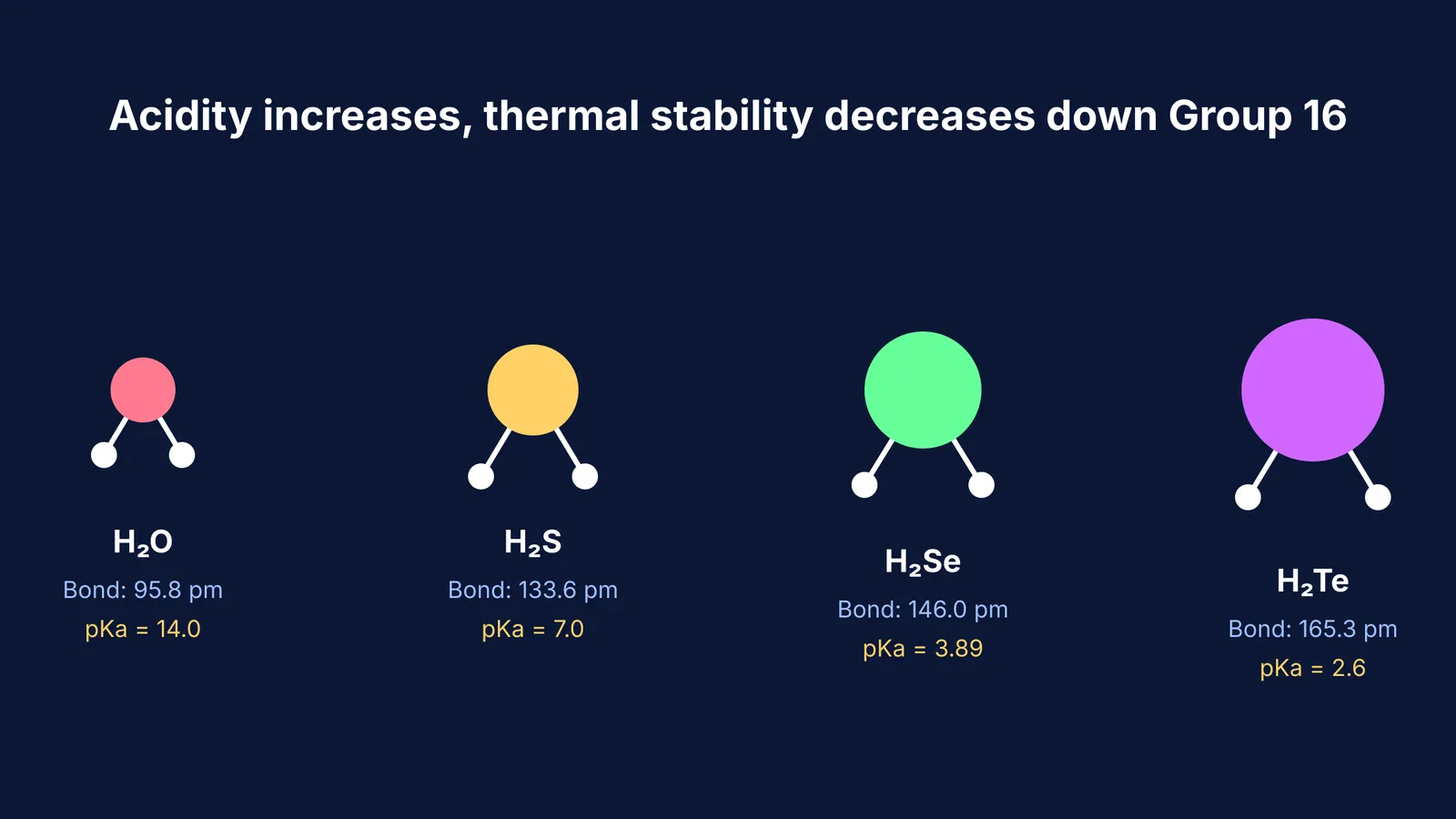
As we move down the periodic table from oxygen to tellurium, the atomic radius of the central atom increases significantly. This larger size stretches the H–E bond. Data from structural chemistry measurements (Hydrogen chalcogenide - Wikipedia) shows the bond length increases from 95.8 pm in water to 133.6 pm in hydrogen sulfide, 146.0 pm in hydrogen selenide, and finally 165.3 pm in hydrogen telluride. A longer chemical bond results in much poorer orbital overlap between the atoms. This poor overlap leads to a profound drop in overall bond strength, and this single physical change governs both the acidity and thermal stability of the entire group.
Why does the acidic strength increase from H2O to H2Te?
The acidic character of a hydride is a measure of how easily it releases a positive hydrogen ion (H⁺) when dissolved in water. You might assume that water would be the most acidic because oxygen is highly electronegative and strongly pulls electrons away from hydrogen. However, bond strength overrides electronegativity in this group.
Because the H–Te bond is much longer and weaker than the H–O bond, hydrogen telluride gives up its proton much more easily than water. Consequently, acidic strength increases steadily down Group 16. We can track this trend by looking at their dissociation constants (Hydrogen chalcogenide - Wikipedia). A lower pKa value indicates a stronger acid that dissociates more readily. Water is highly stable and does not act as an acid in standard conditions, sitting at a neutral pKa of 14.0. Moving down the group, hydrogen sulfide (H₂S) acts as a weak acid with a pKa of 7.0. Hydrogen selenide (H₂Se) is moderately acidic with a pKa of 3.89. Finally, at the bottom of the non-radioactive elements, hydrogen telluride is the strongest acid in the series, boasting a pKa of 2.6.
Why does thermal stability decrease down Group 16?
Thermal stability refers to a chemical compound's resistance to breaking apart into its original constituent elements when exposed to heat. Just like acidity, this physical property relies directly on the bond dissociation enthalpy—the energy required to break the H–E bond.
As the bond becomes weaker and more stretched down the group, far less thermal energy is required to break it. Therefore, thermal stability decreases sharply from oxygen to tellurium. We can quantify this fragility by looking at their standard enthalpies of formation (Hydrogen chalcogenide - Wikipedia). Water is extremely stable, forming via a highly exothermic reaction with an enthalpy of −285.9 kJ/mol. In stark contrast, hydrogen telluride forms endothermically, absorbing +99.6 kJ/mol. Because the bonds in H₂Te are so weak, it is inherently unstable and will slowly decompose into hydrogen gas and a precipitate of elemental tellurium at temperatures above 0 °C, or even when exposed to normal light.
How do Assertion-Reason questions test these trends?
Exam questions in competitive papers like the JEE and NEET frequently test these periodic trends using an Assertion-Reason format. When evaluating a claim about the physical properties of Group 16 or Group 17 hydrides, you can use this mental checklist to avoid common mistakes:
Verify the direction of the trend: Remember that acidic strength always goes up, and thermal stability always goes down as you move to heavier elements in the group. If the assertion states the opposite, it is false.
Verify the fundamental cause: The correct and primary reason for both of these trends is the decreasing bond dissociation enthalpy. This drop in enthalpy is directly caused by the increasing atomic size and the resulting increase in bond length.
Spot the electronegativity trap: If the reason statement claims that the acidity trend is caused by changes in electronegativity, the statement is false. If electronegativity were the driving force, it would incorrectly predict water to be the strongest acid because oxygen is the most electronegative element in the group.
If you are confused about why larger atoms form weaker chemical bonds, the Concept Library holds a lesson for every concept in physics, chemistry, biology, mathematics and computing, letting you trace how atomic size influences reactions. Or, if you need to calculate equilibrium constants and pH values for these weak acids, Fermi's AI tutor can work out what you already know and build a plan for the session, writing out the mathematical steps on a board and checking your understanding as it goes.
For more on chemical trends, read about Comparing bond angles: NH₃ vs PH₃ and H₂O vs H₂S explained and how to calculate dissociation with Conjugate acid-base pairs: Ka × Kb = Kw and what it tells you.


