On this page
Water reports, pollution news and Class 11 numericals all use ppm, and the same concentration can be written as ppm, percent, mg/L or mol/L. This guide shows how to move between them without losing a factor of 1,000 along the way.
What does ppm mean in chemistry?
For solutions, ppm compares masses: ppm = (mass of solute ÷ mass of the whole sample) × 1,000,000, as set out in this LibreTexts chapter on mass percent, ppm and ppb. Mass percent is the same ratio multiplied by 100, and ppb multiplies it by 1,000,000,000.
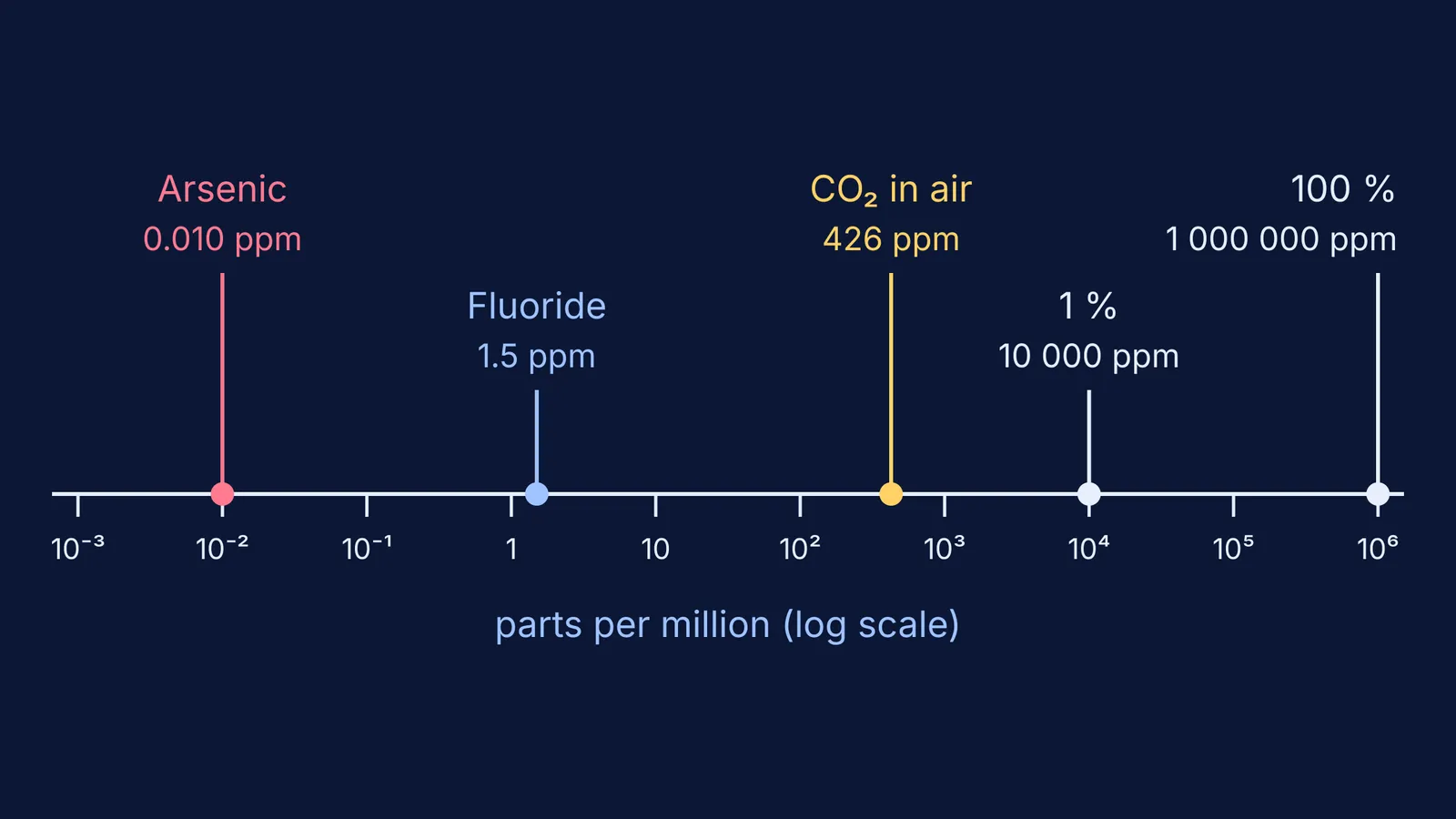
That gives you one bridge you can do in your head: divide ppm by 10,000 to get mass percent. So 1% is 10,000 ppm, and 1 ppm is 0.0001%.
Notice that the denominator is the whole sample, solute plus solvent, not the solvent alone. For trace amounts the difference is tiny, but in a 10% solution it changes your answer.
Why is 1 mg/L the same as 1 ppm in water?
The Water on the Web conversion tables put it simply: 1 mg/L of water is equivalent to 1 ppm "because a liter of water weighs 1000 grams and a milligram is 1 one thousandth of a gram". By the same logic, 1 µg/L is 1 ppb.
That shortcut rests on the density of water. For seawater, a concentrated acid or a sugar syrup, a litre weighs more than 1000 g, so first turn mg/L into mg per kg using the density, then call it ppm.
How do you convert ppm to mass percent, mg/L and molarity?
Take fluoride. The WHO guideline value for fluoride in drinking water is 1.5 mg/L, according to its chemical fact sheet on fluoride. Here is the full chain:
ppm: the water is dilute, so 1.5 mg/L is about 1.5 ppm.
Mass percent: 1.5 ÷ 10,000 = 0.00015%, or 1.5 × 10⁻⁴ %.
Grams per litre: 1.5 mg = 1.5 × 10⁻³ g, so the solution holds 1.5 × 10⁻³ g/L.
Molarity: divide by the atomic weight of fluorine, 18.998 g/mol from the CIAAW standard atomic weights. 1.5 × 10⁻³ ÷ 18.998 = 7.9 × 10⁻⁵ mol/L.
You can also run it backwards. A 5,000 L school tank at 1.5 mg/L holds 5,000 × 1.5 = 7,500 mg, or 7.5 g, of fluoride.
Now arsenic. The WHO arsenic fact sheet gives a provisional limit of 10 µg/L. That is 10 ppb, or 0.010 ppm. With arsenic at 74.92 g/mol from the same CIAAW table, 1.0 × 10⁻⁵ g/L ÷ 74.92 g/mol = 1.3 × 10⁻⁷ mol/L. In mass terms the arsenic limit is 150 times lower than the fluoride one (1.5 ÷ 0.010).
If molarity itself feels shaky, the reasoning behind why pure water is 55.5 M uses the same grams-to-moles step, and it helps to know when square brackets mean concentration before you write [F⁻] in an answer.
How is ppm different for gases like CO2?
For gases, ppm usually counts molecules, not grams. NOAA's Global Monitoring Laboratory reports carbon dioxide as a dry-air mole fraction, "the number of molecules of carbon dioxide divided by the number of all molecules in air", and writes 0.000400 as 400 ppm (NOAA CO2 trends). Its monthly mean at Mauna Loa for September 2026 was 426.07 ppm.
So 426 ppm of CO2 means about 426 molecules in every million, or 0.0426% by moles. It is not 426 mg per kg of air, and the water shortcut does not apply.
Which ppm unit slips cost marks?
Mixing mg and µg: 10 µg/L is 0.010 ppm, not 10 ppm. That is a factor of 1,000.
Dividing by the mass of solvent instead of the mass of the whole solution.
Using 1 mg/L = 1 ppm for dense solutions, or for gases at all.
Using the wrong molar mass: a fluoride limit refers to the fluoride ion, so use 19.00 g/mol from the CIAAW atomic weights table, not the formula mass of the salt it came from.
Treating ppm by mass and ppm by molecules as the same number.
Rounding too early: keep three significant figures until the last line.
Before a test, go through the mistakes to check in mole concept numericals, since most ppm errors are really mole errors. If you get stuck at the mol/L step, the Fermi Problem Library has worked problems with a step-by-step solver that explains the reasoning rather than printing an answer. If the gap is the mole idea itself, the Fermi Concept Library gives every chemistry concept its own lesson.
Try this now: convert 0.5 mg/L of fluoride into ppm, mass percent and mol/L, writing the units on every line.