

On this page
Why does chemistry use square brackets for two different things?
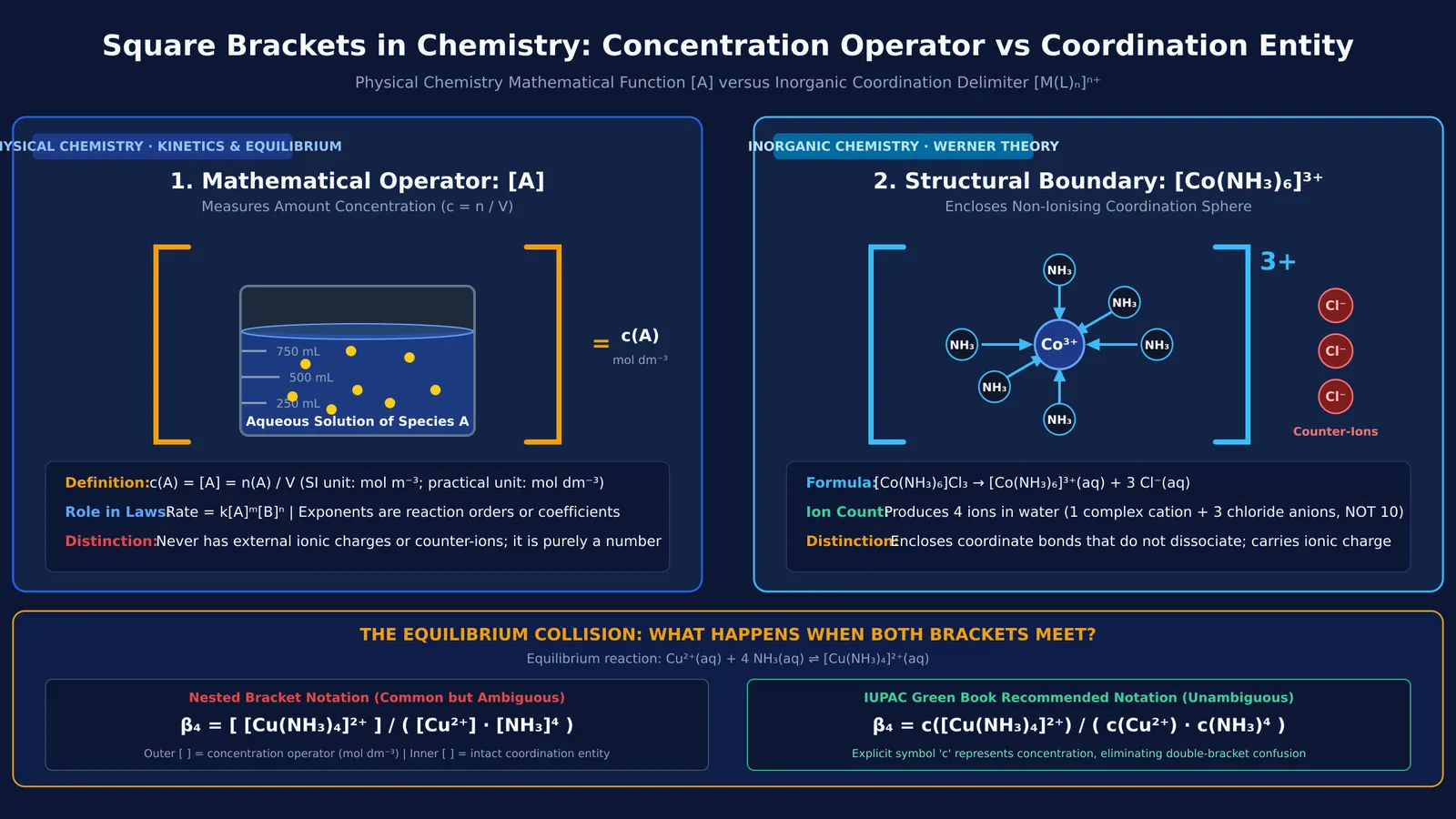
Chemistry students preparing for exams like CBSE Class 12, JEE Main, or NEET-UG often encounter a baffling notation problem: the exact same punctuation mark performs two completely unrelated jobs. In physical chemistry, square brackets signify an operation: measuring the molar concentration of a chemical species in solution. In inorganic chemistry, square brackets act as a structural fence: enclosing a central metal atom and its coordinated ligands to define a discrete coordination entity.
Confusing the two creates serious mistakes. Treating a coordination bracket as a concentration operator leads students to misinterpret formula units, while ignoring the coordination boundary leads to incorrect ion counts in solution. Understanding the historical context and IUPAC guidelines turns this potential trap into an intuitive distinction.
What does [A] mean in rate laws and equilibrium?
In chemical kinetics and equilibrium, writing [A] denotes the amount concentration of substance A. According to the IUPAC Green Book (*Quantities, Units and Symbols in Physical Chemistry*, Section 2.10), amount concentration represents the amount of substance divided by the volume of the mixture, with the standard SI unit of mol m⁻³ and the practical unit of mol dm⁻³ (or mol/L).
This mathematical shorthand developed during the foundation of physical chemistry in Leipzig. In 1888, Wilhelm Ostwald published his dilution law in the *Zeitschrift für physikalische Chemie*, treating dissolved electrolyte concentrations algebraically. A year later in the same journal, Walther Nernst (1889) formalized square brackets [A] to represent the molar concentration of dissolved ions in electrochemical equations. Today, square brackets appear as standard concentration operators in rate expressions like Rate = k[A]¹[B]² and in equilibrium quotients. If you are analyzing reaction kinetics, you can explore how these concentrations translate into linear relationships in our guide on integrated rate law graphs. In equilibrium, square brackets dictate whether a system shifts forward or backward, as explained in our review of the reaction quotient Q versus equilibrium constant K.
What do brackets mean around a coordination complex?
In inorganic chemistry, square brackets do not represent a number or a concentration; they represent a physical entity. As codified in the IUPAC Red Book (*Nomenclature of Inorganic Chemistry*, Chapter IR-9), square brackets enclose the coordination entity: the central transition metal atom or ion and the surrounding array of ligands directly bound to it.
This notation dates to 1893, when Swiss chemist Alfred Werner published his coordination theory in the *Zeitschrift für anorganische Chemie*, earning the 1913 Nobel Prize in Chemistry. Werner separated secondary valency (coordinate bonds that do not dissociate in water) from primary valency (ionisable counter-ions). For instance, in [Co(NH₃)₆]Cl₃, the hexacoordinated cobalt complex [Co(NH₃)₆]³⁺ sits inside the square brackets as a single intact cation, while the three chloride ions reside outside in the ionisation sphere. Dissolving this salt produces 4 ions per formula unit, not 10. For a deeper look at precipitation tests with silver nitrate, read our guide to counting ionisable chlorides in Werner complexes.
What happens when a complex ion enters an equilibrium expression?
The real confusion arises when a coordination complex participates in a chemical equilibrium, such as determining the stability constant (formation constant, β₄) of tetraamminecopper(II) ions in aqueous ammonia:
Cu²⁺(aq) + 4NH₃(aq) ⇌ [Cu(NH₃)₄]²⁺(aq)
If you express the equilibrium constant Kc for this reaction, you must take the molar concentration of a species that already contains coordination square brackets:
β₄ = [[Cu(NH₃)₄]²⁺] / ([Cu²⁺] × [NH₃]⁴)
Here, the outer square brackets represent the molar concentration operator (mol dm⁻³), whereas the inner square brackets define the coordination sphere. Because nested brackets look confusing on the page, the IUPAC Green Book recommends using the explicit symbol c for concentration to maintain clarity:
β₄ = c([Cu(NH₃)₄]²⁺) / (c(Cu²⁺) × c(NH₃)⁴)
How can you avoid bracket confusion in exam problems?
To prevent costly mistakes under exam pressure, apply this three-step verification framework whenever you encounter square brackets:
Identify the chemical context: If the expression contains an equals sign, a rate constant k, or an equilibrium constant K, the outer brackets are mathematical operators representing molarity. If the formula lists a transition metal followed by ligands inside parentheses, the brackets mark a coordination sphere.
Check for counter-ions and external charges: Coordination brackets often carry an ionic charge (such as 2+ or 3−) or are flanked by counter-ions (such as K₄[Fe(CN)₆] or [Ni(NH₃)₆]SO₄). Concentration brackets never have external ionic charges; they take numerical exponents representing reaction order or stoichiometric coefficients.
Translate nested brackets into words: If you see [[Fe(SCN)]²⁺], write "concentration of iron-thiocyanate complex" in your margin before substituting values into your calculator.
The Fermi Concept Library maps every concept in physics, chemistry, biology, mathematics and computing, each with its own lesson and its place in the map. When practicing multistep equilibrium calculations, the Fermi Problem Library has worked problems with a step-by-step solver that explains the reasoning rather than printing an answer.


