

On this page
When you first encounter molarity in chemistry class, it is introduced through solutions: dissolving grams of sodium chloride or moles of hydrochloric acid in water. But ask what the molarity of pure water itself is, and the question often brings students to a sudden halt. In pure water, there is no separate solute—water is both the medium and the substance being counted. That calculation yields roughly 55.5 moles per litre (55.5 M), a number that underpins ionic equilibrium, acid dissociation constants, and the pH scale throughout Class 11 and entrance exams like JEE Main and NEET-UG.
How do you calculate the molarity of pure water?
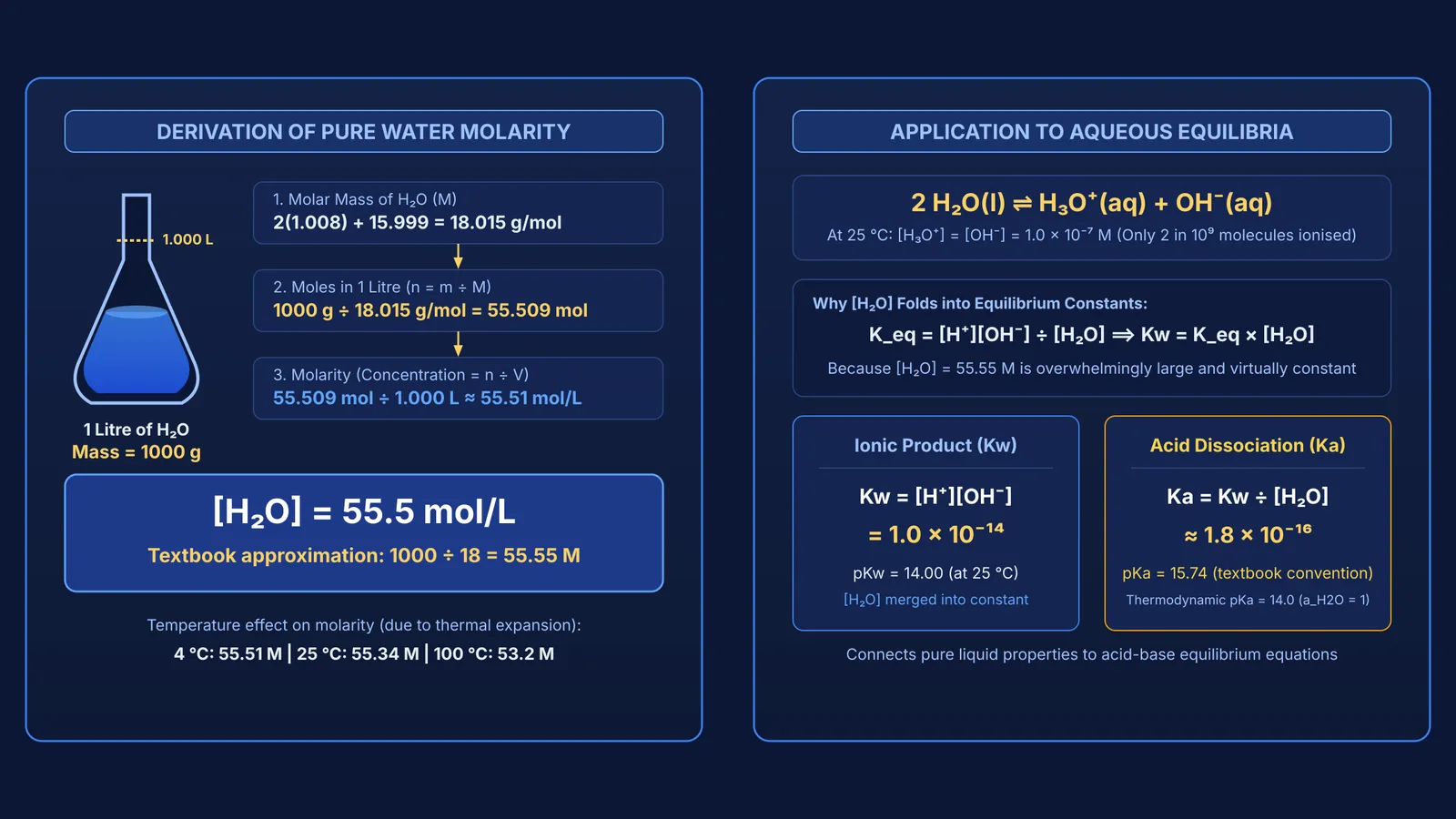
Molarity is defined as the number of moles of a substance contained in one litre of solution. To find the concentration of pure water, you only need two standard physical properties: density and molar mass.
Near 4 °C, liquid water reaches its maximum density of exactly 1.000 g/mL (or 1000 g/L), while at standard room temperature (25 °C), thermal expansion reduces its density slightly to 0.99705 g/cm³, according to thermophysical measurements documented in the NIST Chemistry WebBook. Using the standard classroom value of 1000 grams per litre:
Mass of 1 litre of water: 1000 g
Molar mass of water (H₂O): 2 × 1.008 g/mol + 15.999 g/mol = 18.015 g/mol, as catalogued in PubChem
Number of moles: n = 1000 g ÷ 18.015 g/mol = 55.509 mol
Molarity: M = 55.509 mol ÷ 1.000 L ≈ 55.51 mol/L
If you round water's molar mass to 18 g/mol, as most textbooks do for quick numerical solving, the division 1000 ÷ 18 gives 55.555... mol/L, commonly written as 55.55 M or 55.5 M.
Why does 55.5 M matter in chemical equilibrium?
In pure liquid water, molecules do not remain inert spectators. A tiny fraction of water molecules undergo self-ionisation (autoprotolysis), transferring a proton from one molecule to another:
H₂O(l) + H₂O(l) ⇌ H₃O⁺(aq) + OH⁻(aq)
At 25 °C (298 K), neutral water contains hydronium and hydroxide ion concentrations of exactly 1.0 × 10⁻⁷ mol/L, as established in OpenStax Chemistry 2e. Comparing 1.0 × 10⁻⁷ M to the bulk water concentration of 55.55 M shows that the degree of dissociation (α) is only 1.8 × 10⁻⁹. In plain terms, roughly two out of every one billion water molecules are split into ions at any single moment.
Because 55.5 M is vastly larger than the concentration of dissolved ions—or even typical laboratory solutes ranging from 0.001 M to 1 M—the bulk concentration of water barely changes during reactions. In chemical thermodynamics, this constancy explains why pure liquids and solids drop out of equilibrium expressions. Instead of writing [H₂O] in the denominator of every aqueous equilibrium, chemists merge this constant concentration directly into the equilibrium constant.
When setting up equilibrium equations or navigating multi-step ionic equilibria, the Fermi Problem Library has worked problems with a step-by-step solver that explains the reasoning rather than printing an answer.
What is the difference between Kw and water's Ka?
One of the most persistent traps in entrance exams is confusing the ionic product of water (Kw) with water's actual acid dissociation constant (Ka).
Writing the equilibrium expression for water acting as an acid, H₂O(l) ⇌ H⁺(aq) + OH⁻(aq), gives:
K_eq = [H⁺][OH⁻] ÷ [H₂O]
The numerator [H⁺][OH⁻] is defined as the ionic product of water, Kw, which equals 1.0 × 10⁻¹⁴ at 25 °C, as detailed on LibreTexts Chemistry. Multiplying K_eq by the concentration of undissociated water gives Kw:
Kw = K_eq × [H₂O] = [H⁺][OH⁻] = 1.0 × 10⁻¹⁴
To find water's true acid dissociation constant Ka, you divide Kw by the molarity of water:
Ka = Kw ÷ [H₂O] = (1.0 × 10⁻¹⁴) ÷ 55.55 ≈ 1.8 × 10⁻¹⁶ mol/L
Taking the negative logarithm gives pKa = −log(1.8 × 10⁻¹⁶) = 15.74. This relationship directly governs conjugate acid-base pairs and Ka × Kb = Kw. If water dissociates into H₃O⁺ and OH⁻ via 2 H₂O ⇌ H₃O⁺ + OH⁻, the formal equilibrium constant Kc incorporates [H₂O]²:
Kc = Kw ÷ [H₂O]² = (1.0 × 10⁻¹⁴) ÷ (55.55)² ≈ 3.2 × 10⁻¹⁸
A long-running pedagogical discussion documented by Todd P. Silverstein and Stephen T. Heller in the *Journal of Chemical Education* (DOI: 10.1021/acs.jchemed.6b00623) highlights that while pKa = 15.74 stems from including 55.5 M in the denominator, modern thermodynamic conventions define the activity of pure solvent water as 1, setting thermodynamic pKa to 14.0. For school curricula and JEE or NEET numerical problems, however, 1.8 × 10⁻¹⁶ remains the expected textbook constant.
Does the molarity of water change with temperature?
Because molarity depends on volume, temperature changes water's molar concentration. Water expands as it warms above 4 °C. At 4 °C, where density is 1.000 g/mL, pure water is 55.51 M. When heated to 25 °C, its density drops to 0.99705 g/cm³, lowering the exact molarity to 55.34 M, as confirmed by NIST Chemistry WebBook data. At 100 °C, the density drops further to 0.9584 g/cm³, bringing water's molarity down to approximately 53.2 mol/L.
Simultaneously, the self-ionisation of water is an endothermic process (ΔH > 0). Supplying heat shifts the autoionisation forward according to Le Chatelier's principle. As water warms from 0 °C to 100 °C, Kw surges from 0.11 × 10⁻¹⁴ to 5.6 × 10⁻¹³, according to equilibrium measurements compiled in OpenStax Chemistry 2e. This rise in ion concentrations means that neutral pH changes with temperature, falling from 7.0 at 25 °C to roughly 6.1 at boiling point, even though the liquid remains neutral because [H⁺] remains equal to [OH⁻].
To see how molecular concentrations, chemical equilibrium, and thermodynamics connect across your entire syllabus, the Fermi Concept Library covers every concept in physics, chemistry, biology, mathematics and computing, each with its own lesson and its place in the map.


