On this page
In 2008, infant formula in China was found to contain melamine, an industrial chemical used to make plastics and laminates. It had been added to watered-down raw milk because the standard protein test does not measure protein. It measures nitrogen. Melamine is two-thirds nitrogen by mass, so a little of it made thin milk look rich. The chemistry behind the fraud is the Kjeldahl method from Class 11, and it explains why food labs now run separate tests for nitrogen that does not come from protein.
What happened in the 2008 melamine milk incident?
A WHO and FAO expert meeting held in Ottawa in December 2008 reported, from China's Ministry of Health, that 294,000 infants had been affected by melamine-contaminated formula by 30 November 2008, that more than 50,000 had been admitted to hospital and that six had died (WHO expert meeting report on melamine and cyanuric acid). Many of the children had stones in the kidneys, ureters or bladder, made of melamine and uric acid.
The same report states the root cause plainly: commonly used protein methods cannot tell protein nitrogen from non-protein nitrogen, so products containing melamine are wrongly measured as high in protein. That gave people an economic reason to add it.
How does the Kjeldahl method turn nitrogen into a protein figure?
Kjeldahl's method has three stages, which you can revise in Dumas and Kjeldahl methods: estimating nitrogen in Class 11:
Digestion. Hot concentrated H₂SO₄ (with a catalyst) converts the sample's nitrogen to ammonium sulphate.
Distillation. Excess NaOH releases NH₃, which is absorbed in standard acid.
Titration. The acid left over is titrated, which gives the moles of NH₃ and so the mass of nitrogen.
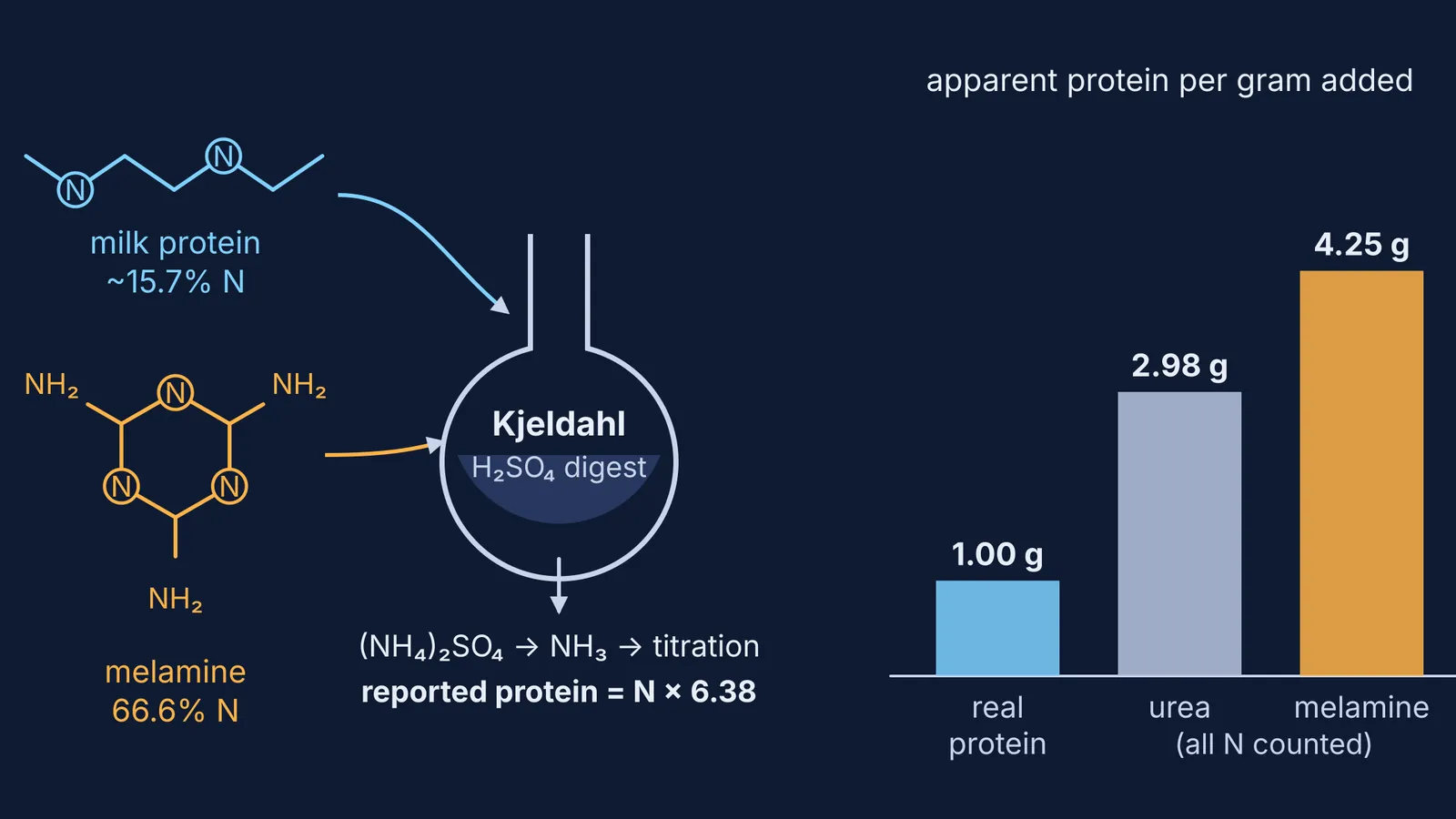
The method, which Johan Kjeldahl built for a brewery lab in 1883, stops there. It reports nitrogen. Food labs then multiply by a conversion factor, because proteins are roughly 16% nitrogen. The general factor is 6.25 (100 ÷ 16), and the factor for milk is 6.38, according to the FAO report on food energy and conversion factors.
The weak point is that multiplication. It assumes every nitrogen atom in the sample came from protein. Foods do contain some non-protein nitrogen (milk naturally holds a little urea), but in an honest sample the error is small. A deliberately added nitrogen compound breaks the assumption completely.
Why does melamine count as so much "protein"?
Melamine is C₃H₆N₆ (molar mass about 126.12 g/mol). It is a six-membered triazine ring of alternating carbon and nitrogen atoms with an NH₂ group on each carbon, so it holds six nitrogen atoms: three in the ring and three in the amino groups.
%N in melamine = (6 × 14.007) ÷ 126.12 × 100 = 66.6%
%N in urea, CH₄N₂O (60.06 g/mol) = (2 × 14.007) ÷ 60.06 × 100 = 46.6%
%N in milk protein ≈ 100 ÷ 6.38 = 15.7%
Multiply each by the milk factor. If all of its nitrogen were counted, 1 g of melamine would read as 0.666 × 6.38 = 4.25 g of "protein". One gram of urea would read as 2.98 g. One gram of real milk protein reads as 1 g.
Doesn't NCERT say Kjeldahl misses ring nitrogen?
It does. NCERT's Class 11 chapter says the method does not work for nitrogen in nitro and azo groups or in a ring such as pyridine, because that nitrogen is not converted to ammonium sulphate under the usual conditions. Melamine has ring nitrogen, so you might expect it to escape the test.
Two points settle this. First, half of melamine's nitrogen is in NH₂ groups, not in the ring. Second, the effect has been measured directly. Finete and co-workers added melamine, urea and ammonium sulphate to UHT milk and whey and found that the Kjeldahl result rose with the added nitrogen compounds while dye-based protein methods did not change (Food Chemistry, 2013).
We did not find a published figure for exactly what fraction of melamine's nitrogen a standard Kjeldahl digestion recovers, and ring nitrogen generally needs harsher digestion than amine nitrogen. So treat melamine as a known exception to the simple NCERT rule, and treat the 4.25 figure above as an upper limit. The worked example below uses it that way.
Worked example: how much of a milk "protein" result is melamine?
A milk sample reads 3.20% protein by Kjeldahl (N × 6.38). A separate, specific test (such as liquid chromatography with mass spectrometry) finds 1,250 mg of melamine per kg of milk. How much of the reported protein is real? Assume, as an upper limit, that all melamine nitrogen is counted.
Melamine per kg of milk: 1,250 mg = 1.25 g.
Its nitrogen: 1.25 g × 0.666 = 0.833 g of N.
Ammonia it gives in the Kjeldahl flask: 0.833 ÷ 14.007 = 0.0595 mol NH₃ (59.5 mmol). Check: 1.25 ÷ 126.12 = 9.91 mmol of melamine, × 6 N each = 59.5 mmol. The two routes agree.
Apparent protein from melamine: 0.833 g × 6.38 = 5.31 g per kg, which is 0.53% of the milk.
Real protein: 3.20 − 0.53 = 2.67%. About one-sixth of the reported figure (0.53 ÷ 3.20 = 0.17) is melamine.
Compare with the legal limit: the Codex Alimentarius limit for melamine in foods other than infant formula is 2.5 mg/kg. 1,250 ÷ 2.5 = 500 times the limit.
What the limit looks like to Kjeldahl: at 2.5 mg/kg, melamine would add 0.0025 g × 0.666 × 6.38 = 0.011 g of "protein" per kg, or 0.001%. No nitrogen titration can see that.
Step 7 is the key result: the safety limit sits far below anything Kjeldahl can detect, so melamine needs its own test.
If one step in a chain like this keeps going wrong, the Fermi Problem Library has a step-by-step solver that explains the reasoning rather than printing an answer.
How do food standards catch non-protein nitrogen now?
After 2008, regulators set limits for melamine itself. In 2010 the Codex Alimentarius Commission adopted a maximum of 1 mg/kg in powdered infant formula and 2.5 mg/kg in other foods and animal feed, and in 2012 added 0.15 mg/kg for liquid infant formula (WHO news release, July 2012). India's FSSAI wrote the same three limits into its Contaminants, Toxins and Residues Regulations in January 2016 (FSSAI gazette notification).
Testing changed in the same direction. Labs use methods that detect the melamine molecule itself, and researchers have proposed comparing Kjeldahl with methods that respond to the protein molecule, such as dye-binding. If the two disagree, extra nitrogen is present. Indian dairy cooperatives pay farmers by fat and solids-not-fat, as explained in how the Amul model works, and any payment or quality test based on one number is open to the same kind of trick.
Quick checklist
Kjeldahl measures nitrogen, not protein. Protein = N × factor (6.38 for milk, 6.25 in general).
Melamine is 66.6% N; 1 g can read as up to 4.25 g of milk "protein". Urea, 46.6% N, reads as up to 2.98 g.
NCERT's pyridine rule is real, but melamine was still counted. Treat it as a known exception.
Codex and FSSAI limits: 1 mg/kg powdered infant formula, 0.15 mg/kg liquid infant formula, 2.5 mg/kg other foods.
Melamine at the legal limit changes a Kjeldahl result by about 0.001%, so specific tests are needed.