On this page
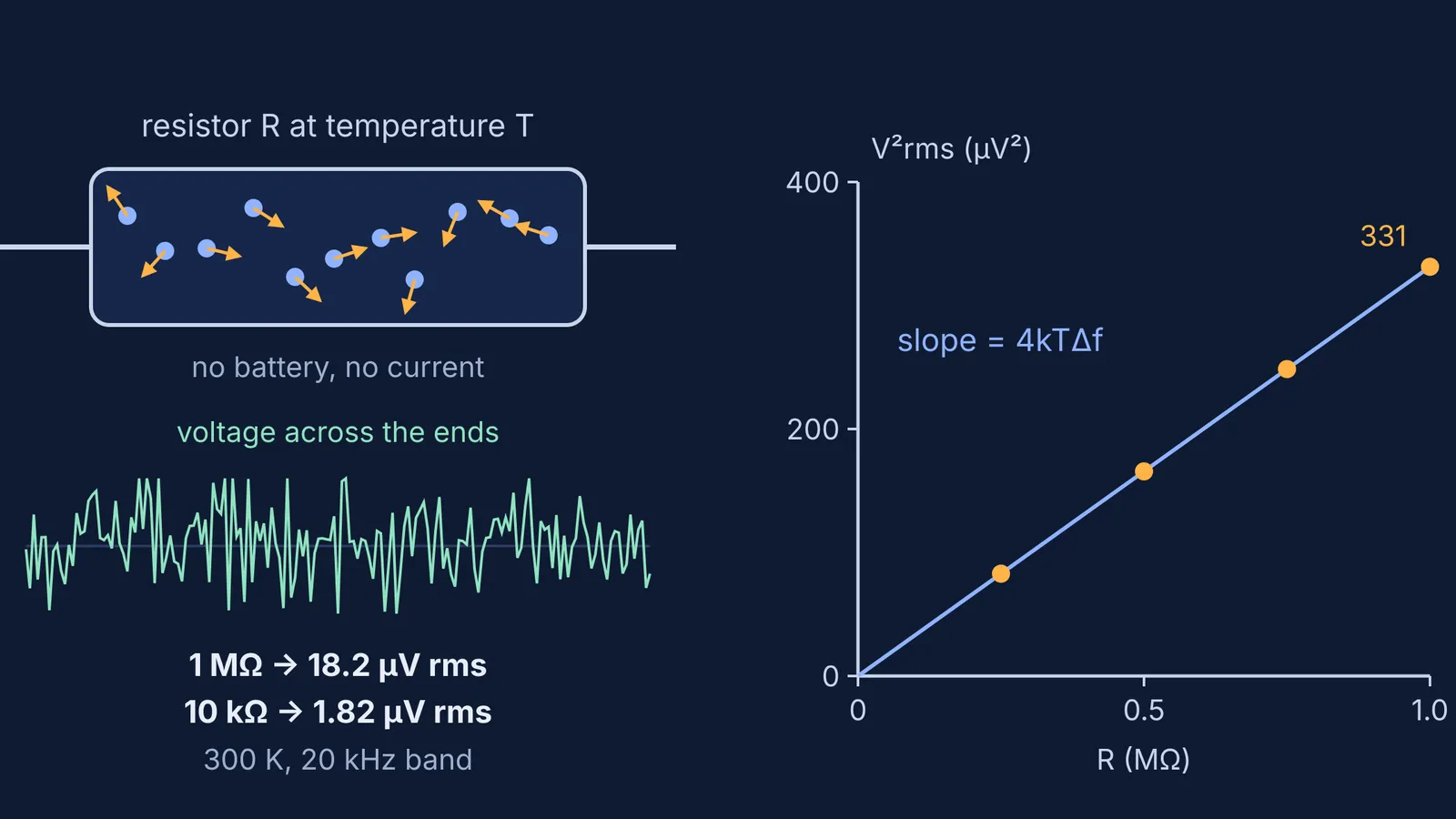
Connect a sensitive voltmeter across a plain resistor with no battery anywhere in the circuit, and the reading is not zero. It flickers. The electrons inside the resistor are moving at random because the resistor is warm, and that random motion makes a tiny, ever-changing voltage across its ends. This is Johnson noise, also called thermal or Johnson–Nyquist noise. John B. Johnson measured it at Bell Labs in the 1920s and Harry Nyquist explained it in 1928. It sets the lowest noise any circuit can reach, and because it depends only on temperature, it can be used to measure Boltzmann's constant k.
What is Johnson noise in a resistor?
The free electrons in a conductor share the thermal energy of the lattice. At any instant, a few more of them happen to be moving towards one end than the other. That tiny imbalance of charge shows up as a voltage between the ends. A moment later the imbalance has changed. Averaged over time the voltage is zero, but its root mean square (rms) value is not.
The result, for a resistor R at absolute temperature T, measured over a frequency band of width Δf, is:
V_rms = √(4kTRΔf)
Three things in this formula matter for exams.
No current is needed. The resistor is just sitting there. This is the key difference from shot noise, which needs a current flowing across a barrier; that one is worked in Walter Schottky and shot noise, σ = √(2qIΔf).
The material does not matter. A carbon, metal-film or wire-wound resistor of the same R at the same T gives the same Johnson noise.
Noise grows with the square root of bandwidth. Measure over a wider range of frequencies and you collect more noise. Δf is the band the instrument actually responds to, not its sampling rate.
Check the units
k is in J/K, T in K, R in Ω and Δf in s⁻¹. So kTRΔf has units J × Ω/s. Since Ω = V/A and A = C/s, that is J × V/C = V × V = V². The square root is in volts, as it should be.
How loud is the hiss? A worked example
Take T = 300 K and the audio band, 20 Hz to 20 kHz, so Δf ≈ 20,000 Hz. Use k = 1.380649 × 10⁻²³ J/K, which has been exact since the 2019 SI redefinition (NIST CODATA value of k).
4kTΔf. 4 × 1.380649 × 10⁻²³ × 300 × 20,000 = 3.31 × 10⁻¹⁶ V²/Ω.
1 MΩ resistor. V² = 3.31 × 10⁻¹⁶ × 10⁶ = 3.31 × 10⁻¹⁰ V², so V_rms = 1.82 × 10⁻⁵ V = 18.2 µV.
10 kΩ resistor. R is 100 times smaller, so V is √100 = 10 times smaller: 1.82 µV.
What it means. A microphone that gives a few microvolts for quiet sounds would be buried under the hiss of a 1 MΩ input resistor. This is one reason low-noise microphone preamplifiers keep the resistance at their input low.
You can also check the formula against series resistors. Two 10 kΩ resistors each give 1.82 µV, and their noises are random and independent, so they add as squares: √(2) × 1.82 = 2.57 µV. A single 20 kΩ resistor gives √(4kT × 20,000 × Δf) = 2.57 µV. The answers agree, as they must.
Why do radio telescopes and deep-space receivers cool their amplifiers?
A resistor connected to a matched load can deliver noise power. Of the 4kTRΔf in V², a quarter is delivered to a matched load of equal resistance, so the available noise power is:
P = kTΔf
It does not depend on R at all. At 300 K, kT = 4.14 × 10⁻²¹ W per hertz of bandwidth. For a 10 kHz radio channel, the noise floor is 4.14 × 10⁻¹⁷ W. In the decibel units engineers use, that is −134 dBm (dB relative to 1 mW).
Because P is proportional to T, radio engineers often describe a receiver's noise as a temperature. The cosmic microwave background discovery was a puzzle about exactly this: an antenna that was a few kelvin hotter than it should have been.
Cool the front-end amplifier from 300 K to 20 K and its thermal noise power falls by 300/20 = 15 times. That is why the large dishes that receive faint signals from distant spacecraft use cryogenically cooled receivers, as mentioned in how ISRO tracks spacecraft far away. Every factor of temperature you remove is a factor of noise power you never have to fight.
How do you measure Boltzmann's constant from resistor noise?
Rearrange the formula:
k = V_rms² / (4TRΔf)
Worked practical. A 1 MΩ resistor at 300 K is connected to an amplifier and filter with a 10 kHz bandwidth. After allowing for the amplifier gain, the rms voltage across the resistor is 12.87 µV.
Square the voltage. (12.87 × 10⁻⁶)² = 1.656 × 10⁻¹⁰ V².
Denominator. 4 × 300 × 10⁶ × 10⁴ = 1.2 × 10¹³ K Ω Hz.
Divide. k = 1.656 × 10⁻¹⁰ / 1.2 × 10¹³ = 1.380 × 10⁻²³ J/K.
That matches the exact value to within 0.02%. Because k appears with T, the same measurement can be run the other way to read temperature, which is the idea behind noise thermometers.
What goes wrong in a real lab?
Amplifier noise. The amplifier adds its own noise, which also adds in squares. If it contributes 5.00 µV, the meter reads √(12.87² + 5.00²) = 13.81 µV. Measure with the input shorted, then subtract the squares.
A better method: use several resistors. Plot V_rms² against R. The points lie on a straight line with slope 4kTΔf. Amplifier noise only shifts the intercept, so the slope gives k without needing to know it.
Bandwidth. Δf must be the effective noise bandwidth of the filter. An error of 1% in Δf gives an error of 1% in k; an error of 1% in V gives 2%, because V is squared.
Interference. Mains hum and radio pickup are not thermal. Shield the resistor.
When does the formula stop working?
V_rms = √(4kTRΔf) is the classical limit, valid when each photon's energy hf is much less than kT. At 300 K, kT/h is about 6 THz, so for any electronics you will meet in a lab the formula is excellent. At very high frequencies or temperatures near absolute zero it needs a quantum correction, which you will not be asked about in JEE or NEET.
To see how kT links thermal energy to the gas laws and to electrical quantities like this one, the Concept Library has short explanations of each idea you need here.
Quick checklist
V_rms = √(4kTRΔf): thermal noise across any resistor, with no current needed.
1 MΩ at 300 K over 20 kHz: 18.2 µV. 10 kΩ: 1.82 µV.
Available noise power: P = kTΔf, about 4.1 × 10⁻²¹ W per Hz at 300 K.
Independent noises add as squares.
Cooling from 300 K to 20 K cuts thermal noise power 15 times.
k = V²/(4TRΔf); plot V² against R and use the slope.