

On this page
Walter Schottky was born in Zurich on 23 July 1886 and died on 4 March 1976; he earned his doctorate in Berlin in 1912 under Max Planck, according to his Wikipedia biography. Two of his ideas still shape electronics: the noise of a current made of separate electrons, and the barrier where a metal meets a semiconductor.
What is shot noise, and how did Schottky find it?
In 1918 Schottky published "Über spontane Stromschwankungen in verschiedenen Elektrizitätsleitern" (on spontaneous current fluctuations in various electrical conductors) in Annalen der Physik, volume 362, pages 541–567. He was studying current in vacuum tubes.
If charge arrives in lumps, a "steady" current cannot be perfectly steady: electrons leave at random moments, so the count in any short interval wobbles. The effect became known as the Schroteffekt, the shot effect, and in 1936 the Royal Society's Hughes Medal cited him "for his discovery of the schrot effect in thermionic emission" (Wikipedia biography).
Shot noise is the random fluctuation in a current caused by charge arriving as separate electrons, and its root-mean-square size is σ = √(2qIΔf) (shot noise, Wikipedia). Here q is the electron's charge, I the average current and Δf the bandwidth your instrument listens to. The elementary charge is exactly 1.602176634 × 10⁻¹⁹ C, a defined value in the NIST CODATA table.
Run the formula backwards and noise plus current give you q: an electrical cousin of Millikan's oil-drop measurement of the electron's charge.
Why does shot noise matter for small currents?
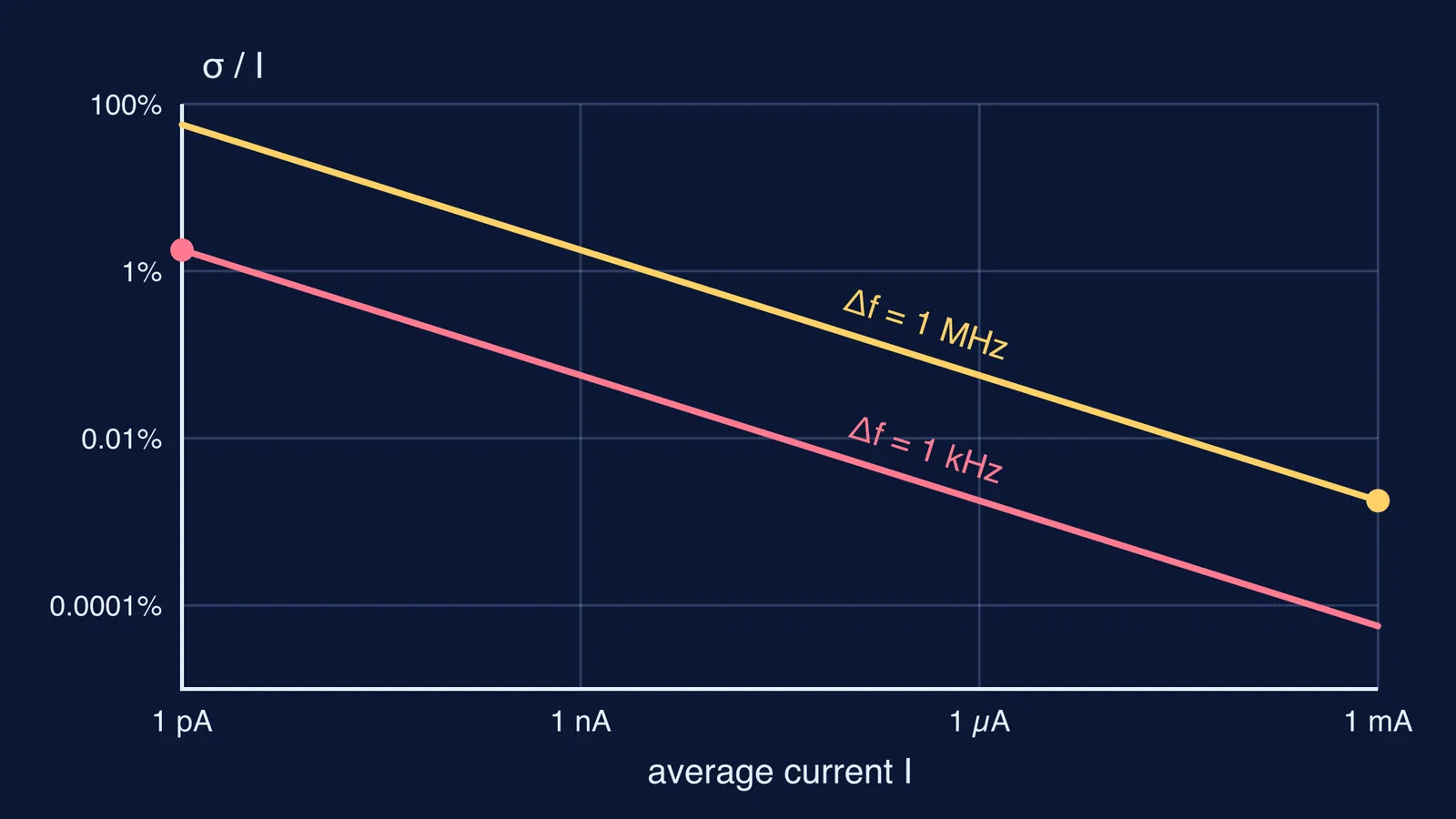
Divide both sides by I and the relative noise is σ/I = √(2qΔf/I). Two cases, using the shot-noise formula and the NIST value of q:
A 1 mA current over a 1 MHz bandwidth: 2 × (1.602 × 10⁻¹⁹ C) × (10⁻³ A) × (10⁶ Hz) = 3.2 × 10⁻¹⁶ A². The square root is about 1.8 × 10⁻⁸ A, or 18 nA. That is 0.0018% of the current, hardly noticeable.
A 1 pA current over just a 1 kHz bandwidth: 2 × (1.602 × 10⁻¹⁹ C) × (10⁻¹² A) × (10³ Hz) = 3.2 × 10⁻²⁸ A². The square root is 1.8 × 10⁻¹⁴ A, which is 1.8% of the signal.
Why the jump? A 1 pA current is only about 6.2 million electrons per second, so each short slice of time holds few enough electrons for the scatter to show. The formula's cure is a narrower bandwidth, which means averaging for longer.
How does a Schottky diode work?
His biography also credits him with a major early role in the theory of electrons escaping hot metals, described by Owen Richardson's law for thermionic emission. In December 1938 he published "Halbleitertheorie der Sperrschicht" (semiconductor theory of the barrier layer), in Die Naturwissenschaften, volume 26, page 843. The barrier layer it describes is what makes a metal on a semiconductor pass current more easily one way than the other.
A Schottky barrier is a potential energy barrier for electrons formed at a metal–semiconductor junction (Schottky barrier, Wikipedia). In the simplest model, the Schottky–Mott rule, its height is the metal's work function minus the semiconductor's electron affinity: Φ_B = Φ_M − χ. In real junctions, charged interface states can pin the Fermi level, so the barrier height stops following the work function.
Forward bias lets electrons from an n-type semiconductor climb over the barrier into the metal; reverse bias raises it, leaving only a tiny current. Unlike the two-carrier picture in forward and reverse bias curves of a p-n junction diode, only one kind of carrier does the work.
Why are Schottky diodes faster than silicon diodes?
According to the Schottky diode article, a silicon p-n diode has a typical forward voltage of 600–700 mV, while a Schottky diode's is 150–450 mV, which the article links to better efficiency.
They also switch faster: as unipolar devices they have no slow recombination of electrons and holes at turn-off, so junction capacitance sets their speed. They appear as rectifiers in switched-mode power supplies and as RF detectors and mixers at frequencies up to about 50 GHz.
How can you practise Schottky's two ideas?
A three-step plan for Class 12 or first-year college, using the shot-noise formula:
Check the units: C × A × Hz = (C/s) × A = A², so the square root gives amperes.
Redo the worked example with 1 nA over 10 kHz. Predict first: is the noise above or below 1% of the current? Then calculate.
Sketch a p-n junction beside a metal–n-type junction. Mark each barrier and the carriers that cross it.
Look closely at the electrons, as Schottky did, and a smooth current turns out to be grainy and a plain contact a one-way gate.
If the barrier picture will not settle, the Fermi Simulation Lab has interactive simulations for ideas that are easier to see than to read. For the arithmetic, the Fermi Problem Library has worked problems with a step-by-step solver that explains the reasoning rather than printing an answer.


