On this page
UV-C LEDs are small chips that give out ultraviolet light at about 265 to 280 nm, the same band used by germicidal mercury lamps. Making them is hard. An LED's colour is set by its band gap, and 265 nm needs a band gap of about 4.68 eV, far above any material used in ordinary LEDs. The answer is an alloy, aluminium gallium nitride (AlGaN), and its composition is a neat band-gap calculation. The physics also explains why UV-C LEDs are still far less efficient than the mercury lamps they compete with.
Safety first. UV-C light harms the eyes and skin. Never look at a UV-C lamp or LED, and never test one on your hand. The US FDA warns that some UV-C devices can injure the skin or eyes after a few seconds of use, causing burn-like skin reactions and photokeratitis, a very painful eye injury (FDA safety communication on UV wands).
Why do germicidal LEDs aim for about 265 nm?
UV-C is the band from 200 to 280 nm. A NIST-published review of light-based disinfection notes that DNA and RNA absorb these wavelengths, with peak absorption around 265 nm, and that UV-C LEDs commonly emit at 265 nm and 280 nm (Spicer, Journal of Research of NIST, 2021). The older source is the low-pressure mercury lamp at 254 nm, whose physics and biology are covered in how a UV water purifier kills germs. This post is about the LED alternative, and we make no claims about how well any device disinfects.
What band gap does a 265 nm LED need?
In an LED, an electron from the conduction band drops into a hole in the valence band and gives out a photon. Its energy is close to the band gap, so Eg ≈ hc/λ. With hc ≈ 1,240 eV nm, this is the same rule used for red, green and blue LEDs in why the colour of an LED depends on its band gap.
280 nm: 1,240 ÷ 280 = 4.43 eV.
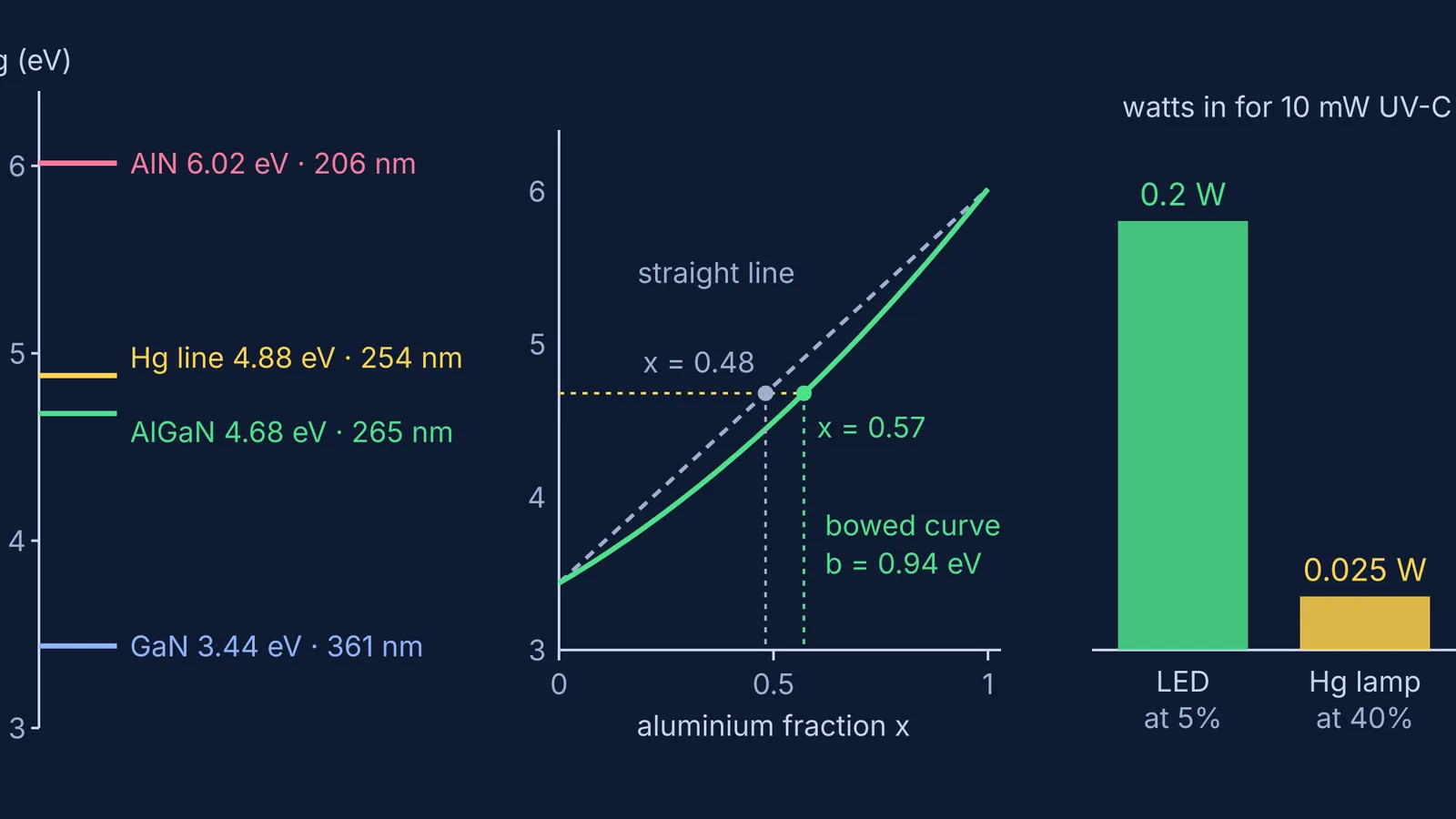
265 nm: 1,240 ÷ 265 = 4.68 eV.
254 nm (mercury line): 1,240 ÷ 254 = 4.88 eV.
Silicon has 1.1 eV and the gallium nitride used in blue and white LEDs has about 3.4 eV. Neither comes close. The emitted photon is usually a little above the band gap, and the gap itself shifts with temperature, so 4.68 eV is an approximate target.
Why mix gallium nitride with aluminium nitride?
Gallium nitride (GaN) and aluminium nitride (AlN) have the same crystal structure and can be mixed in any proportion as AlₓGa₁₋ₓN, where x is the fraction of aluminium. A 2020 Scientific Reports paper uses room-temperature band gaps of 3.44 eV for GaN and 6.02 eV for AlN (Alam and co-workers, 2020). Their wavelengths are 1,240 ÷ 3.44 = 361 nm and 1,240 ÷ 6.02 = 206 nm. Any band gap in between, and so any UV-C wavelength, can be reached by choosing x.
The same family of nitrides made the blue LED possible; AlGaN appeared there as one layer of the device, as told in Akasaki, Amano, Nakamura and the blue LED. For UV-C, AlGaN with a high aluminium fraction is the light-emitting layer itself.
How much aluminium does a 265 nm LED need? A worked example
Take Eg(GaN) = 3.438 eV, Eg(AlN) = 6.015 eV and a target of 1,239.84 ÷ 265 = 4.679 eV.
Straight-line guess (Vegard's law). Assume the gap changes linearly: Eg(x) = 3.438 + x(6.015 − 3.438) = 3.438 + 2.577x.
Solve. 3.438 + 2.577x = 4.679, so x = 1.241 ÷ 2.577 = 0.48. About 48% aluminium.
Add bowing. Real alloys sit below the straight line. The usual model subtracts a bowing term: Eg(x) = 3.438 + 2.577x − b·x(1 − x). The 2020 paper says reported values of b for AlGaN lie between 0.86 and 1.00 eV and uses b = 0.94 eV.
Solve again. 3.438 + 2.577x − 0.94x(1 − x) = 4.679 becomes 0.94x² + 1.637x − 1.241 = 0, so x = [−1.637 + √(1.637² + 4 × 0.94 × 1.241)] ÷ (2 × 0.94) = 0.57.
Answer. About 57% aluminium, not 48%. The bowing pushes the required aluminium fraction up by roughly 9 percentage points.
Check the units: every term is in eV, and x has no units. Check the limits: x = 0 gives GaN, x = 1 gives AlN. Since b is uncertain, quote x ≈ 0.55 to 0.6.
If you want practice turning wavelengths into band gaps and compositions, the Fermi Problem Library has a step-by-step solver that explains the reasoning.
Why are UV-C LEDs still so inefficient?
The useful figure here is wall-plug efficiency: the UV power out divided by the electrical power in. (External quantum efficiency, photons out per electron in, is a different number and is higher.) A UV-C LED maker, Crystal IS, puts most commercial UV-C LEDs at 3% to 6% wall-plug efficiency (Crystal IS on wall-plug efficiency). A lamp maker, Trojan Technologies, says roughly 40% of the electrical energy put into a standard low-pressure mercury lamp becomes 254 nm UV-C (Trojan Technologies on UV lamps).
Compare the input power needed for 10 mW of UV-C:
LED at 5%: 10 mW ÷ 0.05 = 0.20 W in, so 0.19 W is lost as heat.
LED at 3%: 10 mW ÷ 0.03 = 0.33 W in.
Mercury lamp at 40%: 10 mW ÷ 0.40 = 0.025 W in.
So the LED needs about 8 times the electrical power for the same UV output. The main reasons are physical: high-aluminium AlGaN is hard to grow without crystal defects, it is hard to make conduct holes, and much of the UV is absorbed inside the chip before it can escape. LEDs win elsewhere: they contain no mercury, switch on instantly, are tiny and run on low voltage. Crystal IS itself argues that a direct comparison of wall-plug efficiency does not settle which choice suits a given system.
Quick checklist
UV-C is 200 to 280 nm; DNA and RNA absorb most strongly around 265 nm.
Eg ≈ 1,240 ÷ λ(nm) eV: 265 nm needs about 4.68 eV.
GaN 3.44 eV (361 nm) and AlN 6.02 eV (206 nm) bracket all of UV-C.
Straight line: x ≈ 0.48; with bowing b ≈ 0.94 eV: x ≈ 0.57.
Commercial UV-C LEDs are about 3 to 6% efficient; mercury lamps about 40%.
UV-C harms eyes and skin: never look at or test a UV-C source.