

On this page
When you switch on an LED bulb or look at a smartphone screen, you are looking at light created directly by atomic structure, not by heat. For over a century, the world relied on incandescent bulbs, which pass electricity through a tungsten filament until it glows white-hot. That process is highly inefficient because it produces far more heat than visible light. A light-emitting diode (LED), on the other hand, produces almost no heat. Instead, it emits specific wavelengths of light through a purely electronic process. The exact colour an LED produces is locked into the physics of the semiconductor crystal inside it.
How do LEDs produce light?
An LED produces light through a process called electroluminescence HyperPhysics. The device is built around a p-n junction, which is a boundary between two types of semiconductor materials. One side, the n-type, has extra electrons, while the other side, the p-type, has extra "holes" (spaces where an electron could be). When a forward voltage is applied from a battery, electrons from the n-type material and holes from the p-type material are driven into the active region of the junction.
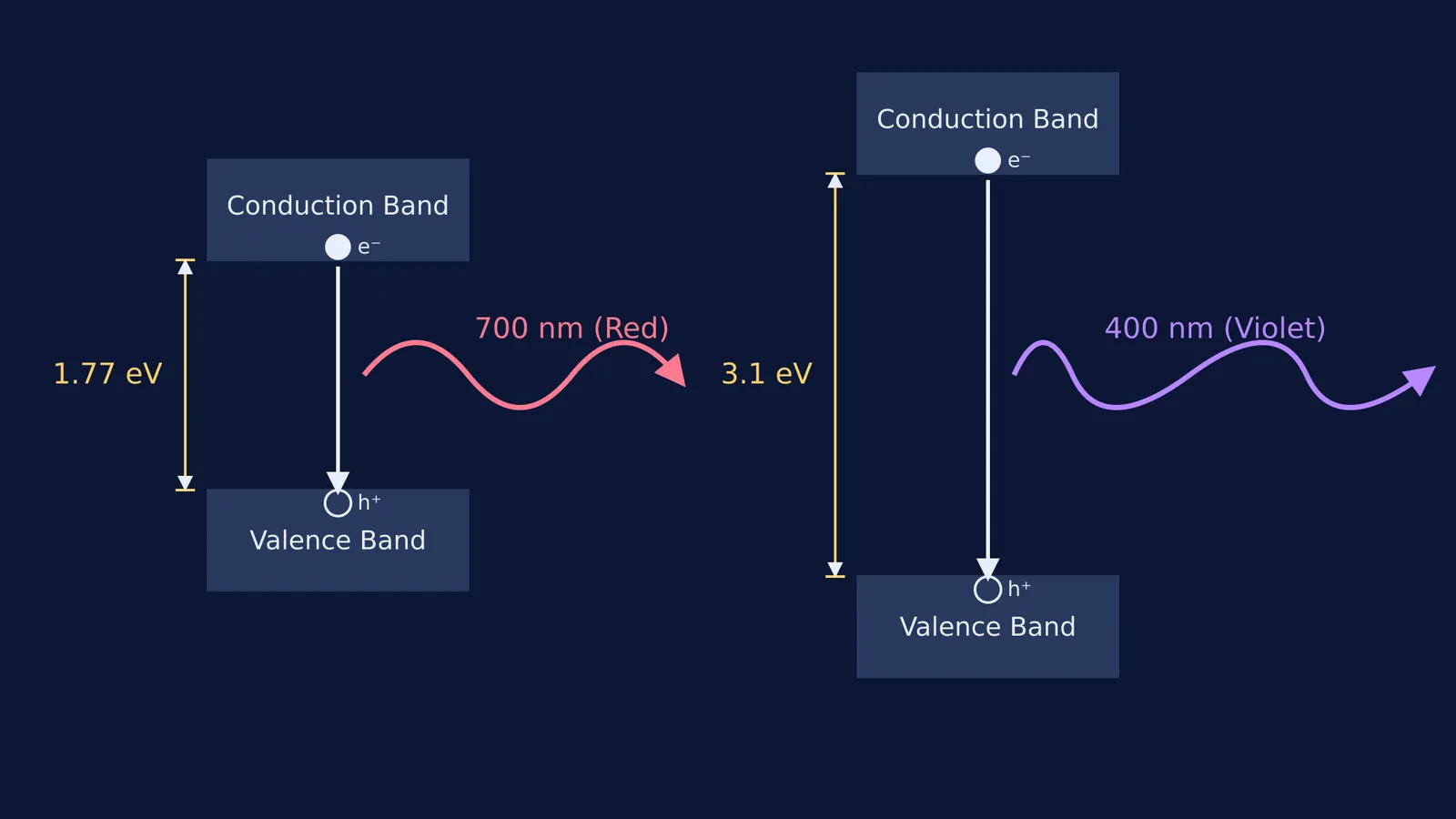
When an electron crosses the junction and recombines with a hole, it drops from the higher-energy conduction band to the lower-energy valence band, which is a more stable state. The extra energy it loses cannot just disappear; it is released as a photon of light. The energy of this photon is approximately equal to the energy difference between the two bands—a property known as the band gap (E_g) of the semiconductor.
In simple materials like silicon and germanium, this electron-hole recombination primarily produces heat rather than visible light. For this reason, these common semiconductors are not suitable for making LEDs. Instead, engineers must use compound semiconductors like gallium arsenide (GaAs) or gallium phosphide (GaP) to ensure the energy is released efficiently as visible or infrared light.
Why does band gap change the wavelength?
Photon energy is tied directly to wavelength by Planck's equation, E = hc/λ, where h is Planck's constant and c is the speed of light. Because wavelength is in the denominator, energy and wavelength are inversely proportional. The wider the band gap, the more energy the photon carries, which means it will have a shorter wavelength.
Small band gaps produce low-energy photons with longer wavelengths. For instance, gallium arsenide (GaAs) is often used for infrared LEDs because its band gap is very small. A slightly larger band gap of about 1.77 eV produces red light at around 700 nm HyperPhysics.
Wide band gaps produce high-energy photons with shorter wavelengths. A wider gap of about 3.1 eV produces violet light at 400 nm HyperPhysics.
This strict relationship explains why you cannot change an LED's colour just by turning up the voltage or increasing the current. The colour is fundamentally determined by the semiconductor's atomic structure. To get different colours, engineers must mix different elements to tune the crystal's band gap.
The difficulty of creating wide band gaps explains why blue LEDs took decades to invent. While red and green LEDs were invented in the 1960s using materials like gallium phosphide, finding a semiconductor that could emit blue light proved incredibly challenging. It was not until 1994 that scientists perfected gallium nitride (GaN), a wide-band-gap crystal, to finally create efficient blue LEDs. Isamu Akasaki, Hiroshi Amano, and Shuji Nakamura won the 2014 Nobel Prize in Physics for this breakthrough, because blue light is essential for creating the white LED lamps that light our modern world NobelPrize.org.
How do you calculate LED wavelength from band gap?
If you are preparing for physics exams, you do not need to punch in the exact values of Planck's constant and the speed of light every time. You can use the shortcut discussed in E = 1240/λ: the quick photon-energy formula in eV and nm.
To find the wavelength in nanometres (nm), simply divide 1240 by the band gap in electron-volts (eV): λ ≈ 1240 / E_g
For example, if you have a semiconductor with a band gap of 2.2 eV:
λ = 1240 / 2.2
λ ≈ 563 nm. This wavelength sits perfectly in the green and yellow part of the visible spectrum.
We can also run the formula in reverse to find the band gap required for a specific colour. What if we want to calculate the band gap needed for a violet LED at 400 nm? Using the rearranged formula, E_g ≈ 1240 / λ. Plugging in 400 nm, we get E_g = 1240 / 400 = 3.1 eV. This calculation confirms why violet and blue LEDs are so difficult to manufacture; they require semiconductor crystals with unusually large energy gaps that are hard to grow without defects.
This is a standard calculation you will encounter in the Fermi Concept Library when studying semiconductor physics. If you are struggling with photon energy calculations or want to review the underlying physics of Energy bands: conductors, semiconductors and insulators compared, Fermi's AI tutor can work out what you already know and build a plan for the session. It teaches rather than answers, checking your understanding as it goes. Once you are comfortable with the physics of photon emission, you can also practice sketching the Photodiode, LED and solar cell I-V curves to see how these optical devices operate in real circuits.


