On this page
Switch off the light and the stars on the ceiling keep shining green. They are slowly giving back energy they took in from your room lights.
What is inside a glow-in-the-dark star?
The plastic contains a powder called a phosphor. Persistent luminescence is light that "remains visible for an appreciable time – from seconds to many hours - after the excitation has stopped", according to a review in the journal Materials, which notes it is also called phosphorescence or afterglow.
For decades the usual phosphor was zinc sulfide doped with copper. Its brightness and glow time were low, so makers often added traces of radioactive promethium or tritium, the same review says. In 1996, Matsuzawa and colleagues at Nemoto and Company in Tokyo reported strontium aluminate doped with europium and dysprosium. According to the review, its afterglow was more than 10 times brighter than that of zinc sulfide doped with copper and cobalt.
Why do glow-in-the-dark stickers glow after the lights go off?
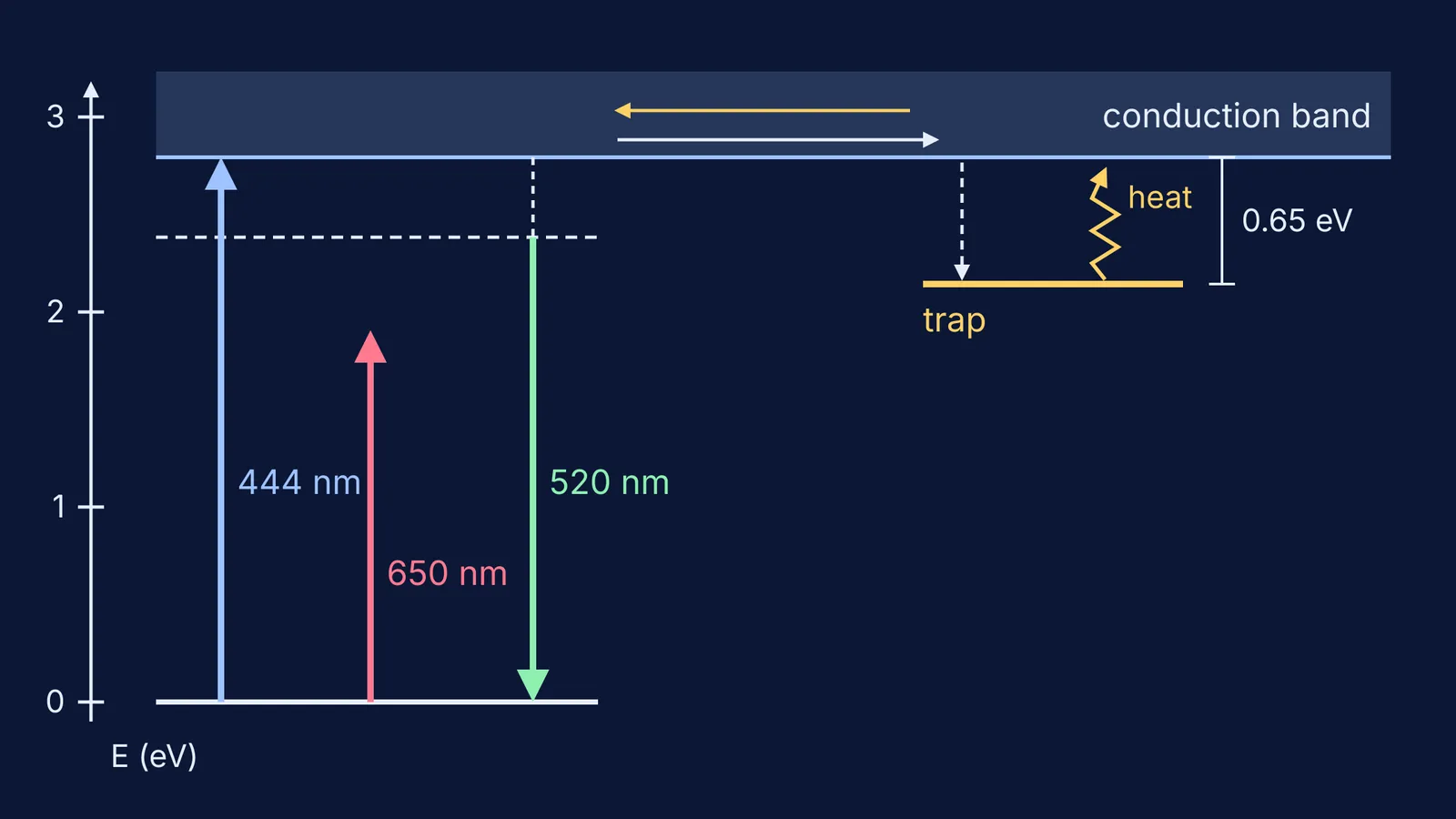
Light pushes electrons up to a higher energy, some of them get stuck there, and heat slowly lets them go. The Materials review puts it like this: "The long afterglow is governed by the slow liberation of trapped charge carriers by thermal excitation." The review notes that details are still debated. In one widely used model, shown in the diagram above, there are four steps:
Charging: a blue or ultraviolet photon lifts an electron in a europium ion (Eu²⁺) to a level that lies very close to the crystal's conduction band.
Trapping: some electrons escape into that band and get caught at defects called traps.
Waiting: a trapped electron cannot drop back down on its own. It needs a small kick of energy to climb out.
Release and glow: at room temperature, the atoms' heat jiggling supplies that kick, one electron at a time. Each freed electron returns to a europium ion and gives out a green photon at about 520 nm.
The depth of the trap sets the timing. The review says a trap depth of around 0.65 eV is considered optimal for afterglow at room temperature. Too shallow, and the traps empty almost at once. Too deep, and room heat can hardly empty them. In a 2022 study in the Journal of Rare Earths, raising the dysprosium content from 0.1 mol% to 0.5 mol% doubled the total afterglow, evidence that dysprosium takes part in trapping.
For the other kind, see how glow sticks make light from a chemical reaction.
Why does blue light charge them better than red light?
Photon energy depends on wavelength: E (eV) = 1.2398 / λ (μm). Here it is for three colours:
Blue at 444 nm: 1.2398 / 0.444 = 2.79 eV.
Green glow at 520 nm: 1.2398 / 0.520 = 2.38 eV.
Red at 650 nm: 1.2398 / 0.650 = 1.91 eV.
A single red photon carries less energy than the green photon the star gives out, so on its own it cannot supply the energy the glow gives back. Blue can. The 2022 study found that, at the same intensity, 444 nm blue light produced a stronger afterglow than 382 nm near-ultraviolet light. For more practice, see photon energy using 1240 over lambda and how emission and absorption spectra work.
Why do the stars fade, and how long can they glow?
Each electron that escapes leaves one fewer in the traps, so the glow is brightest right after lights-out and then fades. The Materials review times the glow until it drops below 0.32 mcd/m², roughly 100 times the sensitivity of the dark-adapted human eye. By that measure, it lists more than 30 hours for europium- and dysprosium-doped strontium aluminate, as a rough order of magnitude. A thin sticker holds far less phosphor than a lab sample, so don't expect yours to last that long.
Try it tonight: a test of the trap model
You need two identical stars, a phone torch, a small plastic bag and a fridge.
Leave both stars in a dark drawer overnight so they start out the same.
Charge both under the torch for 30 seconds.
Seal one in the bag and put it in the fridge. Leave the other somewhere dark at room temperature.
After 10 minutes, compare them in a dark room.
Hold the cold star in your warm palm for a minute and look again.
What the model predicts: with less heat, electrons escape more slowly. So the cold star should look dimmer at first, then brighten as your hand warms it, because more electrons are still waiting in its traps. Note what you actually see.
Energy levels make more sense when you can see them. The Fermi Simulation Lab has interactive simulations for ideas that are easier to see than to read. To revise the theory, the Fermi Concept Library has a lesson for every concept in physics and chemistry.