

On this page
A ship cannot lower a tape measure four kilometres to the seabed. It sends a pulse of sound straight down and waits for the echo: the longer the wait, the deeper the water. Once you can predict that wait, you can also explain how a bat in the dark judges distance.
How does sonar measure the depth of the sea?
Sonar stands for Sound Navigation and Ranging, and NOAA explains that it is useful for mapping the ocean because sound travels farther in water than radar and light waves do. An active sonar transducer sends a pulse of sound into the water, and the time between sending the pulse and hearing it come back gives the range to whatever reflected it.
The sound makes a round trip: down to the seabed and back up. So the depth is only half the distance the sound travelled. A NOAA data centre note on echo-sounding corrections says the travel time is commonly halved and multiplied by an assumed speed of sound in seawater of 1,500 m/s.
Depth from echo time: d = v × t ÷ 2
Echo time from depth: t = 2d ÷ v
On multibeam survey ships, NOAA Ocean Exploration says scientists measure the local speed of sound to turn two-way travel time into depth.
Worked example: what echo time should you predict?
Use v = 1,500 m/s, the standard figure in the NOAA echo-sounding note, and the depths NOAA gives in how deep is the ocean.
A 30 m harbour: t = 2 × 30 ÷ 1,500 = 0.04 s, so the echo returns in 40 milliseconds.
The average ocean depth of 3,682 m: t = 7,364 ÷ 1,500 ≈ 4.9 s.
Challenger Deep, about 10,935 m: t = 21,870 ÷ 1,500 ≈ 14.6 s.
Working backwards, an echo after 2.0 s means d = 1,500 × 2.0 ÷ 2 = 1,500 m.
Echo time grows in proportion to depth: double the depth, double the wait.
Why does the medium change the echo time?
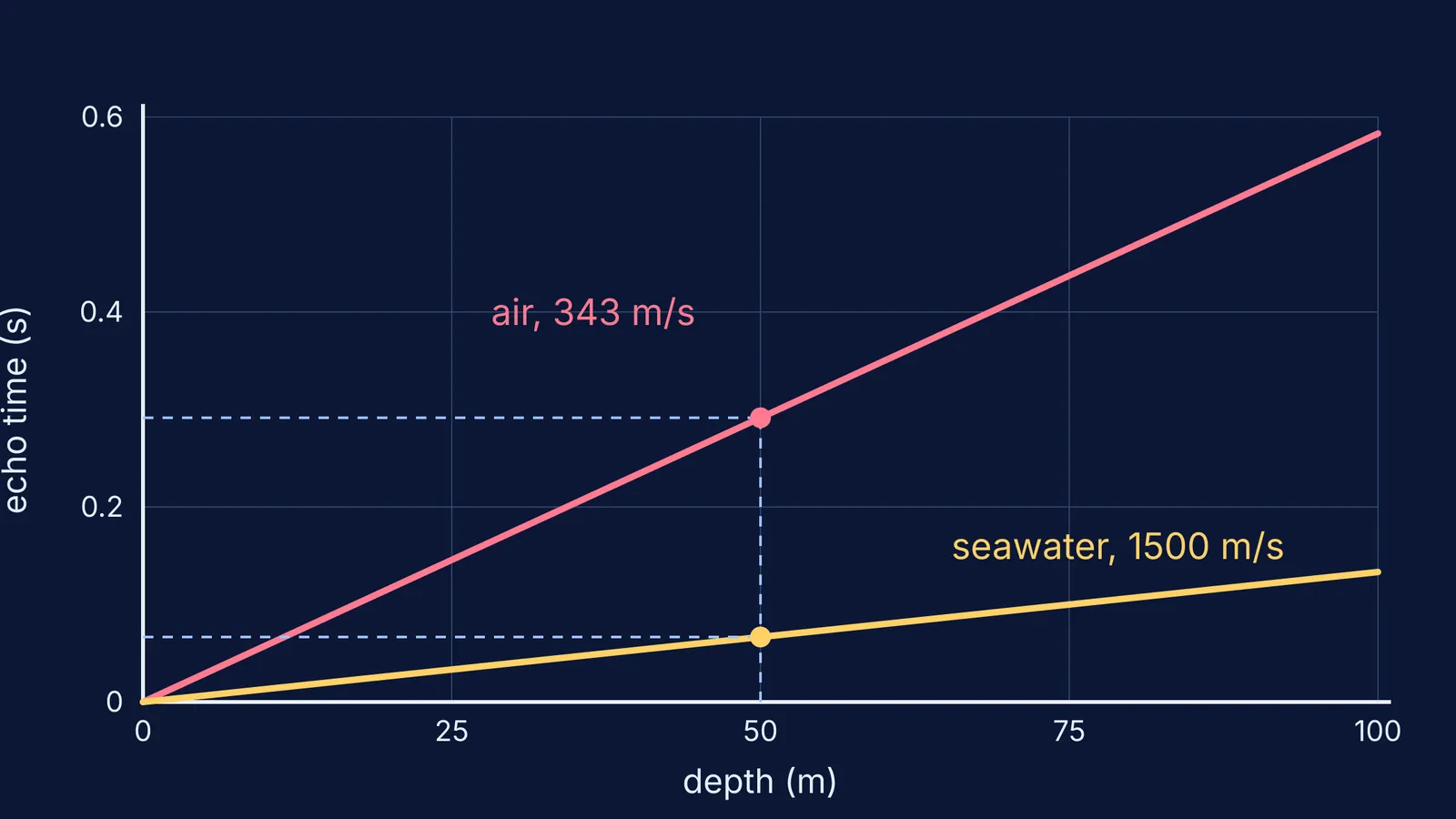
Sound travels at different speeds in different materials. The speed of sound is about 343 m/s in dry air at 20 °C, about 1,481 m/s in fresh water at 20 °C, and about 1,500 m/s in seawater at 10 °C.
So the same 100 m gives very different echoes: t = 200 ÷ 343 ≈ 0.58 s in air, but 200 ÷ 1,500 ≈ 0.13 s in seawater.
Even within the sea the speed varies, and the NOAA correction note says raw depths must be corrected for temperature, salinity and pressure. If the real speed were 1,480 m/s but you assumed 1,500 m/s, a true depth of 3,682 m would read as about 3,732 m, roughly 50 m too deep.
How do bats use the same distance-time idea?
Bats send out calls and listen for echoes, just like a ship. In a review of how bat brains process target distance, Jeffrey Wenstrup and Christine Portfors write that echolocating bats judge target distance from the time delay between their call and the returning echo. Each metre of distance adds an echo delay of 5.8 ms, so a target 5 m away returns its echo after 29 ms. You can check this with the sonar formula: 2 × 1 ÷ 343 ≈ 0.0058 s.
That formula needs a speed of sound, and bats seem to be born with one. Eran Amichai and Yossi Yovel at Tel Aviv University reported in PNAS in 2021 that bats' reference to the speed of sound is innate and not flexible in adulthood. In their experiments, described by ScienceDaily, bats flying in helium-enriched air, where sound travels faster, consistently landed in front of the target: the echo came back early, so they judged it closer.
That is the ship's wrong-speed error, inside an animal. Dolphins do something similar under water, as our piece on how dolphins use echolocation explains.
Five predictions to test in a sonar simulation
Write each prediction down before you send the pulse. Then check.
Double the depth. Prediction: the echo time doubles.
Swap seawater for air at the same depth. Prediction: a much later echo, because sound is slower in air.
Warm the water. Prediction: sound speeds up, the echo returns sooner, and an uncorrected reading shows the seabed too shallow.
Read an echo time and compute the depth. Prediction: d = v × t ÷ 2, not v × t.
Put a fish shoal halfway down. Prediction: a weak early echo at half the seabed time.
The Fermi Simulation Lab has interactive simulations for ideas that are easier to see than to read. If a numerical still goes wrong, the Fermi Problem Library has a step-by-step solver that explains the reasoning rather than printing an answer.
To try the idea with a clap and a wall, read how to measure the speed of sound using an echo. When the reflector moves, the echo changes pitch too: see our Doppler effect simulation guide.


