

On this page
When we talk about seeing with sound, dolphins are masters of the marine world. Water is an exceptionally efficient conductor. Sound travels through water at roughly 1,500 meters per second, which is about 4.5 times faster than its speed in air (SeaWorld). This rapid transmission allows marine mammals to build high-resolution mental maps of their environment without relying on light.
How do dolphins use echolocation?
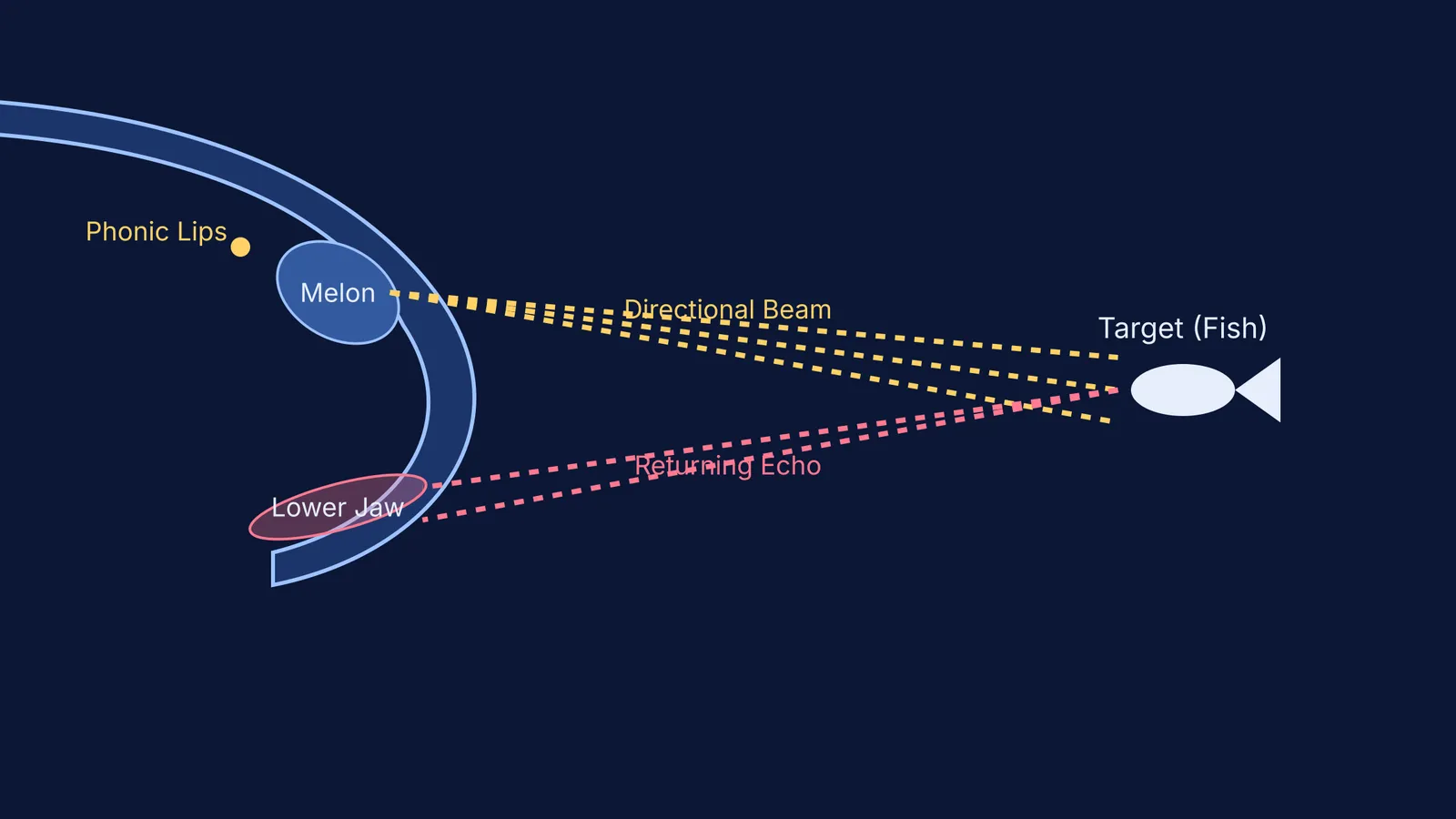
The mechanism of a dolphin's sonar involves three distinct stages: making the sound, focusing it, and receiving the echo.
First, instead of using vocal cords like humans, dolphins move air through specialized structures in their nasal passages called phonic lips (or monkey lips). These produce broad, high-frequency clicks. According to SeaWorld, echolocation clicks typically peak between 40 kHz and 130 kHz. This range sits well above the 20 kHz upper limit of human hearing.
Next, the sound must be directed. This is the job of the melon, the bulbous, fatty structure on a dolphin's forehead. The fats in the melon have a different density than the surrounding tissue, allowing it to act exactly like an acoustic lens. It gathers the scattered sound waves and focuses them into a narrow, directional beam projected forward.
Finally, when these sound waves strike an object—like a fish—they bounce back. The dolphin receives these returning echoes not through its ears, but through its lower jaw. The jawbone is filled with specialized fats that channel the sound directly to the animal's middle and inner ear. If you have studied displacement and pressure waves in sound, you know that sound is a mechanical wave. The dolphin's brain measures the time delay and the intensity of these returning mechanical waves to determine the target's distance, size, speed, and even its internal density.
How is dolphin echolocation different from bats?
Bats also use biological sonar, but the physics of their environment forces them to use different hardware.
While dolphins rely on their nasal passages and the melon, bats produce sounds using their larynx (voice box) and focus them using the shape of their mouths or noses. Bats receive the echoes through large, specialized ears rather than a fat-filled jaw.
The biggest difference, however, comes down to the speed of sound. Sound travels at around 343 meters per second in standard air. Because of this, bats have evolved an entirely different perception of space. A 2021 study published in the *Proceedings of the National Academy of Sciences* (PNAS) found that bats are born with an innate, inflexible mental map for the speed of sound. Researchers placed bats in a helium-enriched environment where sound travelled 15% faster, and the bats consistently misjudged distances. This proved that bats perceive the world primarily in terms of time delay in milliseconds, rather than calculating distance in meters.
Both animals, however, use similar pacing. A hunting bat might start by emitting 5 to 10 pulses per second. It then speeds up to a "terminal buzz" of over 160 pulses per second just before catching an insect (Science). Dolphins do exactly the same thing. They start with slower clicks to scan an area and ramp up to a rapid buzz as they close in on prey.
Active learning: Draw the echolocation path
If you are studying wave reflection, reading about it is rarely enough. To properly understand biological sonar, map out the path of the wave yourself.
You can use this sequence to test yourself on the anatomy and the physics:
Source: Blowhole → Phonic lips (Clicks generated)
Focus: Melon (Acoustic lens focuses the beam)
Transmission: Water (Waves travel at 1,500 m/s)
Reflection: Target (Wave scatters)
Reception: Lower jaw (Fatty tissue conducts returning wave)
Processing: Inner ear → Brain (Time delay gives distance)
Whether you are working out the speed of sound in gases or mapping a dolphin's jaw, sketching the physical system makes the abstract numbers concrete. If you get stuck on the mechanics of waves or how density changes transmission speed, the Fermi Concept Library maps out every concept in physics and biology. And if you need help visualising it, Fermi's AI tutor teaches through the problem alongside you—drawing the figure on a board and checking your understanding as it goes.


