On this page
Bleach and toilet cleaner often sit side by side in the bathroom cupboard, and it is tempting to pour both in for a cleaner loo. Do not. The two react and release chlorine gas. You already know the chemistry from Class 10 acids and bases, and the fix is simple: one product at a time.
What happens if you mix bleach and toilet cleaner?
You make chlorine gas in your bathroom. The New Jersey Department of Health's hazard alert on mixing cleaners states it plainly: when chlorine bleach is mixed with an acid, chlorine gas is produced. Low levels for short periods irritate the eyes, nose and throat and cause coughing; higher levels can cause chest pain, severe breathing trouble, vomiting and lung damage, and very high levels can be fatal.
Many toilet cleaners are acids. MedlinePlus lists toilet bowl and other porcelain cleaners among the products that contain hydrochloric acid, and some contain sulfuric acid instead. The same NJ alert names toilet bowl cleaners on its list of products never to mix with bleach, alongside vinegar, lemon juice, drain cleaners and ammonia.
The US Centers for Disease Control and Prevention says chlorine smells like bleach and is heavier than air, so it sinks to lower areas. That matters in a small bathroom with the door shut.
How does an acid turn bleach into chlorine gas?
Household liquid bleach is a solution of sodium hypochlorite, NaOCl. Bleaching powder, calcium oxychloride, works through the same hypochlorite ion. Our post on how bleaching powder is made and how it reacts covers the Class 10 equations.
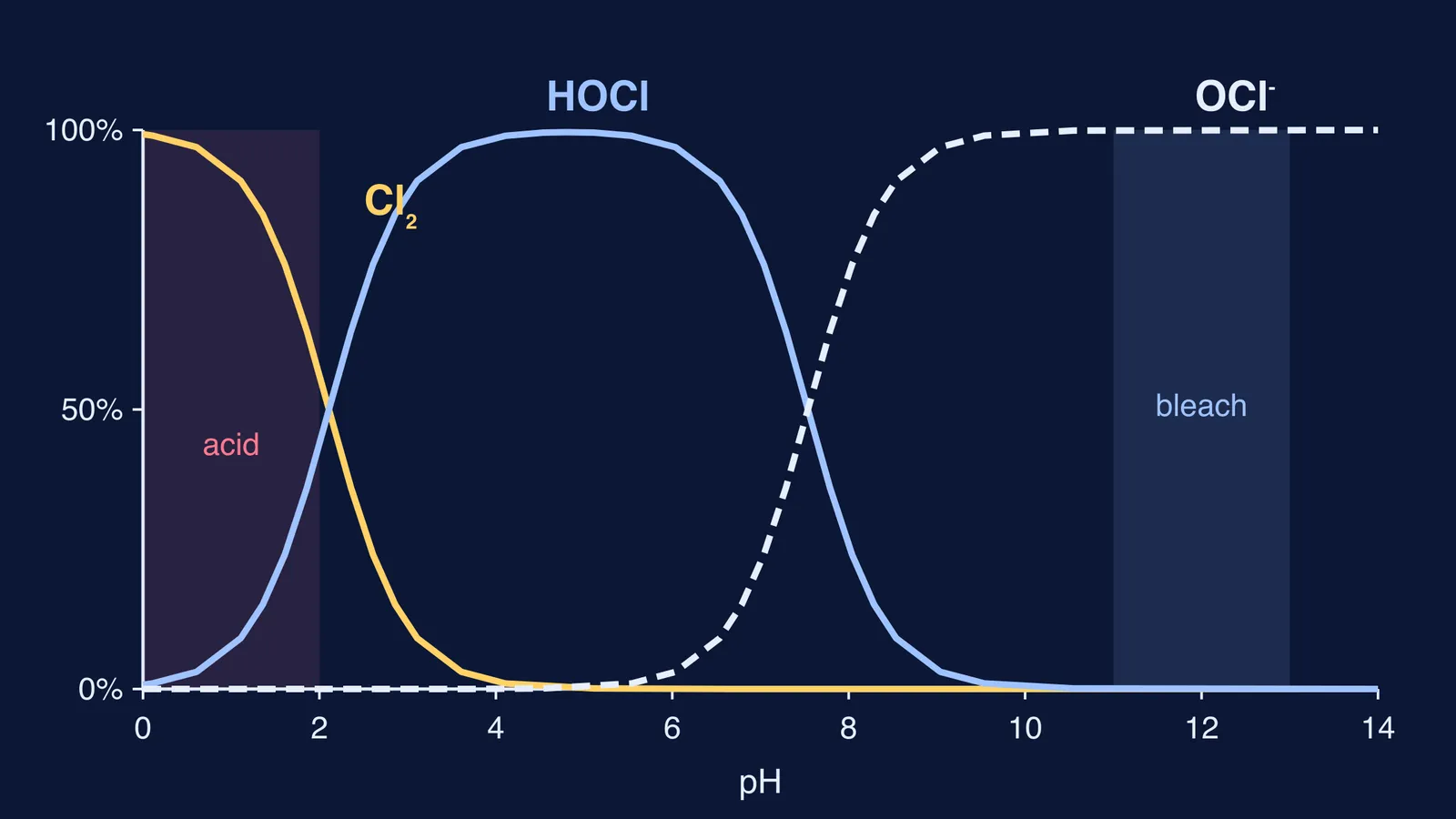
Sodium hypochlorite bleach typically has a pH of 11 to 13, according to the ATSDR toxicological profile for chlorine. At that pH almost all of it sits as the hypochlorite ion, OCl⁻, which stays dissolved.
Now add an acid such as hydrochloric acid. Think of it in two steps:
H⁺ + OCl⁻ → HOCl. The acid's hydrogen ions turn hypochlorite into hypochlorous acid, a weak acid. This is the ordinary acid-base reaction from your Class 10 acids, bases and salts chapter.
HOCl + H⁺ + Cl⁻ → Cl₂ + H₂O. With even more acid and chloride ions around, hypochlorous acid and chloride combine into chlorine molecules, which escape as gas.
Add them up with hydrochloric acid and you get the equation worth memorising: NaOCl + 2HCl → NaCl + H₂O + Cl₂.
ATSDR treats these as equilibria that shift with pH: adding acid to bleach can drive the pH low enough to release dangerous amounts of chlorine gas. The diagram at the top, computed from ATSDR's equilibrium constants with an assumed chloride level, reads right to left: almost all OCl⁻ at bleach's pH, mostly HOCl from about pH 2 to 7.5, and mostly Cl₂ below about pH 2.
If the jump from OCl⁻ to HOCl to Cl₂ feels abstract, a pH curve is easier to see than to read; the Fermi Simulation Lab has interactive simulations for ideas like this, and the Fermi Concept Library has a lesson for each chemistry concept, from pH to redox.
How little chlorine can you smell?
Very little. ATSDR's profile gives an odour threshold of 0.2 to 0.4 ppm in air, with sensory irritation at 1.0 ppm, and a density 2.482 times that of air. The CDC says chlorine smells like bleach, so a sharp, choking smell that gets stronger after products meet is a warning, not a sign the cleaner is working.
A safe storage and cleaning checklist for your home
Use one product per job. If you want to disinfect after descaling, flush the toilet, rinse the surface with water and wait before using bleach.
Never pour bleach into a toilet that still has a toilet cleaner, drain opener, vinegar or lemon in it.
Keep every cleaner in its original, labelled bottle. Never refill a cold-drink or water bottle with a cleaner.
Store bleach and acidic cleaners on separate shelves, caps closed, out of children's reach.
Open a window or run the exhaust fan while cleaning, and keep the door open.
Wear rubber gloves, and never stand with your face over the bowl while pouring.
Read the label for words like hydrochloric acid, sulfuric acid or hypochlorite before you start.
To see how bleach works when used correctly, read our explainer on how bleach removes stains.
What should you do if someone breathes the fumes?
The CDC chlorine fact sheet gives three steps: get away from the area into fresh air, get clean by removing contaminated clothing and washing, and get medical help immediately.
In India, the AIIMS National Poisons Information Centre lists its toll-free number, 1800 116 117, and says you can call 24 hours a day, 7 days a week. If anyone has trouble breathing, a hard cough or chest pain, follow the CDC's third step and get medical help straight away.
The rule to take away: one cleaner at a time, rinse in between, and keep the air moving.