

On this page
When a bright turmeric or tomato stain lands on a white shirt, rinsing with tap water rarely solves the problem. Most people assume bleach acts like an aggressive soap that scrubs pigment out. In reality, bleach does not dissolve stains. While detergents encapsulate grime in micelles—as explained in our guide on how soaps and detergents clean through micelles—bleach destroys colour chemically right where the pigment sits.
Why do stains have colour in the first place?
To understand how bleach erases stains, consider what creates colour at the molecular level. Sunlight and lamps emit photons across the visible spectrum (400 to 700 nanometres). In most organic molecules, electrons sit in single covalent sigma bonds with a wide Highest Occupied Molecular Orbital (HOMO) to Lowest Unoccupied Molecular Orbital (LUMO) gap of 4 to 5 electron-volts. Visible photons carry only 1.7 to 3.1 electron-volts and cannot excite these electrons. As noted in IUPAC's photochemistry definitions, unabsorbed light reflects or transmits, leaving materials white or clear.
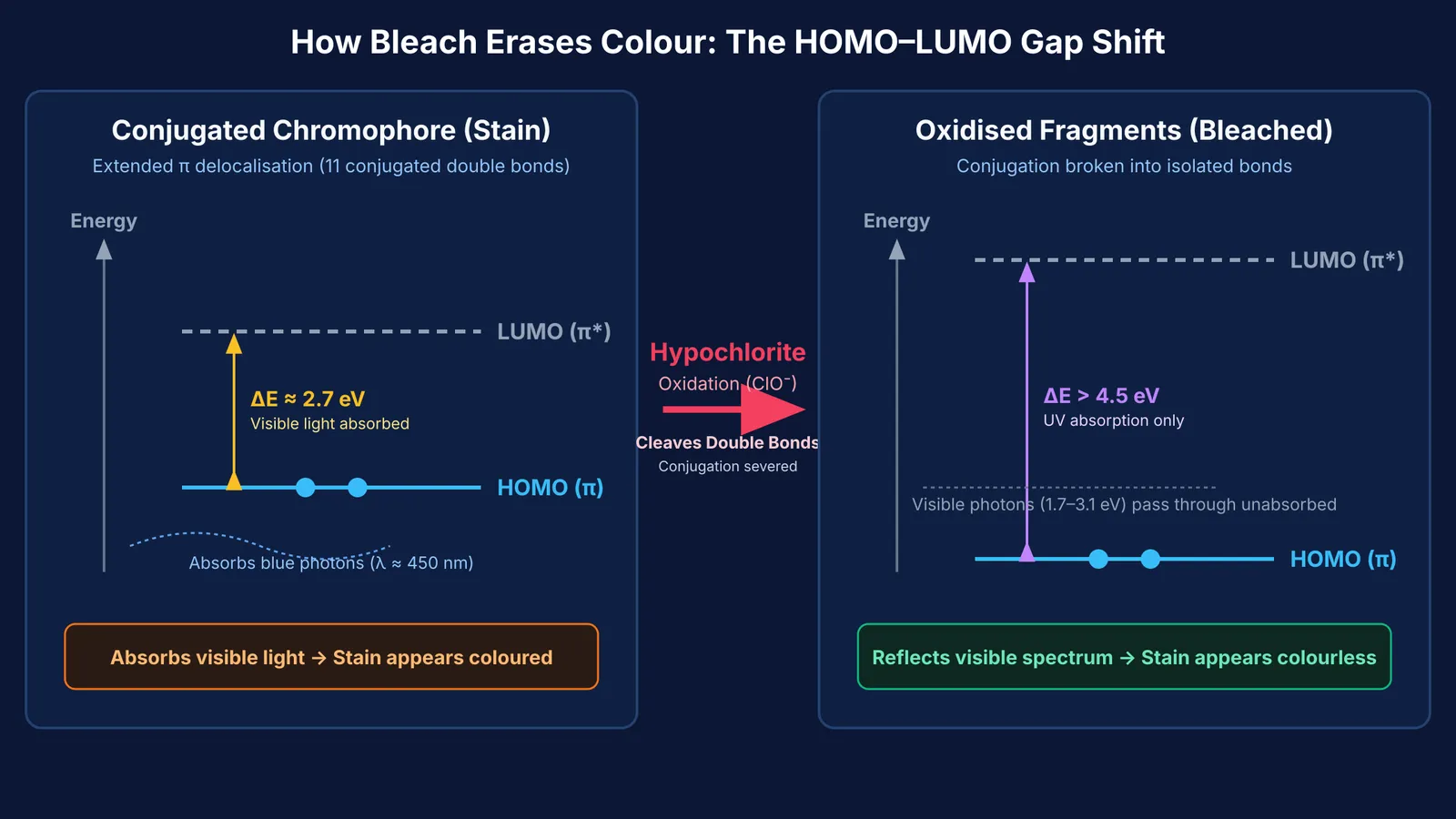
Food, wine, and plant stains differ because they contain conjugated systems of alternating single and double bonds. Overlapping p-orbitals allow π electrons to delocalise, narrowing the HOMO-LUMO gap into the visible range.
For example, beta-carotene, the orange pigment in carrots and sweet potatoes, has 11 conjugated double bonds. This delocalisation shrinks its energy gap to roughly 2.7 electron-volts, absorbing blue light near 450 nanometres while reflecting orange-red. For concepts that are difficult to picture, the Fermi Simulation Lab provides interactive simulations for the ideas that are easier to see than to read.
How does hypochlorite chemically break down stains?
Standard liquid bleach contains roughly 5% to 6% sodium hypochlorite (NaOCl) at pH 11 to 13. Commercial bleaching powder is calcium oxychloride (CaOCl2), prepared by passing chlorine gas over dry slaked lime, Ca(OH)2.
In water, hypochlorite forms hypochlorite ions (ClO⁻) and hypochlorous acid (HOCl). Standard electrode potential data in the Journal of Physical and Chemical Reference Data list reduction potentials of +1.482 V for HOCl in acid and +0.890 V for ClO⁻ in base. When hypochlorite meets a stain, it attacks electron-rich π bonds:
Electrophilic addition: Hypochlorous acid adds across double bonds to form chlorohydrins, converting planar sp² carbons into tetrahedral sp³ carbons.
Oxidative cleavage: Severe oxidation cleaves double bonds into short carboxylic acids, aldehydes, and ketones.
Breaking even one or two double bonds disrupts the π electron highway, widening the HOMO-LUMO gap from ~2.7 eV back above 4.5 eV. The molecule now absorbs only ultraviolet rays below 300 nanometres, rendering it colourless. Spectroscopic work in the Journal of Chemical Education shows this decolourisation follows pseudo-first-order kinetics with respect to the dye, while polar oxygen groups let fragments rinse away in water.
Why does soap turn turmeric red while bleach erases it?
Scrubbing a yellow turmeric stain with laundry soap turns it reddish-brown because turmeric's primary pigment is curcumin, a polyphenol linked by a conjugated heptadiene chain.
Laundry soap is mildly alkaline (pH 9 to 10). The basic solution deprotonates curcumin's phenolic groups into phenolate ions, extending delocalisation. This shifts peak absorption from ~425 nanometres (blue) to ~490 nanometres (green-blue), reflecting red. Soap only changes local pH without breaking bonds.
Bleach causes an irreversible redox reaction. Hypochlorite oxidises phenolic rings and cleaves the conjugated chain into colourless fragments within seconds. To see how oxidation affects materials, explore our review of everyday oxidation in corrosion and rancidity. Chlorine textile bleaching began over two centuries ago; read about Claude Louis Berthollet's discovery of chlorine bleaching.
What is the difference between chlorine bleach and oxygen bleach?
Modern laundry products use two main bleaching mechanisms:
Chlorine bleach uses sodium hypochlorite (NaOCl) or calcium oxychloride (CaOCl2). Its high oxidation potential attacks chromophores indiscriminately, stripping colours from dyed garments alongside stains.
Oxygen bleach uses sodium percarbonate (2Na2CO3·3H2O2) or hydrogen peroxide (H2O2). In water, percarbonate generates milder perhydroxyl anions (HO2⁻) that remove food stains without bleaching coloured fabrics.
Fabric structure determines bleach compatibility. Cotton and linen consist of cellulose, a glucose polymer linked by β-1,4-glycosidic bonds that withstands moderate hypochlorite exposure. Animal fibres like wool and silk are protein polymers joined by peptide bonds and disulphide links. Hypochlorite rapidly chlorinates peptide bonds and oxidises disulphides into cysteic acid, weakening the protein and creating fabric holes.
If you want structured practice on oxidation numbers and balancing redox equations, the Fermi Problem Library offers worked problems with a step-by-step solver that explains the reasoning rather than printing an answer.
Which fabrics and stains should you never bleach?
To treat stained garments safely, follow this 4-step decision process:
Check fibre origin: Never use chlorine bleach on wool, silk, or spandex. Reserve hypochlorite for white cotton, linen, and bleach-safe synthetics.
Identify stain chemistry: Grease consists of saturated hydrocarbons without chromophores. Bleach cannot remove grease; treat oily stains with surfactants first. Use bleach on pigmented organic stains like curry, tea, wine, and fruit.
Keep water cool: Hypochlorite works best in cool water. Hot water causes it to disproportionate into chlorate and chloride, wasting oxidising power.
Never mix cleaners: Safety guidelines from the Centers for Disease Control and Prevention warn that mixing bleach with acids or vinegar releases toxic chlorine gas, which reacts with airway moisture to form hydrochloric acid and cause acute irritation.


