

On this page
Bleaching powder is a pale yellowish solid with a strong smell of chlorine. In Class 10 chemistry, it is introduced as one of the most useful salts derived from the chlor-alkali process, alongside topics such as how soaps clean in Class 10 carbon and the everyday oxidation seen in corrosion and rancidity.
How is bleaching powder prepared?
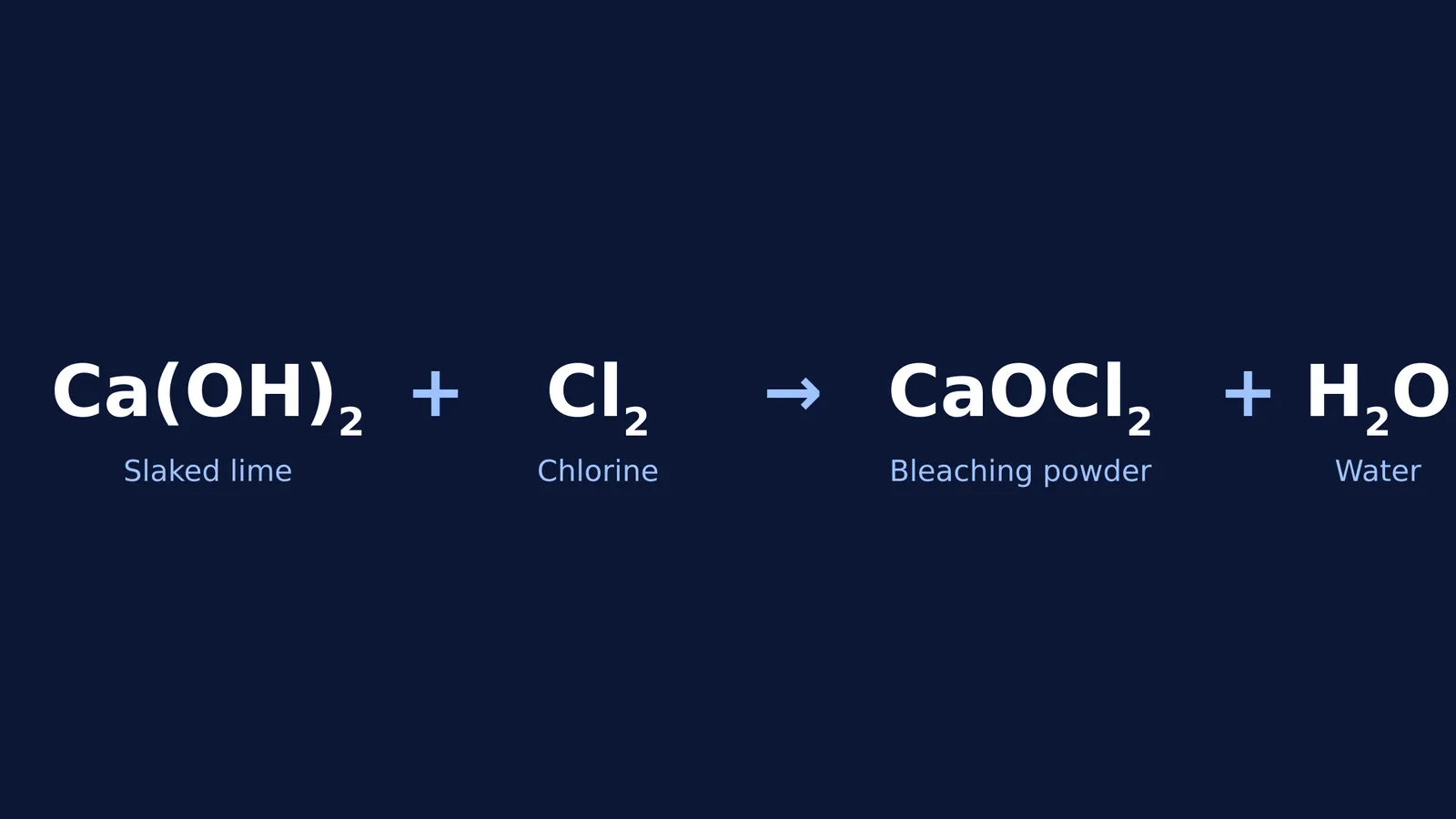
Bleaching powder is synthesised by the action of chlorine gas on dry slaked lime (BYJU'S). The primary active ingredient in the resulting product is calcium hypochlorite, though it is commonly referred to by its generic name.
The chemical equation for this preparation is: Ca(OH)₂ + Cl₂ → CaOCl₂ + H₂O
The chlorine gas (Cl₂) used in this reaction is typically a by-product of the electrolysis of aqueous sodium chloride (brine), a method known as the chlor-alkali process. When this gas is passed over dry slaked lime (Ca(OH)₂), the resulting product is calcium oxychloride (CaOCl₂), commonly known as bleaching powder.
While the formula is often written simply as CaOCl₂ for educational purposes, the actual industrial product is a more complex mixture of calcium hypochlorite, calcium chloride, and unreacted lime. It has a strongly basic character, similar to household bleach solutions which typically have a pH of about 11.
Why use dry slaked lime instead of a solution?
The physical state of the slaked lime used in the synthesis is critical. If chlorine gas is bubbled through a solution of slaked lime (also known as limewater), it forms a dissolved mixture of calcium chloride and calcium hypochlorite. To produce a free-flowing solid powder that can be easily packaged, transported, and stored for months, the chlorine must be passed over solid, *dry* slaked lime.
The water produced in the reaction slightly moistens the final powder, but it fundamentally remains a solid basic salt. This solid form makes it a stable and highly convenient way to handle what is otherwise a volatile and hazardous gas.
The Fermi Concept Library contains every concept in physics, chemistry, biology, mathematics and computing, each with its own lesson and its place in the map.
How does bleaching powder act as a disinfectant?
Bleaching powder is highly soluble in water, though it rarely forms a completely clear solution because of the small amounts of unreacted lime impurities left over from its preparation.
Its true power lies in its basic nature and its role as a strong oxidizing agent. When it reacts with dilute acids, such as hydrochloric acid, bleaching powder decomposes to yield calcium chloride, chlorine, and water. This released chlorine is what does the actual work of bleaching fabrics in the textile industry and killing germs in water supplies.
For emergency water treatment, the Centers for Disease Control and Prevention (CDC) advises that after adding chlorine or bleach and stirring well, you must let the water stand for at least 30 minutes before drinking it (CDC). This 30-minute contact time ensures the chemical disinfectant has effectively destroyed harmful viruses and bacteria.
If the water is cloudy, the CDC recommends filtering it through a clean cloth, paper towel, or coffee filter, or letting it settle and drawing off the clear water before disinfection. For water that remains murky, colored, or is very cold, the chemical dose must be doubled—for example, using 16 drops per gallon instead of 8 drops—though the 30-minute wait time remains exactly the same.
Everyday uses of CaOCl₂
Because it is a stable way to store and transport chlorine, bleaching powder is widely used across several industries worldwide to maintain hygiene and process raw materials:
Textiles and laundry: It acts as a primary bleaching agent for cotton and linen in the textile industry, and is used for whitening dirty clothes in commercial laundries.
Paper industry: It is used extensively for bleaching wood pulp before it is rolled into white paper products.
Chemical manufacturing: It acts as an oxidizing agent in various industrial reactions and plays a role in the manufacture of chemicals like chloroform.
Public health: It serves as an essential disinfectant in municipal water treatment plants to make drinking water potable and safe for communities.
Working out how salts behave and why they decompose can be difficult when you are learning chemistry from a textbook. If you find yourself forgetting the difference between slaked lime and quicklime, Fermi's AI tutor can work out what you already know and build a plan for the session, writing on a board and checking your understanding as it goes.


