

On this page
Is chlorine really what turns your eyes red?
Most swimmers assume burning, bloodshot eyes after swimming mean the pool has too much chlorine. In reality, clean water disinfected with pure chlorine rarely produces that stinging red reaction on its own.
According to clinical guidance from the American Academy of Ophthalmology, post-swim redness is chemical conjunctivitis triggered by chloramines—irritating compounds formed when chlorine binds to organic nitrogenous waste. Standard pool disinfection maintains free chlorine between 1.0 and 3.0 milligrams per litre under World Health Organization guidelines, which alone causes minimal ocular distress.
Those same World Health Organization guidelines recommend keeping combined chlorine (chloramines) as low as possible, ideally below 0.2 milligrams per litre, and never above half the free chlorine level. Above this threshold, swimmers experience sharp stinging and inflamed eyelids. The pungent chemical odour often mistaken for a clean pool is actually volatile chloramine gas. This distinction between mineral chlorine and organic contamination reflects the foundations of sanitary water analysis, pioneered when Ellen Swallow Richards mapped chlorine and nitrogen levels in water supplies to identify pollution.
How do sweat and urine create chloramines?
When pool operators add chlorine gas or hypochlorite salts to water, it hydrolyses to form hypochlorous acid (HOCl) and hypochlorite ions (OCl⁻):
Cl₂ + H₂O ⇌ HOCl + H⁺ + Cl⁻
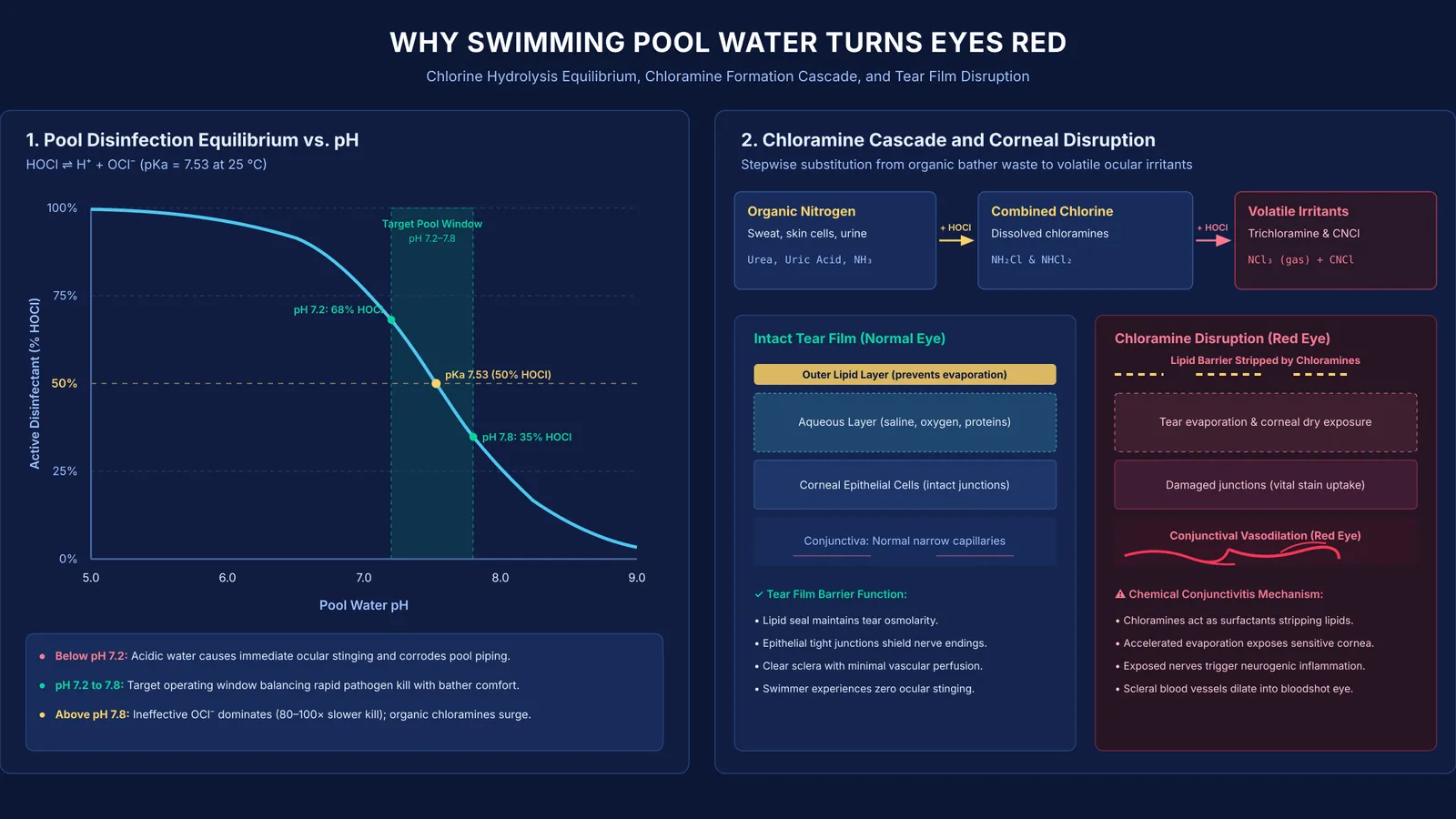
Hypochlorous acid has an acid dissociation constant (pKa) of 7.53 at 25 °C. As detailed in our guide to conjugate acid-base pairs and equilibrium dissociation constants, the ratio of HOCl to OCl⁻ depends strictly on pH. At pH 7.53, exactly 50% exists as active HOCl, while 50% exists as OCl⁻, which the World Health Organization notes is roughly 80 to 100 times less effective at disinfection. Understanding how temperature and autoionisation shift neutral pH is equally vital for pool maintenance.
For chemical equilibria that are hard to visualize, the Fermi Simulation Lab provides interactive simulations for the ideas that are easier to see than to read, letting students observe how shifting pH redistributes acid and conjugate base concentrations.
Swimmers introduce nitrogen through sweat, skin cells, and urine, primarily as urea, uric acid, and ammonia (NH₃). Hypochlorous acid attacks ammonia in a rapid substitution cascade:
HOCl + NH₃ ⇌ NH₂Cl (monochloramine) + H₂O
NH₂Cl + HOCl ⇌ NHCl₂ (dichloramine) + H₂O
NHCl₂ + HOCl ⇌ NCl₃ (trichloramine) + H₂O
A 2014 study led by Lushi Lian and Ernest R. Blatchley III in *Environmental Science & Technology* demonstrated that uric acid from urine is an exceptionally reactive precursor, yielding up to 44% cyanogen chloride at pH 6.0 and up to 108% trichloramine at pH 7.0. Trichloramine off-gasses rapidly into the air above the water, attacking swimmers' eyes and airways.
What happens to your cornea and tear film?
The human cornea is shielded by a delicate three-layer tear film: an outer lipid barrier that prevents evaporation, a central aqueous layer supplying oxygen and electrolytes, and an inner mucin layer anchoring fluid to epithelial cells.
According to the American Academy of Ophthalmology, exposure to pool water strips away this outer oily layer, causing rapid tear evaporation and ocular surface dryness. Chloramines act as surfactants and oxidisers, destabilising the lipid barrier and exposing corneal epithelial cells directly to water and chemical irritants.
In a clinical study published in *Cornea*, Misaki Ishioka and colleagues evaluated 20 eyes across 10 volunteers exposed to 0.5 milligrams per litre of chlorinated water. They measured significant increases in fluorescein uptake and Rose Bengal staining, showing that chlorinated water damages corneal epithelial cells and disrupts barrier integrity.
When the epithelial barrier is compromised, corneal sensory nerves trigger a local inflammatory reflex. Conjunctival blood vessels across the sclera dilate to deliver protective immune factors, producing the classic swollen, bloodshot appearance of swimmer's eye.
How can swimmers and pool operators prevent red eyes?
Pool operators monitor water using a simple arithmetic balance:
Combined Chlorine = Total Chlorine − Free Chlorine
If testing shows Total Chlorine at 2.2 milligrams per litre and Free Chlorine at 1.4 milligrams per litre, Combined Chlorine is 0.8 milligrams per litre. Because 0.8 milligrams per litre exceeds the World Health Organization recommended ceiling of 0.2 milligrams per litre, eye irritation becomes widespread. Operators eliminate accumulated chloramines through breakpoint chlorination, adding sufficient free chlorine to oxidise them into harmless nitrogen gas.
For students working through chemical stoichiometry and buffer problems, the Fermi Problem Library has worked problems with a step-by-step solver that explains the reasoning rather than printing an answer.
Swimmers and facilities can minimize chloramine formation and ocular irritation by adopting preventive hygiene practices:
Showering before entering the pool: Pre-swim rinsing removes sweat, skin oils, and personal care products before they can react with chlorine.
Never urinating in pool water: Avoiding urination cuts off the primary supply of uric acid, preventing the formation of volatile trichloramine and cyanogen chloride.
Wearing watertight swim goggles: Creating a physical barrier protects the delicate tear film and keeps chlorinated water off corneal cells.
Avoiding swimming with contact lenses: Lenses trap chemical irritants and microbes against the cornea, magnifying tissue irritation.
Rinsing the face with clean tap water after swimming: Washing closed eyelids with fresh water removes residual pool droplets from the skin and eyelashes.


