

On this page
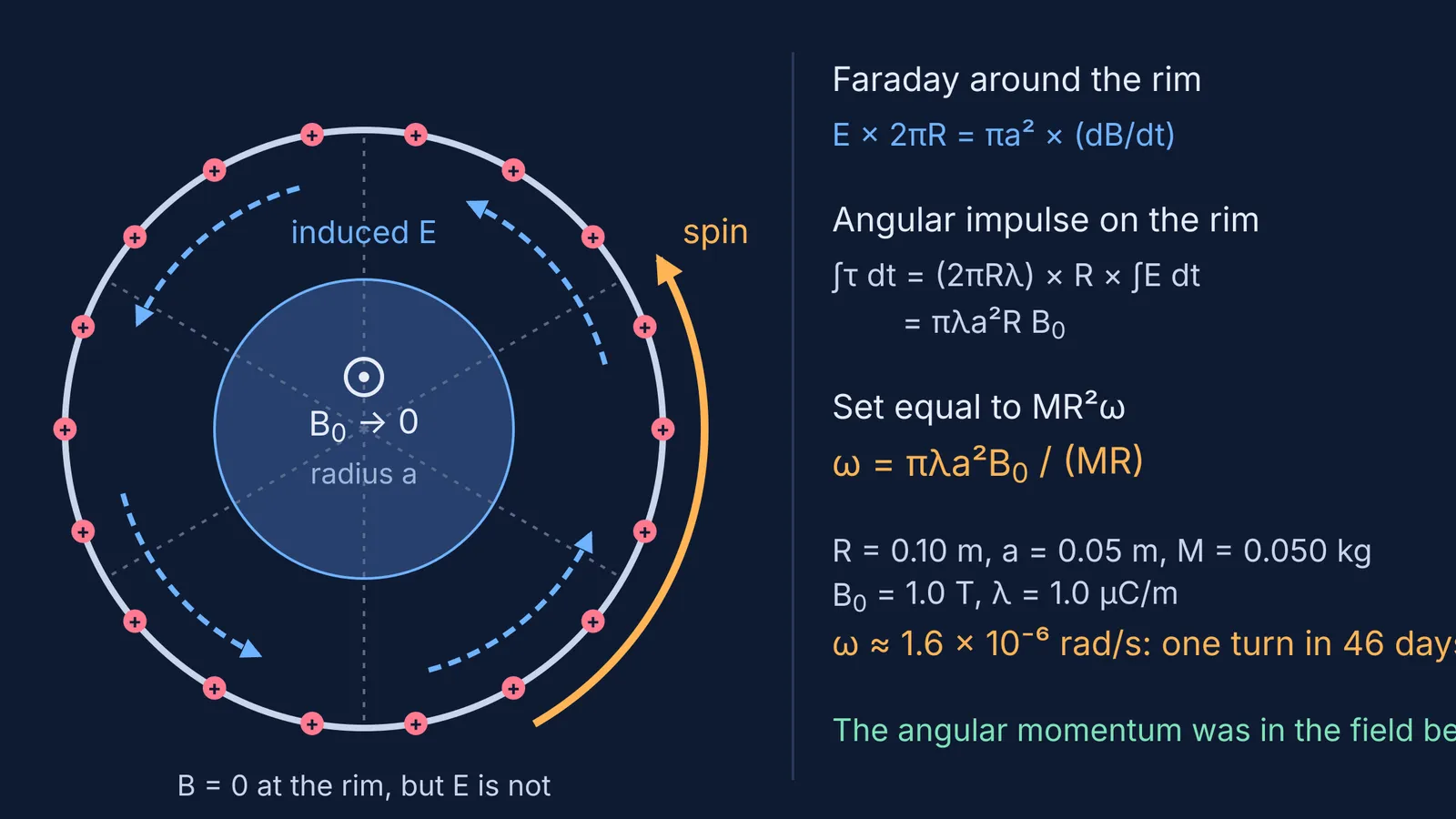
Here is a wheel that starts turning although nothing touches it. Its rim carries a fixed electric charge, and a magnetic field fills only a small circle at its centre, well inside the rim. When the field is switched off, the wheel starts to spin. This is an NCERT Class 12 Electromagnetic Induction exercise, and it is a simple version of a puzzle Richard Feynman posed in his lectures. The calculation takes five lines. The ideas inside it, an electric field where there is no magnetic field, and angular momentum that seems to come from nowhere, are what make it worth learning.
What is the setup of the charged wheel problem?
A wheel of mass M and radius R, with light, non-conducting spokes, so nearly all its mass is in the rim.
A uniform line charge λ fixed on the rim. The total charge is Q = 2πRλ.
A uniform magnetic field B₀, perpendicular to the wheel, that fills only a central circle of radius a < R. Outside that circle, including at the rim, B = 0.
The wheel is free to turn about its axle and starts at rest. The field is then switched off.
Question: what angular velocity does the wheel end up with?
Why is there an electric field at the rim if B is zero there?
Faraday's law links the EMF around a closed loop to the rate of change of magnetic flux through that loop:
∮E · dl = −dΦ/dt
Take the loop to be the rim itself. The flux through it is Φ = πa²B, because only the central circle carries any field. As B falls, the flux falls, and an EMF appears around the rim even though B is zero at every point on it. Only the flux inside the loop matters, not the field on the loop.
By symmetry the induced E has the same size all round the rim and points along it, so
E × 2πR = πa² × |dB/dt|, which gives E = a²|dB/dt| / (2R).
This circulating field and its 1/r fall-off outside a solenoid are explained in the circulating E inside and around a solenoid. The fact that this field exists whether or not a conductor is present is covered in EMF in an open circuit without current. The new step here is what the field does to charges that are fixed to something that can turn.
How do you derive the angular velocity of the wheel?
Work with angular impulse, so you never need to know how fast the field was switched off.
Force on the rim. A small piece of rim of length dl carries charge λ dl. The field pushes it along the rim with force λE dl.
Torque. Each piece sits at distance R from the axle and the force is tangential, so its torque is Rλ E dl. Add over the whole rim: τ = R × λE × 2πR = 2πR²λE.
Put in E. τ = 2πR²λ × a²|dB/dt| / (2R) = πλa²R |dB/dt|.
Angular impulse. Integrate over the switch-off: ∫τ dt = πλa²R × ∫|dB/dt| dt = πλa²R B₀. Only the total change in B appears.
Final angular momentum. The wheel started at rest, so MR²ω = πλa²R B₀, which gives
ω = πλa²B₀ / (MR)
In terms of the total charge Q = 2πRλ, the same answer reads ω = QB₀a² / (2MR²).
Unit check: λ in C/m, a² in m², B in T = kg/(C s), M in kg and R in m. C/m × m² × kg/(C s) ÷ (kg m) = 1/s. That is an angular velocity.
Limiting check: if the field filled the whole wheel (a = R), ω = QB₀/(2M). The result depends only on charge, field and mass, which is reassuring.
Worked example: how fast does a real wheel turn?
Take R = 0.10 m, M = 0.050 kg, a = 0.05 m, B₀ = 1.0 T and λ = 1.0 µC/m.
Total charge: Q = 2π × 0.10 × 1.0 × 10⁻⁶ = 6.3 × 10⁻⁷ C (0.63 µC).
ω = π × (1.0 × 10⁻⁶) × (0.05)² × 1.0 / (0.050 × 0.10) = 1.57 × 10⁻⁶ rad/s.
Angular momentum gained: MR²ω = 0.050 × 0.01 × 1.57 × 10⁻⁶ = 7.9 × 10⁻¹⁰ kg m²/s.
Time for one turn: 2π/ω = 4.0 × 10⁶ s, about 46 days.
The effect is real but tiny. The rim moves at about 1.6 × 10⁻⁷ m/s. Any friction in the axle would hide it completely, which is why this is a thought experiment and not a lab demonstration.
For more induction problems with a step-by-step solver that explains the reasoning, try the Fermi Problem Library.
Which way does the wheel turn?
Use Lenz's law. Suppose B₀ points out of the page, towards you, and is falling. The induced EMF tries to keep the flux out of the page, so it drives positive charge anticlockwise as you look at the page. With λ positive, the wheel turns anticlockwise. Its angular momentum then points out of the page, along the field that was switched off. If λ is negative, the wheel turns the other way. Switching the field on instead of off also reverses the spin.
Where did the angular momentum come from?
Before the switch-off nothing moved, yet afterwards the wheel has angular momentum. It was not created. With both the electric field of the charged rim and the magnetic field present, the electromagnetic field itself carries angular momentum. As B falls to zero, that field angular momentum is handed to the wheel, and the total stays the same. This is the resolution of the puzzle in The Feynman Lectures on Physics, Volume II, where Feynman uses a charged disc and a current-carrying coil. The mechanical version of the same conservation law is in conservation of angular momentum for spinning skaters and discs.
A few details that do not change the answer:
Speed of switch-off. A fast switch-off gives a big torque for a short time, a slow one a small torque for a long time. The angular impulse is the same.
Number of spokes. They are light and non-conducting, so they add no mass to speak of and carry no current.
The wheel's own field. Once it spins, the charged rim is a tiny current, λωR ≈ 1.6 × 10⁻¹³ A here, far too small to matter.
Quick checklist
Faraday's law around the rim: E × 2πR = πa²(dB/dt), even though B = 0 at the rim.
Torque = 2πR²λE; angular impulse = πλa²R B₀.
ω = πλa²B₀/(MR) = QB₀a²/(2MR²), independent of how fast B is switched off.
Moment of inertia is MR² because the mass is on the rim.
Direction by Lenz's law: for positive charge and a falling B out of the page, anticlockwise.
Angular momentum moves from the field to the wheel; it is conserved, not created.


