On this page
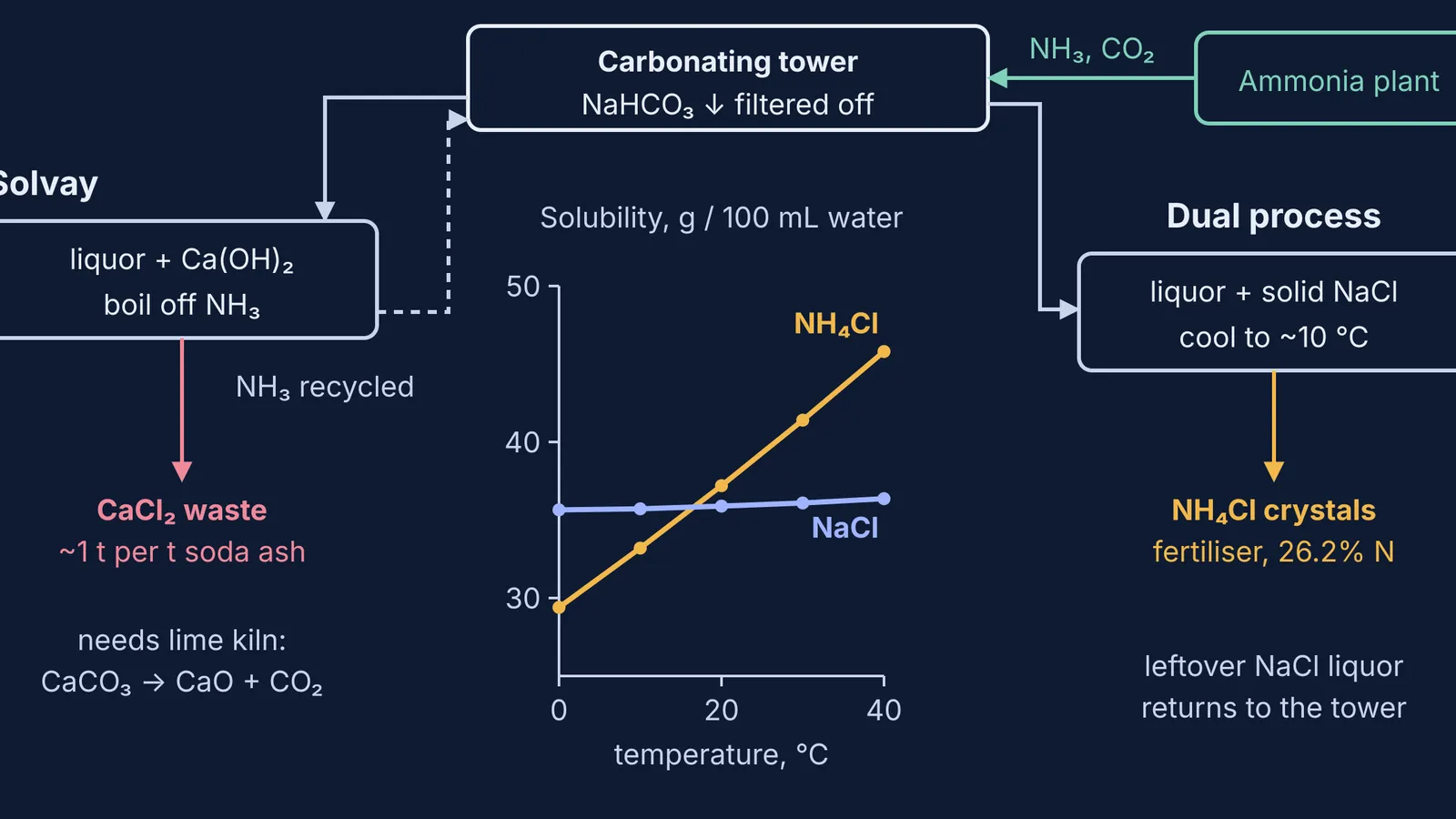
The Solvay process in NCERT ends with a step that throws something away. Ammonia is recovered by boiling the ammonium chloride liquor with slaked lime, and the calcium ends up as calcium chloride solution, about a tonne of it for every tonne of soda ash. A variant worked out in China by the chemist Hou Debang keeps the ammonium chloride instead and sells it as a nitrogen fertiliser. It uses two ideas from your syllabus: the common-ion effect and a solubility curve. This post explains how the "dual process" works, works through its mass balance, and checks how much NH₄Cl cooling alone can crystallise.
How is the dual process different from the Solvay process?
Both start the same way. Brine is saturated with ammonia, carbon dioxide is passed in, and sodium hydrogencarbonate crystallises because it is the least soluble salt in the mixture. The steps, and why NaHCO₃ is the salt that comes out, are in the Solvay process steps and the NaHCO₃ solubility ranking.
The difference is what happens to the mother liquor after NaHCO₃ is filtered off. It is rich in NH₄Cl.
Solvay: add Ca(OH)₂, boil off NH₃ and send it back to the tower. 2NH₄Cl + Ca(OH)₂ → 2NH₃ + CaCl₂ + 2H₂O. The CaCl₂ is the main by-product. The lime comes from heating limestone, which also supplies the CO₂.
Dual process: do not recover the ammonia. Crystallise the NH₄Cl itself, sell it, and send the remaining liquor back to make more NaHCO₃. Fresh NH₃ and CO₂ come from a neighbouring ammonia plant, so there is no lime kiln and no CaCl₂.
Wikipedia's Solvay process article credits this modification to Hou Debang (1890–1974) in the 1930s, and notes that the NH₄Cl can be used as a fertiliser. Other accounts date the finished process to the early 1940s, so treat the exact year loosely.
How does adding salt make ammonium chloride crystallise?
The same article describes the steps. Ammonia and CO₂ are put back into the liquor, sodium chloride is added until the solution saturates at 40 °C, and then it is cooled to 10 °C. Ammonium chloride precipitates and is filtered off.
Two effects work together.
Common-ion effect. Solid NaCl adds Cl⁻ to a solution already holding NH₄⁺ and Cl⁻. More Cl⁻ pushes NH₄Cl(s) ⇌ NH₄⁺ + Cl⁻ to the left, so less NH₄Cl can stay dissolved. This is the same idea as why HCl gas makes pure salt crystallise out of brine, with NH₄Cl as the salt pushed out.
Cooling. NH₄Cl is much less soluble when cold, while NaCl hardly changes. In grams per 100 mL of water, Wikipedia's solubility table gives NH₄Cl as 45.8 at 40 °C and 33.2 at 10 °C, but NaCl as 36.37 at 40 °C and 35.72 at 10 °C.
So cooling brings out NH₄Cl while the added NaCl stays dissolved. That dissolved NaCl is not lost: it is the salt for the next pass through the carbonating tower. The cycle closes.
What is the overall equation for the dual process?
Add up the tower, the calcining of NaHCO₃ and the NH₄Cl step, and you get:
2NaCl + 2NH₃ + CO₂ + H₂O → Na₂CO₃ + 2NH₄Cl
Check it: 2 Na, 2 Cl, 2 N, 1 C on both sides. Hydrogen: 6 + 2 = 8 on the left, 8 in 2NH₄⁺ on the right. Oxygen: 2 + 1 = 3 on the left, 3 in Na₂CO₃ on the right.
Compare the Solvay overall equation, 2NaCl + CaCO₃ → Na₂CO₃ + CaCl₂. In Solvay, ammonia cancels out because it is recycled. In the dual process, it is a raw material and leaves as product.
Worked example: what does one tonne of soda ash give?
These are ideal stoichiometric figures, not data from any plant. Molar masses (g/mol): Na₂CO₃ 105.99, NaCl 58.44, NH₃ 17.03, CO₂ 44.01, NH₄Cl 53.49, CaCl₂ 110.98, CaCO₃ 100.09.
Moles of soda ash. 1,000,000 g ÷ 105.99 g/mol = 9,435 mol Na₂CO₃.
Salt. 2 × 9,435 = 18,870 mol NaCl, which is 18,870 × 58.44 g = 1.10 t.
Ammonia. 18,870 mol × 17.03 g/mol = 0.321 t.
Net CO₂. 9,435 mol × 44.01 g/mol = 0.415 t. The tower takes in two CO₂ per Na₂CO₃ (as 2NaHCO₃), but heating the NaHCO₃ gives one back, so the net is one.
Ammonium chloride. 18,870 mol × 53.49 g/mol = 1.01 t.
Mass check. Inputs, including 0.170 t of water, total 2.009 t; outputs, 1 t Na₂CO₃ plus 1.009 t NH₄Cl, total 2.009 t.
Nitrogen value. %N in NH₄Cl = 14.007 ÷ 53.49 = 26.2%. So 1.01 t carries 264 kg of nitrogen. Urea is 46.6% N, so that is the nitrogen in about 0.57 t of urea. The method is the same as in calculating nitrogen percentage in fertilisers.
The Solvay comparison. For the same 9,435 mol, Solvay leaves 9,435 × 110.98 g = 1.05 t of CaCl₂ and burns 9,435 × 100.09 g = 0.944 t of limestone.
So one route makes about a tonne of fertiliser where the other makes about a tonne of waste salt. The cost is that the dual process needs ammonia that is not recycled, which is why it sits beside an ammonia plant.
How much NH₄Cl does cooling alone bring out?
A simplified estimate. Take a solution of pure NH₄Cl in water, saturated at 40 °C, and cool it to 10 °C with no salt added. Use the same solubility table, treating 100 mL of water as 100 g.
At 40 °C: 45.8 g NH₄Cl dissolved per 100 g water.
At 10 °C: only 33.2 g can stay dissolved.
Crystals: 45.8 − 33.2 = 12.6 g per 100 g water.
Fraction: 12.6 ÷ 45.8 = 0.275, about a quarter of the dissolved NH₄Cl.
The real liquor also holds Na⁺, HCO₃⁻ and dissolved NH₃, which this estimate ignores. Cooling alone leaves about three-quarters in solution, which is why the plant adds NaCl as well. The common-ion effect pushes out more of the remaining NH₄Cl. If reading crystal mass off a curve is new to you, see how to read a solubility curve. For more equilibrium and solubility numericals, the Fermi Problem Library has a step-by-step solver that explains the reasoning.
Is ammonium chloride a good fertiliser?
It supplies nitrogen, but it has two drawbacks worth knowing. NH₄⁺ releases H⁺ as soil microbes convert it to nitrate, so it makes soil more acidic over time. It also adds chloride, which some crops tolerate poorly. Which crops and soils it suits is a question for agronomists, not this post. The chemistry point is that the dual process turns its chlorine into a saleable product instead of a waste stream.
Quick checklist
Both processes make NaHCO₃ in the tower; they differ in what they do with the NH₄Cl liquor.
Solvay: lime recovers NH₃; about 1.05 t CaCl₂ per t soda ash.
Dual process: add NaCl, cool (about 10 °C in the cited description), filter NH₄Cl; NH₃ and CO₂ from an ammonia plant.
Overall: 2NaCl + 2NH₃ + CO₂ + H₂O → Na₂CO₃ + 2NH₄Cl.
Per tonne of soda ash: 1.10 t NaCl, 0.321 t NH₃, 0.415 t CO₂ in; 1.01 t NH₄Cl (26.2% N) out.
Cooling a saturated NH₄Cl solution from 40 to 10 °C crystallises about a quarter; common ion does the rest.