On this page
Crude salt is not only sodium chloride. A Class 11 method cleans it: saturate a solution and bubble hydrogen chloride gas through it. Pure NaCl crystallises; the other salts stay dissolved. Here is why.
What does NCERT say about purifying common salt?
The method sits in section 6.13.2 of the NCERT Class 11 Chemistry chapter on Equilibrium. NCERT says that when HCl gas is passed through saturated sodium chloride solution, NaCl precipitates because of the increased concentration (activity) of chloride ions from HCl. The salt obtained is of very high purity, and impurities such as sodium and magnesium sulphates are left behind.
Two ideas from the same chapter carry the explanation:
Solubility product (Ksp): for a saturated solution in equilibrium with the solid, the product of the ion concentrations is a constant for that salt at that temperature.
Ionic product (Qsp): the same product worked out for any solution, saturated or not. When Qsp is greater than Ksp, solid forms until the two are equal again.
NCERT also notes that for soluble salts like sodium chloride, activities, not plain molarities, belong in the expression for Qsp.
Why does passing HCl gas through brine give pure sodium chloride?
Start with saturated brine. Sodium chloride dissolves to 36.0 g per 100 g of water at 25 °C, the CRC Handbook value listed on PubChem's sodium chloride record, which also gives its molar mass as 58.44 g/mol. In that solution, NaCl(s) ⇌ Na⁺(aq) + Cl⁻(aq) is exactly balanced.
HCl is a strong acid, so in water it splits completely into H⁺ and Cl⁻. Chloride is a common ion: it belongs to NaCl too. Now [Na⁺][Cl⁻] exceeds the saturation value, so by Le Chatelier's principle the equilibrium shifts left and solid NaCl forms until the ionic product falls back to Ksp.
A worked example with real solubility data
A concentration-only sketch, ignoring activities, using the PubChem sodium chloride data:
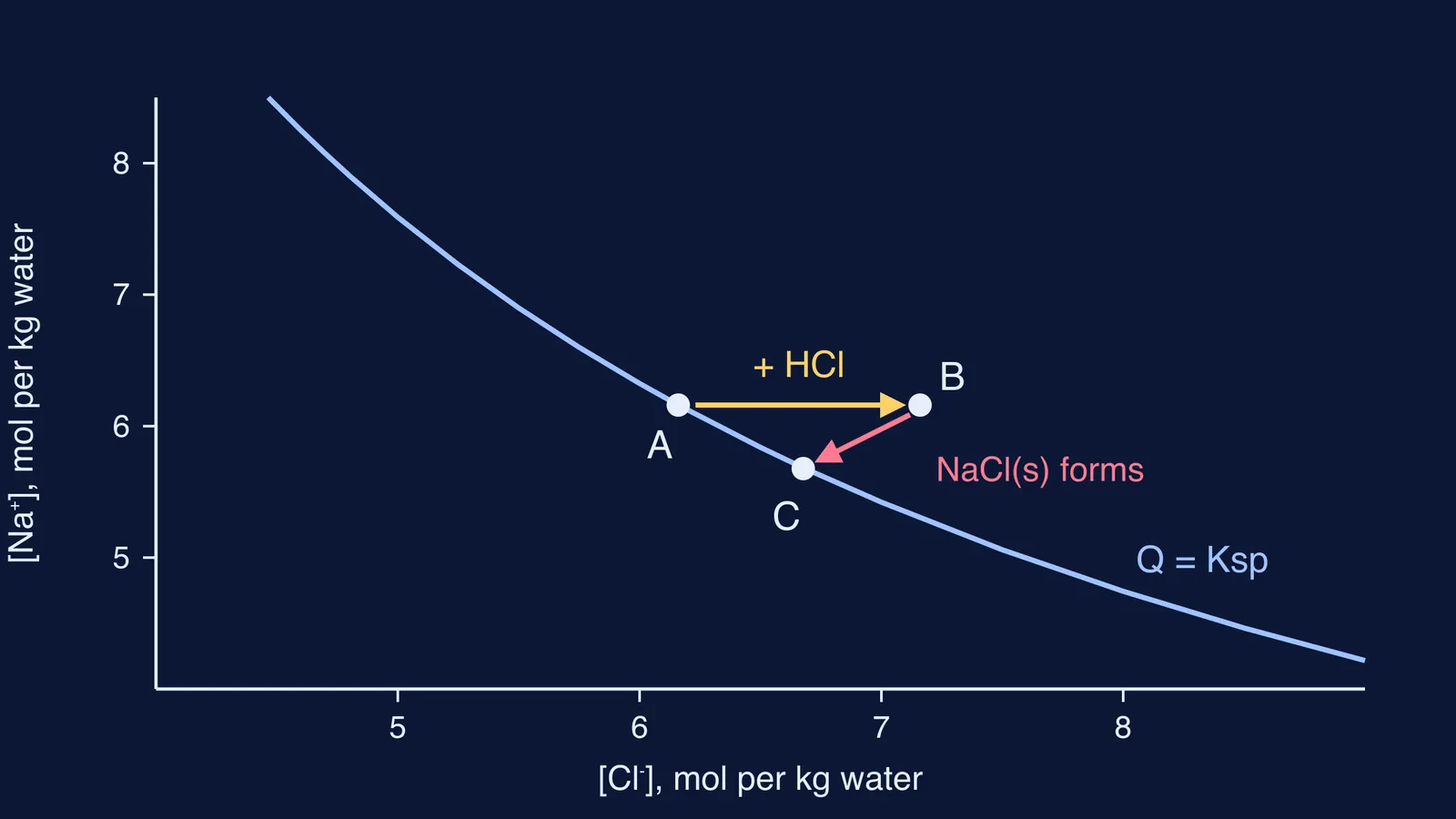
Take 1 kg of water saturated with NaCl: 360 g of salt, or 360 ÷ 58.44 = 6.16 mol. So [Na⁺] = [Cl⁻] ≈ 6.16 mol per kg of water.
Ionic product at saturation: 6.16 × 6.16 ≈ 37.9. Treat this as Ksp in these units.
Bubble in 1.00 mol of HCl. Now [Cl⁻] = 7.16, so Q = 44.1, above 37.9: NaCl must come out.
Let x mol of NaCl precipitate: (6.16 − x)(7.16 − x) = 37.9. Solving the quadratic gives x ≈ 0.48 mol.
That is about 0.48 × 58.44 ≈ 28 g of crystals per kilogram of water.
The real yield differs because activities are not concentrations here, but the logic is what an exam answer needs. The diagram at the top shows it: A on the saturation curve, a step right to B as HCl adds chloride, then a slide back to C as solid NaCl forms.
Why do impurities like MgCl2 stay dissolved?
A salt precipitates only when its own ionic product crosses its own limit, and the small amounts of other salts in crude salt stay far below theirs.
Magnesium chloride dissolves to 54.6 g per 100 g of water at 20 °C, according to PubChem's magnesium chloride record, which lists its molar mass as 95.21 g/mol. Run the same sketch. A saturated MgCl2 solution holds about 5.7 mol of Mg²⁺ per kg of water, so its limit for [Mg²⁺][Cl⁻]² is roughly 5.7 × 11.5² ≈ 750. Suppose the crude salt brought in 2 g of MgCl2, about 0.02 mol. Even with chloride pushed to about 6.7 mol/kg, its ionic product is only 0.02 × 6.7² ≈ 0.9, hundreds of times too small to precipitate.
The sulphate impurities NCERT names behave the same way: HCl adds no sulphate, so their ionic products do not rise. On filtering, the pure crystals stay on the paper and the impurities pass through.
For more examples, read our explainer on solubility product, the common ion effect and precipitation and how much salt dissolves in 100 mL of water.
How do you write this in a board or JEE answer?
Use five lines:
Write the equilibrium NaCl(s) ⇌ Na⁺(aq) + Cl⁻(aq) and Ksp = [Na⁺][Cl⁻].
State that HCl dissociates completely, HCl → H⁺ + Cl⁻, raising [Cl⁻], the common ion.
Say the ionic product now exceeds Ksp, so the equilibrium shifts back and NaCl precipitates.
Explain the purity: the impurity salts stay below their own solubility limits, so they remain in the filtrate.
For a long answer, mention that activities replace concentrations for NaCl.
Do not write that HCl reacts with the impurities: here it only supplies chloride ions. To see the same idea in a lab, try the common ion effect practical with acetic acid.
If the quadratic in the worked example tripped you up, the Fermi Problem Library has worked problems with a step-by-step solver that explains the reasoning rather than printing an answer. If Ksp versus ionic product still feels shaky, the Fermi Concept Library gives each chemistry concept its own lesson and its place in the map.
Next time, sketch the saturation curve first: the answer is the arrow from B to C.