

On this page
Stir salt into a glass of water and it vanishes, until it stops vanishing. That point is called saturation, and for salt it arrives at a definite, measurable amount. Here is the number, and a kitchen test to check it.
How much salt dissolves in 100 mL of water?
The solubility of sodium chloride is 36.0 g per 100 g of water at 25 °C, the figure from the CRC Handbook of Chemistry and Physics listed on PubChem's sodium chloride record. The Merck Index entry on the same page puts it another way: one gram of salt dissolves in 2.8 mL of water at 25 °C.
Solubility is the largest mass of a substance that dissolves in a fixed amount of solvent at a given temperature. Because 100 mL of water has a mass of almost exactly 100 g, you can read "36 g per 100 g" as "36 g per glass of 100 mL" for any kitchen purpose. If the words saturated, unsaturated and supersaturated still blur together, our explainer on saturated, unsaturated and supersaturated solutions sorts them out.
Why does sugar dissolve so much more than salt?
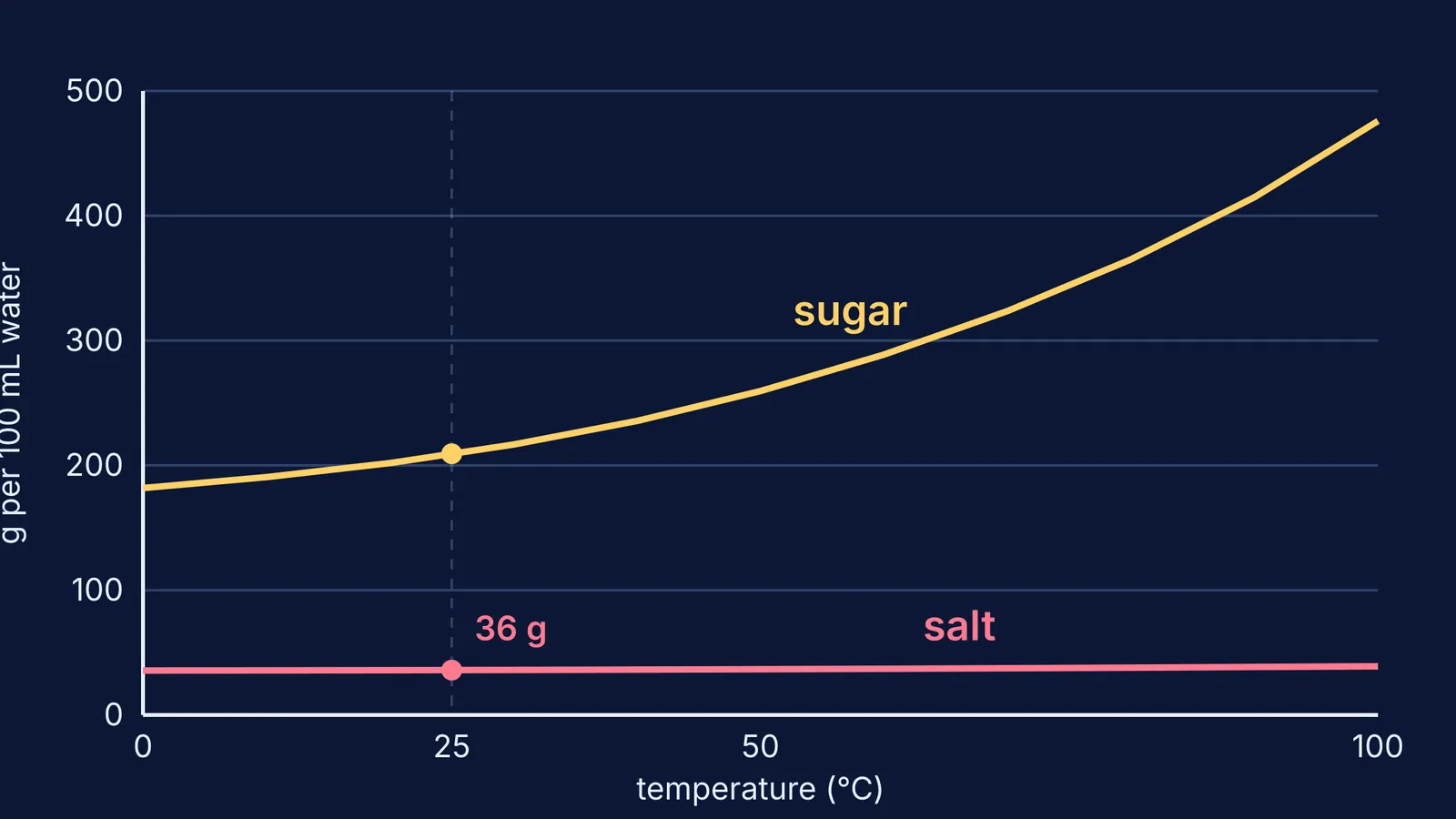
Sugar (sucrose) is in a different league. The ILO-WHO International Chemical Safety Card quoted on PubChem's sucrose record gives its solubility as 200 g per 100 mL of water at 25 °C, and the Merck Index says one gram dissolves in 0.5 mL of water. That is more than five times as many grams as salt.
Grams are not the fair comparison; the number of particles is. PubChem lists the molar mass of sodium chloride as 58.44 g/mol and of sucrose as 342.30 g/mol (PubChem property data). So:
Salt: 36.0 g ÷ 58.44 g/mol ≈ 0.62 mol in 100 g of water
Sugar: 200 g ÷ 342.30 g/mol ≈ 0.58 mol in 100 mL of water
Counted in moles, the two are about the same at room temperature. Sugar looks far more soluble mostly because each sugar molecule is almost six times heavier than a unit of NaCl.
Does hot water dissolve more salt?
Only a little. The temperature data compiled in Wikipedia's solubility table give sodium chloride as 35.65 g per 100 mL at 0 °C, 35.89 at 20 °C and 38.99 at 100 °C. Boiling water takes about 3 g more salt than water at 20 °C does.
Sugar behaves very differently. The same table rises from 181.9 g at 0 °C to 201.9 g at 20 °C and 476.0 g at 100 °C, more than double the room-temperature value. We explain the reasons in how temperature changes the solubility of solids.
How can you test salt solubility at home?
You need a kitchen scale that reads to 1 g, a glass, a spoon, table salt and tap water.
Put the empty glass on the scale and press tare (zero). Pour in 100 g of water.
Tare again. Add 10 g of salt and stir for a full minute.
Keep adding salt 5 g at a time, stirring a minute after each, and write down the running total.
Near 30 g, switch to 1 g at a time. Stop when a few grains stay on the bottom after two minutes of stirring.
Your last fully dissolved total is your measured solubility. Compare it with the 36 g reference value on PubChem.
Repeat with sugar in a second glass, starting with 50 g portions. Expect about 200 g.
Kitchen scales round and hand-stirring is slow near saturation, so getting within 2 or 3 g of 36 g is a good result. For a weekend extension, our guide to growing salt or sugar crystals with kids uses the solution you have just made.
How do you use 36 g in a solubility problem?
Three worked examples, using the CRC value of 36.0 g per 100 g of water from PubChem:
How much salt saturates 250 g of water at 25 °C? 250 × 36.0 ÷ 100 = 90 g.
What is the mass percentage of a saturated solution? 36.0 ÷ (100 + 36.0) × 100 ≈ 26.5%.
You dissolve 30 g of salt in 100 g of water. Is it saturated? No: it can take about 6 g more.
The usual slip is the second line: dividing by the mass of water (100 g) instead of the mass of solution (136 g). If you keep making that mistake, the Fermi Problem Library has worked problems with a step-by-step solver that explains the reasoning rather than printing an answer. If the idea of solubility itself feels shaky, the Fermi Concept Library gives each chemistry concept its own lesson.
Try the test this weekend, write down your number, and see how close to 36 g you get.


