

On this page
Many crystal recipes say the same thing: boil water, add salt or sugar until no more dissolves, hang a string, wait. That works, but for different reasons with salt and with sugar, and that difference is the real chemistry lesson. Here is a seven-day plan with real numbers, a photo log and what to say when nothing seems to happen.
Why do salt and sugar crystals grow differently?
A solution is saturated "when as much salt has been dissolved into a solution as possible", as Scientific American's salt stalactite activity puts it.
A supersaturated solution contains more than the maximum amount of solid that can dissolve at a given temperature, as the Pacific Science Center's grow-your-own-crystals sheet defines it. That state is temporary: the extra comes out of solution as crystals.
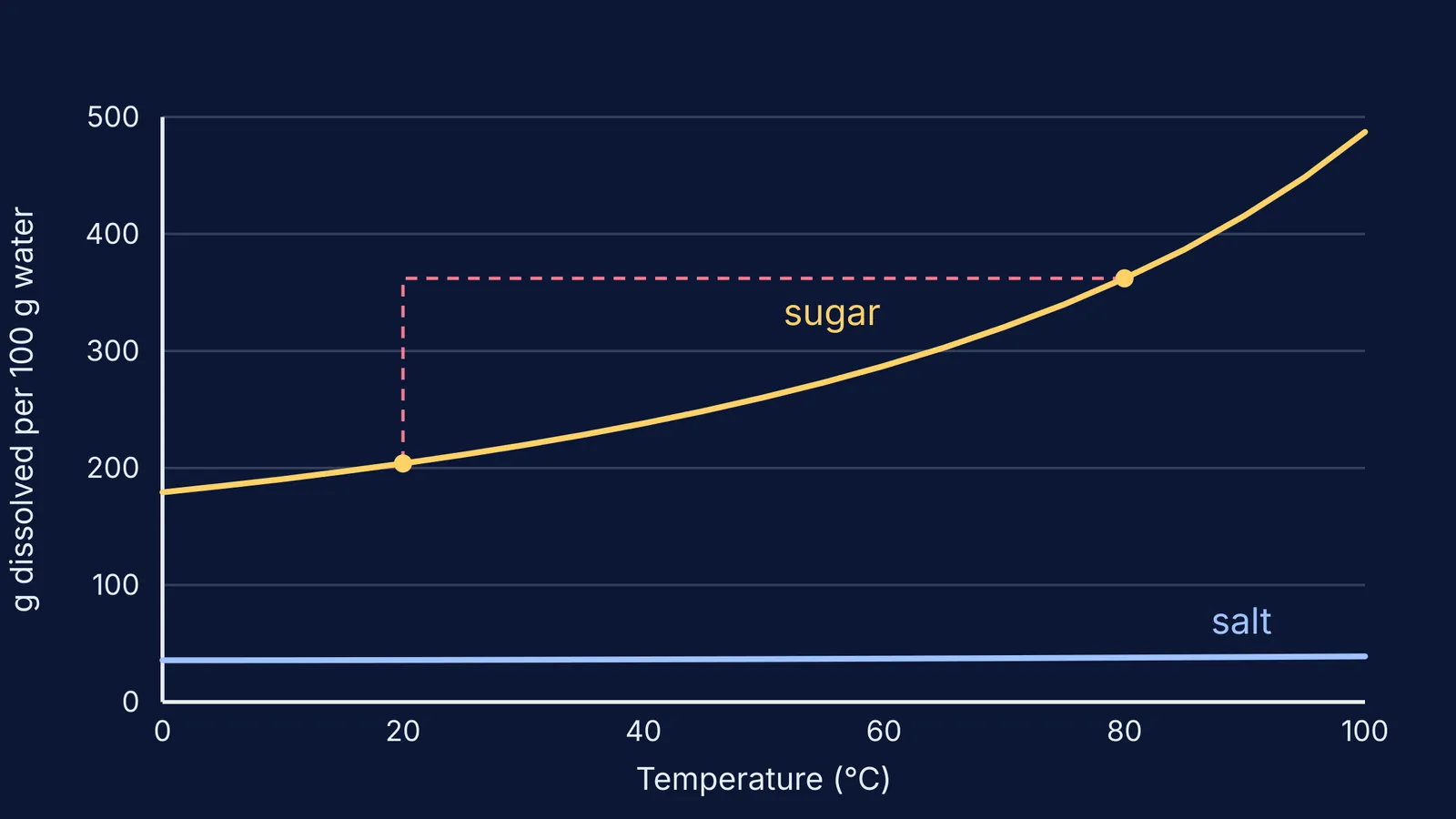
Salt hardly responds to heat: 100 g of water dissolves 35.89 g of salt at 20 °C and 38.99 g at 100 °C, according to the AUS-e-TUTE solubility table for sodium chloride. The CRC Handbook value listed on PubChem's sodium chloride page agrees: 36.0 g per 100 g of water at 25 °C.
Sugar is the opposite: 100 g of water holds 203.9 g of sucrose at 20 °C and 487.2 g at 100 °C, in the table from Browne's Handbook of Sugar Analysis reprinted in Belle Lowe's Experimental Cookery.
So the two grow differently:
Sugar crystallises mainly as hot syrup cools, because cool water holds far less of it.
Salt crystallises mainly as water evaporates, because cooling from boiling to room temperature releases only about 3 g per 100 g of water.
How do you grow salt crystals at home with kids?
You need table salt, a clean glass jar, cotton string, a pencil, a kitchen scale and a pan. Weigh rather than use cups, because solubility is measured in grams. By the AUS-e-TUTE table, 200 g of water dissolves only about 72 g of salt at 20 °C and about 78 g at 100 °C, so 80 g is slightly more than will go in.
1.Your child weighs 200 g of water (200 mL) and about 80 g of salt.
An adult heats the water until it steams and stirs the salt in, a spoonful at a time.
Pour the clear liquid into the jar, leaving any undissolved grains in the pan.
Tie the string to the pencil, rest the pencil across the jar's mouth, and let the string hang into the liquid without touching the bottom.
Leave the jar open, somewhere warm and still where nobody will bump it.
In Scientific American's version, the strings should look fatter within a couple of days.
For sugar (rock candy), the maths is the lesson. Dissolve 300 g of sugar in 100 g of water; by the Browne table in Experimental Cookery, the water must be at about 65 °C (302.9 g) or hotter to hold that much. When it cools to 30 °C, a warm room, it can hold only 219.5 g, so about 80 g is surplus and has to go somewhere: onto your string.
What should the seven-day photo log look like?
Shoot at the same time, from the same spot, with a ruler or coin beside the jar for scale.
Day 0: Photograph the clear solution. Ask: where did the salt go?
Day 1: Mark the liquid level on the glass with a marker. Look for a crust at the waterline.
Day 2: Compare the string with the Day 0 photo. Is it thicker?
Day 3: Zoom in with a phone or magnifier and sketch one crystal.
Day 4: Check the waterline mark. How far has it dropped, and where did that water go?
Day 5: Compare crystals on the string with those on the jar wall. Which are bigger?
Day 6: Predict what Day 7 will look like and write it down.
Day 7: Lift out the string and lay all eight photos side by side.
The Pacific Science Center sheet calls a crystal's visible outer shape its habit; Day 3 is when your child names the habit they see.
What do you say when nothing seems to happen?
If interest drops midweek, try:
"The water leaves a little every day. Let's check the line we drew."
"Put yesterday's photo next to today's. What changed?"
"What would you change next time: more salt, a warmer spot, or sugar?"
If nothing grows by Day 4, the solution may not have been saturated; make a fresh batch and stop only when grains are left in the pan.
If the questions keep coming after the week, each concept in chemistry has its own lesson and its place in the map in the Fermi Concept Library, so a curious teenager can follow "why does sugar dissolve more in hot water?" further.
Weigh out the salt tonight, take the Day 0 photo, and let the water do the rest.


