

On this page
Urea and ammonium sulphate are both sold mainly for their nitrogen, and one line of school chemistry tells you how much each carries. Here is the method, both answers, a cost comparison, and the slips that throw answers off.
How do you calculate the percentage of nitrogen in a compound?
Mass percentage of an element = (number of atoms of that element in the formula × its atomic mass) ÷ molar mass of the compound × 100.
The atomic weights used here are the abridged standard values from IUPAC's Commission on Isotopic Abundances and Atomic Weights: H 1.008, C 12.011, N 14.007, O 15.999 and S 32.06. Textbooks round these to 1, 12, 14, 16 and 32, which barely changes the answers. (Ammonium sulphate is ionic, so strictly it has a formula unit mass rather than a molecular mass; the arithmetic is identical.)
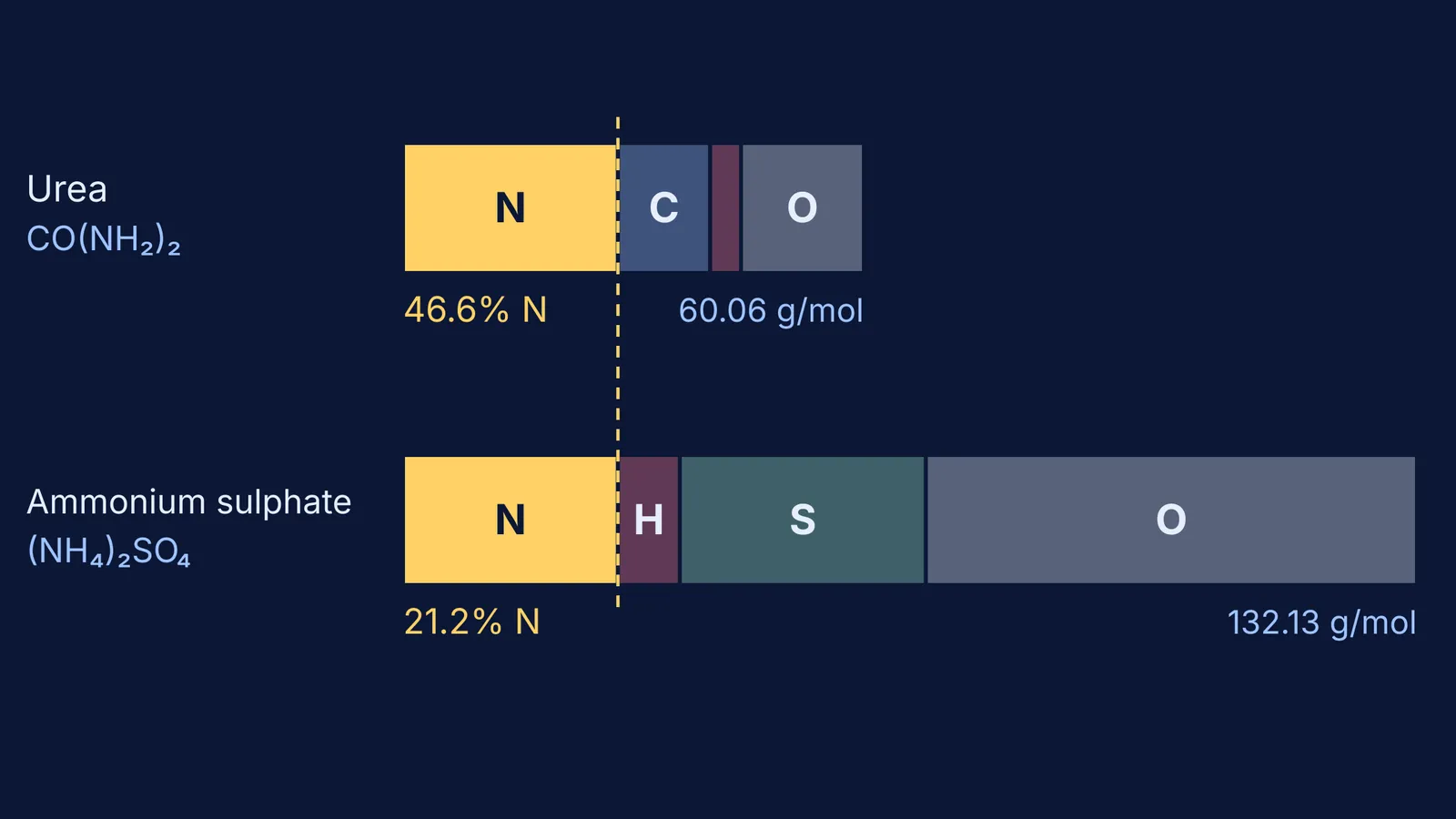
What is the percentage of nitrogen in urea?
Urea is CO(NH₂)₂ (masses from the CIAAW table).
Count atoms. The 2 outside the bracket doubles everything inside it, so urea has 1 C, 1 O, 2 N and 4 H.
Molar mass = 12.011 + 15.999 + 2(14.007) + 4(1.008) = 60.056 g/mol.
Mass of nitrogen = 2 × 14.007 = 28.014 g.
% N = 28.014 ÷ 60.056 × 100 = 46.6%.
Rounded masses give 28 ÷ 60 × 100 = 46.7%. Neem-coated urea in India is specified at 46.0% total nitrogen minimum under the Fertiliser Control Order, as KRIBHCO's product specification lists, a shade below the pure compound.
What is the percentage of nitrogen in ammonium sulphate?
Ammonium sulphate is (NH₄)₂SO₄ (masses from the CIAAW table).
Count atoms. The 2 outside the bracket gives 2 N and 2 × 4 = 8 H, plus 1 S and 4 O.
Molar mass = 2(14.007) + 8(1.008) + 32.06 + 4(15.999) = 132.134 g/mol.
% N = 28.014 ÷ 132.134 × 100 = 21.2%.
The government's nutrient-based subsidy list for rabi 2025-26 gives ammonium sulphate the grade 20.5-0-0-23, meaning 20.5% nitrogen and 23% sulphur on the N-P-K-S scale (PIB backgrounder, 5 January 2026).
Both formulas hold exactly two nitrogen atoms, 28.014 g per mole. Urea just carries far less other mass with them.
Which fertiliser gives more nitrogen per rupee?
Rupees per kg of nitrogen = bag price ÷ (bag mass in kg × %N ÷ 100).
The subsidised MRP of a 45 kg bag of urea is ₹242, excluding neem-coating charges and taxes, according to a Press Information Bureau release of 29 November 2024. Using the 46% label figure:
Nitrogen in the bag = 45 × 0.46 = 20.7 kg.
Cost of nitrogen = 242 ÷ 20.7 = about ₹11.7 per kg.
Ammonium sulphate has no fixed national price: under the subsidy scheme described in the same PIB backgrounder, companies set the MRP and every bag must display it. So ask what 50 kg would have to cost to match urea.
Nitrogen in 50 kg = 50 × 0.205 = 10.25 kg.
Break-even price = 10.25 × 11.7 = about ₹120.
On nitrogen alone, 50 kg of ammonium sulphate would need a printed MRP under about ₹120 to beat urea. It also supplies sulphur, so nitrogen per rupee is a fair arithmetic comparison, not the whole farming decision; what a field needs is a question for a soil test and the local agriculture officer.
Which molar mass slips skew the answer?
Each slip uses the CIAAW weights.
Counting one nitrogen in urea: 14.007 ÷ 60.056 = 23.3%, half the true value, so urea's nitrogen looks twice as expensive (about ₹23 per kg).
Using 28, the mass of N₂, as the atomic mass of N: urea becomes 88.07 g/mol and 63.6% N.
Dropping the bracket and working with NH₄SO₄ (114.10 g/mol) while still counting two N: 24.6%.
Counting four hydrogens instead of eight in ammonium sulphate: 128.10 g/mol and 21.9%.
Writing urea as NH₂CONH₂ and counting only two H: 58.04 g/mol and 48.3%.
The cure: write each element's atom count in a row before touching a calculator. Practise the counting step with our guide to finding moles of atoms inside a compound, and the general method in how to find the percentage of an element in a compound.
A quick checklist for any fertiliser question
Expand every subscript, including those outside brackets.
Multiply atom counts by atomic masses and add them for the molar mass.
Divide the nitrogen mass by the molar mass and multiply by 100.
Compare with the grade on the bag.
For cost, divide the price by the kilograms of nitrogen in the bag.
If a step keeps slipping, the Fermi Problem Library has worked problems with a step-by-step solver that explains the reasoning rather than printing an answer. If the mole idea itself feels shaky, the Fermi Concept Library gives each chemistry concept its own lesson.


