

On this page
When a chemistry problem asks for the number of oxygen atoms in a sample, the math looks straightforward. Yet in Class 11 exams and national tests like JEE Main and NEET-UG, finding the moles of individual atoms inside a compound is where many students lose easy marks. The error rarely comes from difficult arithmetic; it comes from treating a chemical formula as a single entity rather than a ratio of bonded particles.
Why do chemical subscripts act as mole ratios?
A chemical formula is a recipe written at the sub-microscopic scale. In water (H₂O), the subscript 2 indicates that each molecule contains two hydrogen atoms bonded to one oxygen atom. Under the BIPM definition of the mole, one mole contains exactly 6.02214076 × 10²³ elementary entities, and those entities must always be specified—whether atoms, molecules, or formula units.
Because Avogadro's constant scales every particle equally, whatever ratio holds for a single molecule holds for a mole of molecules. One mole of water contains two moles of hydrogen atoms. As established in the laws of chemical combination in Class 9, subscripts define a compound's fixed stoichiometry. Multiplying the moles of compound by an atom's subscript gives the moles of that atom directly.
How many moles of oxygen atoms are in 0.5 mol of Al₂(SO₄)₃?
Consider aluminium sulphate, Al₂(SO₄)₃. What happens when a question asks: "How many moles of oxygen atoms are present in 0.5 mol of aluminium sulphate?"
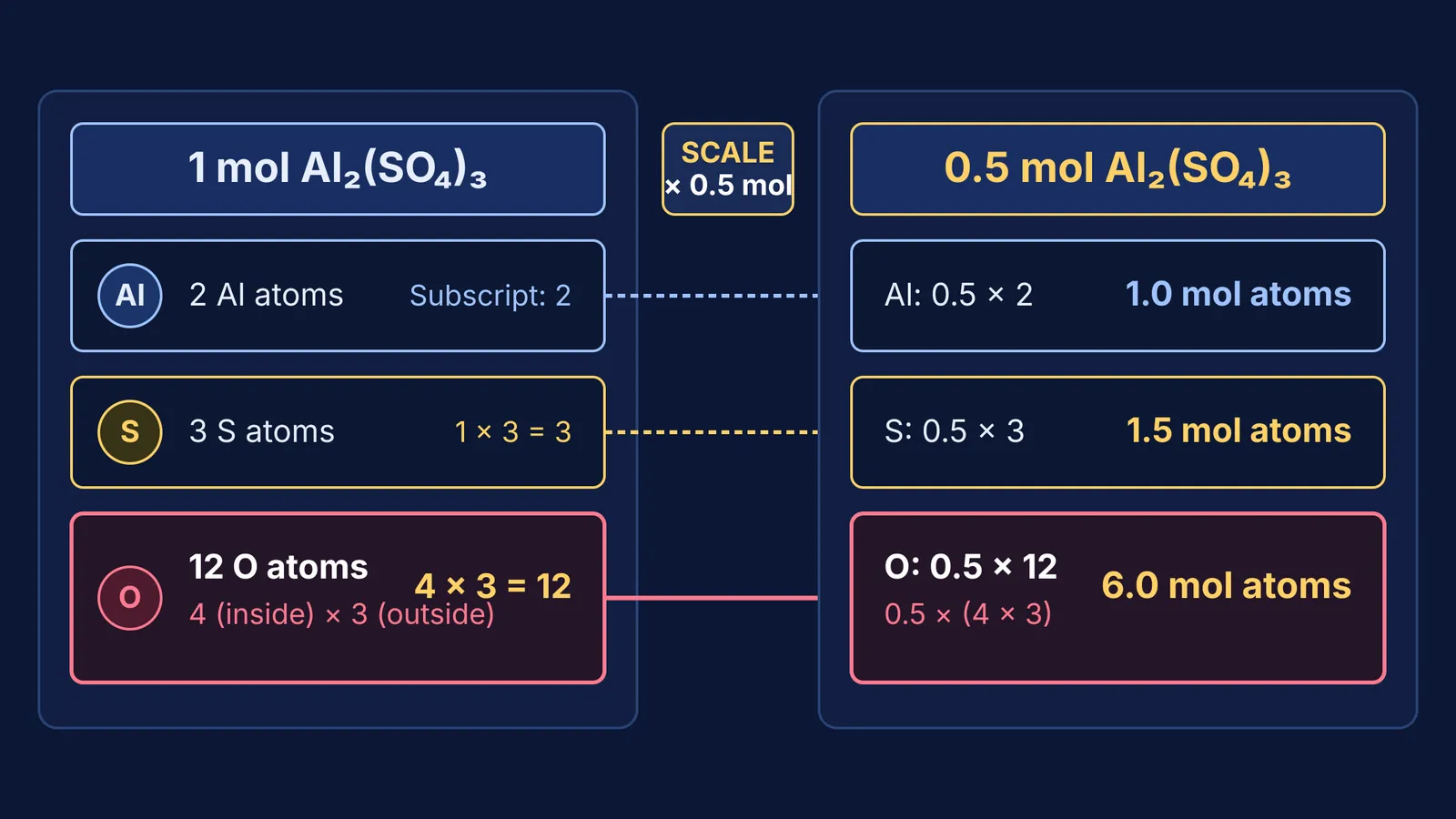
Start by unpacking the formula unit. The subscript 4 belongs to oxygen inside each sulphate ion (SO₄²⁻), while the subscript 3 outside the parentheses multiplies the entire group. Each formula unit of Al₂(SO₄)₃ contains:
2 aluminium atoms
1 × 3 = 3 sulfur atoms
4 × 3 = 12 oxygen atoms
Under BIPM measurement standards, substance amounts scale directly with entity counts. Because 1 mol of Al₂(SO₄)₃ contains 12 mol of oxygen atoms, 0.5 mol of the compound contains: 0.5 mol × 12 = 6.0 mol of oxygen atoms.
To find the actual count of oxygen atoms, multiply by Avogadro's constant: 6.0 mol × (6.02214076 × 10²³ atoms/mol) = 3.613 × 10²⁴ oxygen atoms.
The most common slip is calculating 0.5 × 4 = 2.0 mol, forgetting the outer multiplier 3.
How many moles of hydrogen atoms are in glucose?
Now take glucose, C₆H₁₂O₆. Suppose you have 0.25 mol of glucose, which equals 45.04 g given its molar mass of 180.16 g/mol under IUPAC standard atomic weights. How many moles of hydrogen atoms are present?
Each molecule of glucose contains 6 carbon, 12 hydrogen, and 6 oxygen atoms—24 atoms in total. Scaling to moles:
1 mol of glucose contains 12 mol of hydrogen atoms.
In 0.25 mol of glucose, the moles of hydrogen atoms equal 0.25 mol × 12 = 3.0 mol of H atoms.
In individual entities, this equals 3.0 × 6.02214076 × 10²³ = 1.807 × 10²⁴ hydrogen atoms.
When tackling multi-step questions like calculating empirical and molecular formulas, keeping atom-to-molecule ratios clear prevents dead ends. The Fermi Problem Library provides worked problems with a step-by-step solver that explains the reasoning rather than printing an answer.
Why do students confuse moles of molecules with moles of atoms?
Why do these slips happen under exam pressure? In a classic analysis of chemistry learning, Johnstone (1991) showed that students struggle because they must simultaneously process macroscopic substances, sub-microscopic particles, and symbolic formulas. Under timed conditions, working memory overloads, and students mistake the formula label for a single unit.
Nakhleh (1993) showed that many learners rely strictly on mathematical formulas like n = m/M without picturing the particles involved. In a study of 156 students, Sanger (2005) observed that confusing subscripts with coefficients is a primary source of error in stoichiometry. Students see 0.5 mol of compound and mistakenly assume 0.5 mol of each constituent element.
To eliminate common mole concept errors, students must connect formulas to physical structure. The Fermi Concept Library covers every concept in physics, chemistry, biology, mathematics and computing, each with its own lesson and its place in the map, making it easy to ground formulas in their particulate reality.
What is the three-step routine to avoid subscript mistakes?
To calculate moles of constituent atoms reliably, follow this three-step routine:
Expand all subscripts: If a formula has parentheses, resolve them first. Write Al₂(SO₄)₃ as Al₂S₃O₁₂ on rough paper so each atom's multiplier is unmistakable.
Specify the elementary entity: State clearly whether the question asks for moles of formula units, moles of individual atoms, or moles of diatomic gas molecules.
Multiply moles by the expanded subscript: Calculate moles of target atoms = (moles of compound) × (subscript).
When practicing stoichiometric calculations, Fermi's AI tutor works out what you already know and builds a plan for the session, checking your understanding as it goes.


