On this page
If you are short-sighted, your spectacle lenses are thin in the middle and thick at the edge. A stronger prescription means a thicker edge, and at −6 dioptres an ordinary plastic lens can have an edge over 6 mm thick. High-index lenses cut that down by bending light more strongly, so their surfaces can be flatter. This post uses the lens maker's formula and the geometry of a curved surface to work out exactly how much thinner they get, and what you give up in return.
This is a physics explainer, not eyewear or medical advice. Which lens material and prescription suit a person is a decision for an eye doctor or optometrist, and nothing here is a claim about how any lens will work for you.
Why does a higher refractive index make a lens thinner?
The power of a thin lens comes from the lens maker's formula:
P = (n − 1)(1/R₁ − 1/R₂)
For a plano-concave lens (one flat face, one concave face), this simplifies to P = −(n − 1)/R, where R is the radius of the curved face. Rearranged, the radius you need for a given power is
R = (n − 1)/|P|
A larger n gives a larger R, which means a flatter curve. A flatter concave face dips in less across the lens, so the edge is thinner. If the signs in the formula still trip you up, see how to assign signs in the lens maker's formula.
The indices used below are real material values. PPG describes its CR-39 monomer as a 1.5 index lens material, and Mitsui Chemicals lists its MR series lens materials at refractive indices of 1.60, 1.67 and 1.74. Exact values vary slightly between makers and grades.
How do you calculate the edge thickness of a minus lens?
The extra thickness at the edge is the sag (sagitta) of the curved face: how far the curve dips below a flat line across a chord. For a sphere of radius R and half-width h,
s = R − √(R² − h²)
This is the same h that a spherometer measures, as explained in how to use a spherometer to find radius of curvature.
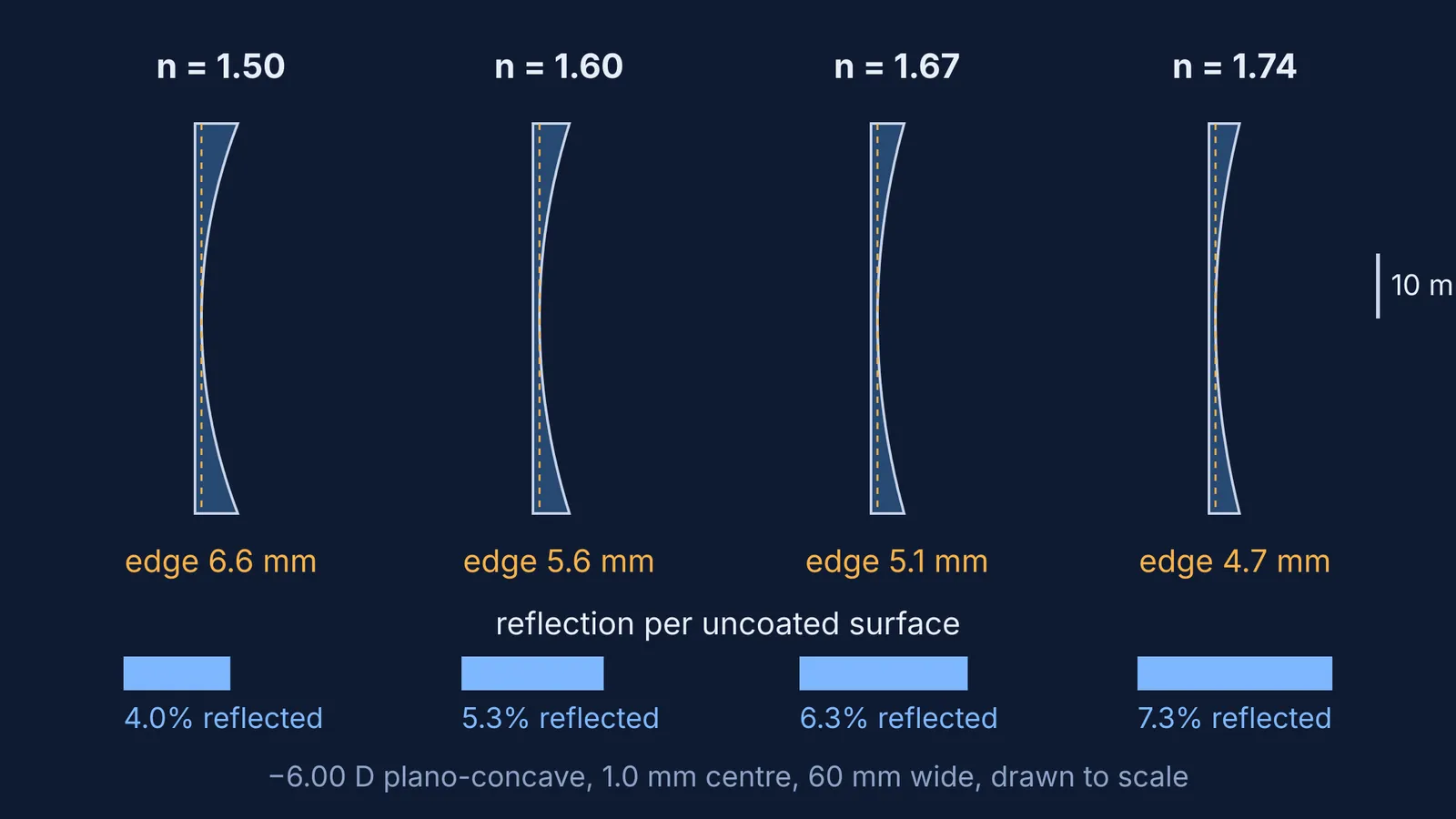
Worked example. Take a −6.00 D plano-concave lens, 1.0 mm thick at the centre, with 30 mm from the centre to the frame edge. The 1.0 mm centre and the 30 mm half-width are round illustrative values; real ones depend on the material, the frame and how the lens is fitted.
Radius for n = 1.50. R = (1.50 − 1)/6.00 D = 0.0833 m = 83.3 mm.
Sag at h = 30 mm. s = 83.3 − √(83.3² − 30²) = 83.3 − 77.7 = 5.6 mm.
Edge thickness. Centre + sag = 1.0 + 5.6 = 6.6 mm.
Repeat for the other materials. n = 1.60 gives R = 100.0 mm, sag 4.6 mm, edge 5.6 mm. n = 1.67 gives R = 111.7 mm, sag 4.1 mm, edge 5.1 mm. n = 1.74 gives R = 123.3 mm, sag 3.7 mm, edge 4.7 mm.
Check units. Dioptres are m⁻¹, so (n − 1)/P is in metres; the sag is a length in mm. Going from 1.50 to 1.74 takes the edge from 6.6 to 4.7 mm, about 29% thinner.
Does a real meniscus lens change the answer?
Real spectacle lenses are not plano-concave. They are meniscus shaped: the front is gently convex and the back is more strongly concave. Take a front face of +2 D and a back face of −8 D, which still add to −6 D. The edge is then the centre thickness plus the back sag minus the front sag. The results are 6.9, 5.8, 5.2 and 4.8 mm for n = 1.50, 1.60, 1.67 and 1.74. The front curve adds a little thickness, but the pattern is the same.
Why are plus lenses thick in the middle instead?
A converging lens for long sight has convex faces, so it is thickest at the centre and needs a minimum thickness at the edge. The same physics applies: higher n means flatter curves and less sag, so a high-index plus lens has a thinner centre. The saving moves from the edge to the middle.
What do you give up with a high-index lens?
Two things, both from the same optics that makes the lens thin.
More reflection. At normal incidence, each uncoated surface reflects a fraction ((n − 1)/(n + 1))² of the light. That is 4.0% at n = 1.50, 5.3% at 1.60, 6.3% at 1.67 and 7.3% at 1.74. Through two surfaces, an uncoated 1.74 lens passes about 85.9% of the light against 92.2% for 1.50, and the extra reflections show up as glare and ghost images. This is why high-index lenses are almost always sold with an anti-reflection coating, whose thickness follows the rule in minimum thickness of an anti-reflection coating.
More colour spread. The Abbe number measures how little a material's index changes across the spectrum; a lower Abbe number means more dispersion. Mitsui's lens material comparison gives 58 for ADC, the polymer that CR-39 is made of, and 28–30 for polycarbonate. Its lineup page gives 41 for MR-8 (1.60), 31 for MR-7 and MR-10 (1.67) and 32 for MR-174 (1.74).
Why it matters: when you look through a lens away from its centre, the lens acts like a prism. By Prentice's rule, the prism power in prism dioptres is the distance from the centre in centimetres times the lens power, so 1 cm from the centre of a −6 D lens gives 6 prism dioptres. The colour spread is roughly that prism divided by the Abbe number: about 0.10 prism dioptres for Abbe 58 and about 0.19 for Abbe 32. Looking off-centre through a strong high-index lens can show faint coloured fringes on high-contrast edges.
Why does frame size matter as much as lens material?
The sag grows roughly as h², so a smaller frame helps a lot. Shrink the half-width from 30 mm to 25 mm and the same −6 D lens has edges of 4.8, 4.2, 3.8 and 3.6 mm for n = 1.50, 1.60, 1.67 and 1.74. An ordinary 1.50 lens in a 50 mm wide frame is about as thin at the edge as a 1.74 lens in a 60 mm wide one. Where the optical centre sits relative to the frame also matters, because the edge furthest from it is the thickest.
If you want to check sag and edge-thickness problems step by step, the Fermi Problem Library has a step-by-step solver that explains the reasoning.
Quick checklist
Plano-concave lens: R = (n − 1)/|P|. Higher n, flatter curve.
Edge of a minus lens = centre thickness + sag, with s = R − √(R² − h²) computed exactly.
−6 D, 1.0 mm centre, 30 mm half-width: 6.6, 5.6, 5.1 and 4.7 mm for n = 1.50 to 1.74.
Reflection per surface rises from 4.0% to 7.3%, so high-index lenses need an anti-reflection coating.
Abbe number falls from about 58 to about 31–32, so colour fringing rises off-centre.
Frame size changes the edge almost as much as the material.
Lens choices belong to an eye doctor or optometrist; this is the physics only.