

On this page
The spherometer experiment, finding the radius of curvature of a watch glass or convex mirror, is Experiment 3 in the NCERT Class 11 physics laboratory manual. Three slips spoil many results: a misread least count, mixed units, and a carelessly measured leg spacing.
What does a spherometer actually measure?
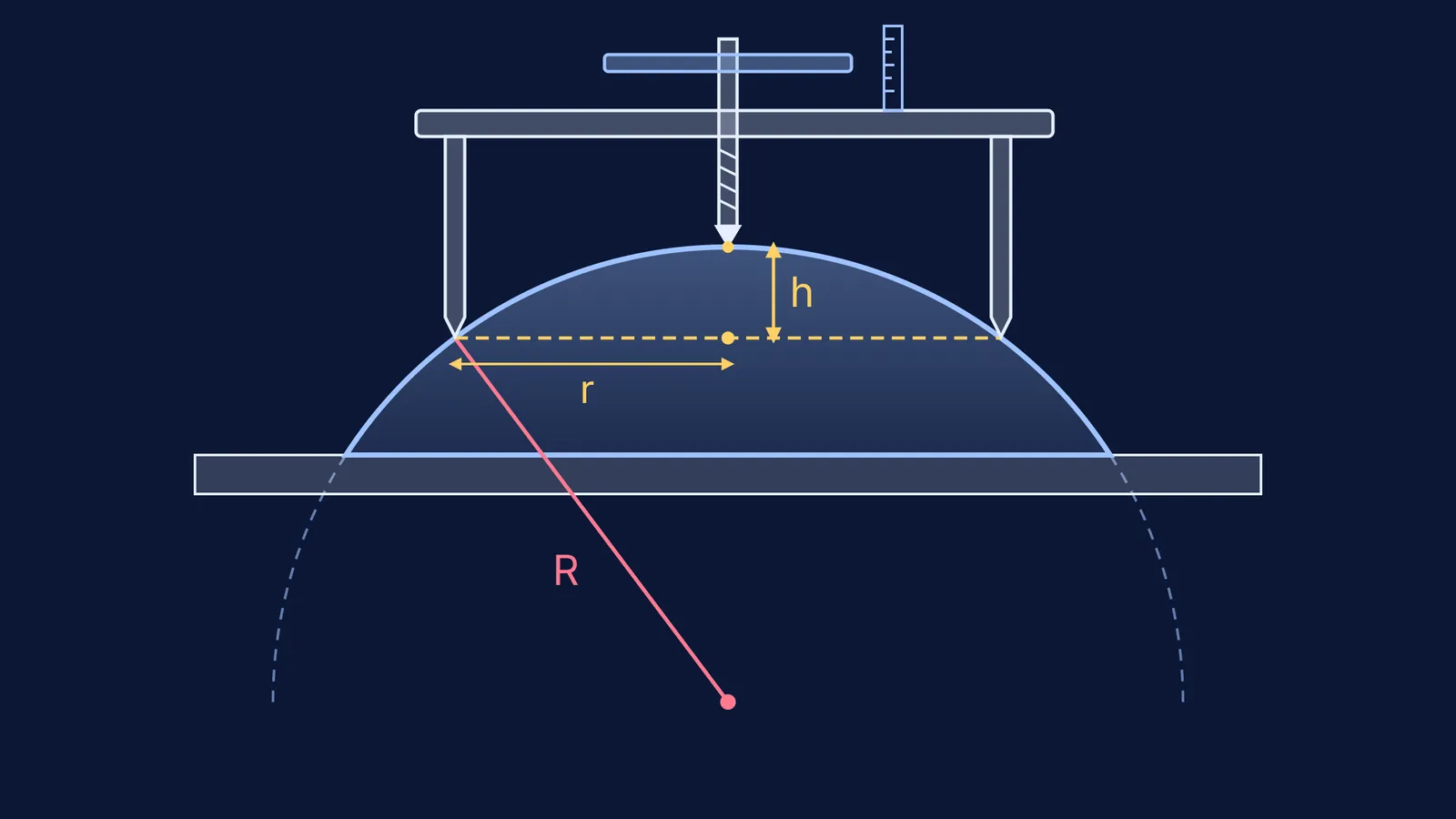
According to the NCERT manual, a spherometer has three legs whose tips form an equilateral triangle, a central screw that moves through a nut at the centre, a circular disc divided into 100 or 200 equal parts, and a small vertical pitch scale.
It measures one length: the sagitta h, how far the middle of a curved surface rises above the flat plane of the three leg tips.
How do you find the least count of a spherometer?
The least count of a spherometer is its pitch divided by the number of divisions on the circular scale (NCERT).
The same manual says school spherometers usually have a 1 mm pitch and 100 circular divisions, so the least count is 0.01 mm. To check the pitch, turn the disc through a few full rotations and divide the distance moved on the pitch scale by the number of rotations.
How do you take readings on the glass plate and the lens?
The NCERT procedure, in order:
Press the spherometer lightly on a page of your notebook, join the three leg marks into a triangle, measure all three sides, and take their mean as l.
Put the lens or watch glass on the flat glass plate and stand the spherometer on it, all three legs on the curved surface.
Turn the screw until its tip just touches the surface. Note the pitch-scale reading and the circular-scale division in line with it. This is h1.
Remove the lens, stand the spherometer on the glass plate, and turn the screw until it just touches the glass. This is h2.
The sagitta is h = h1 − h2. Repeat with the lens rotated and its centre in the same place, then average h.
Where does R = l²/6h + h/2 come from?
When two chords of a circle cross, the products of their parts are equal. With r as the distance from the centre of the leg triangle to each leg, the NCERT manual gets r² = h(2R − h), so R = r²/2h + h/2. For an equilateral triangle of side l, r = l/√3, which gives R = l²/6h + h/2. NCERT adds that h/2 may be dropped for surfaces with a large radius of curvature.
Here is a worked example with a least count of 0.01 mm:
On the lens: pitch scale 4 mm, circular division 62, so h1 = 4 + 62 × 0.01 = 4.62 mm.
On the plate: pitch scale 2 mm, circular division 37, so h2 = 2.37 mm.
Sagitta: h = 2.25 mm = 0.225 cm.
Triangle sides 4.0, 4.1 and 3.9 cm, so l = 4.0 cm.
Then R = 16 / (6 × 0.225) + 0.225/2 = 11.85 + 0.11 ≈ 12.0 cm. Here, dropping h/2 changes R by about 1%. To practise reading a main scale plus a fractional scale, try this vernier caliper reading simulation.
Which errors spoil a spherometer result?
Using the worked example:
Mixed units. Put l in cm but h in mm (2.25) and you get R ≈ 2.3 cm, about a fifth of the right value. Convert h first.
Using l where r belongs. Writing l²/2h gives about 35.7 cm, three times too large. The 6 in the formula exists because r² = l²/3.
Careless l. An error of 1 mm in a 4.0 cm side is 2.5% of l, and because l is squared it becomes about 5% of R. One least count in h (0.001 cm out of 0.225 cm) is under 0.5%. This is why the NCERT manual asks for great care with l.
Backlash. NCERT explains that worn threads leave play, so the screw can slip a little without turning. Turn the screw in one direction only while taking readings.
Parallax and contact. NCERT also lists parallax on the pitch scale, uneven circular divisions, and a tip not quite touching.
The first two are calculation mistakes: they shift every trial the same way, so averaging will not cancel them. See our explainer on random and systematic errors.
What can you do with R next?
For a spherical mirror, the focal length is about half the radius of curvature for rays close to the axis. Our post on why focal length is half the radius of curvature shows when that holds. The NCERT manual suggests finding a mirror's focal length with a spherometer as a follow-on activity.
If least count or error propagation still feels unclear, the Fermi Concept Library has a lesson for each concept in physics. To check your own working on numericals like this one, the Fermi Problem Library has worked problems with a step-by-step solver that explains the reasoning rather than printing an answer.


