

On this page
Open any physics textbook to the ray optics chapter, and you will find the same rule: the focal length of a spherical mirror is half its radius of curvature. We use it to solve mirror equations and trace ray diagrams. But this familiar equation, f = R/2, is not an absolute law of geometry. It is an approximation.
Here is the step-by-step proof for why the rule works, and the exact mathematics of what happens when the assumption breaks down.
How do you prove the focal length is half the radius of curvature?
The geometric proof relies on tracing a single ray parallel to the principal axis. This method applies to both concave and convex mirrors, but the concave case is the easiest to visualize.
Draw a concave mirror with a center of curvature C and a pole P. The distance CP is the radius of curvature R, which describes how sharply the sphere curves.
A ray strikes the mirror at point M. The line CM connects the center of the sphere to the surface, making it the normal to the mirror at that exact point. Let the angle of incidence be θ. By the law of reflection, the angle of reflection is also θ.
Because the incoming ray is parallel to the principal axis, the alternate interior angle MCF is also equal to θ. This makes triangle CMF an isosceles triangle. Since the angles are equal, the sides opposite them are equal: CF = MF.
Now comes the crucial step: the paraxial approximation. If the ray is very close to the axis (a paraxial ray), the point M is practically on top of the pole P. Therefore, the distance MF is essentially the same as PF.
According to HyperPhysics, this geometry dictates that the focal point lies exactly midway between the center of curvature and the vertex. Substituting our approximation into the isosceles triangle gives CF ≈ PF.
Since the total radius R = CF + PF, we can replace CF with PF to get R = 2PF. The distance PF is the focal length f, giving us the final result: f = R/2.
Why does the f = R/2 formula fail for marginal rays?
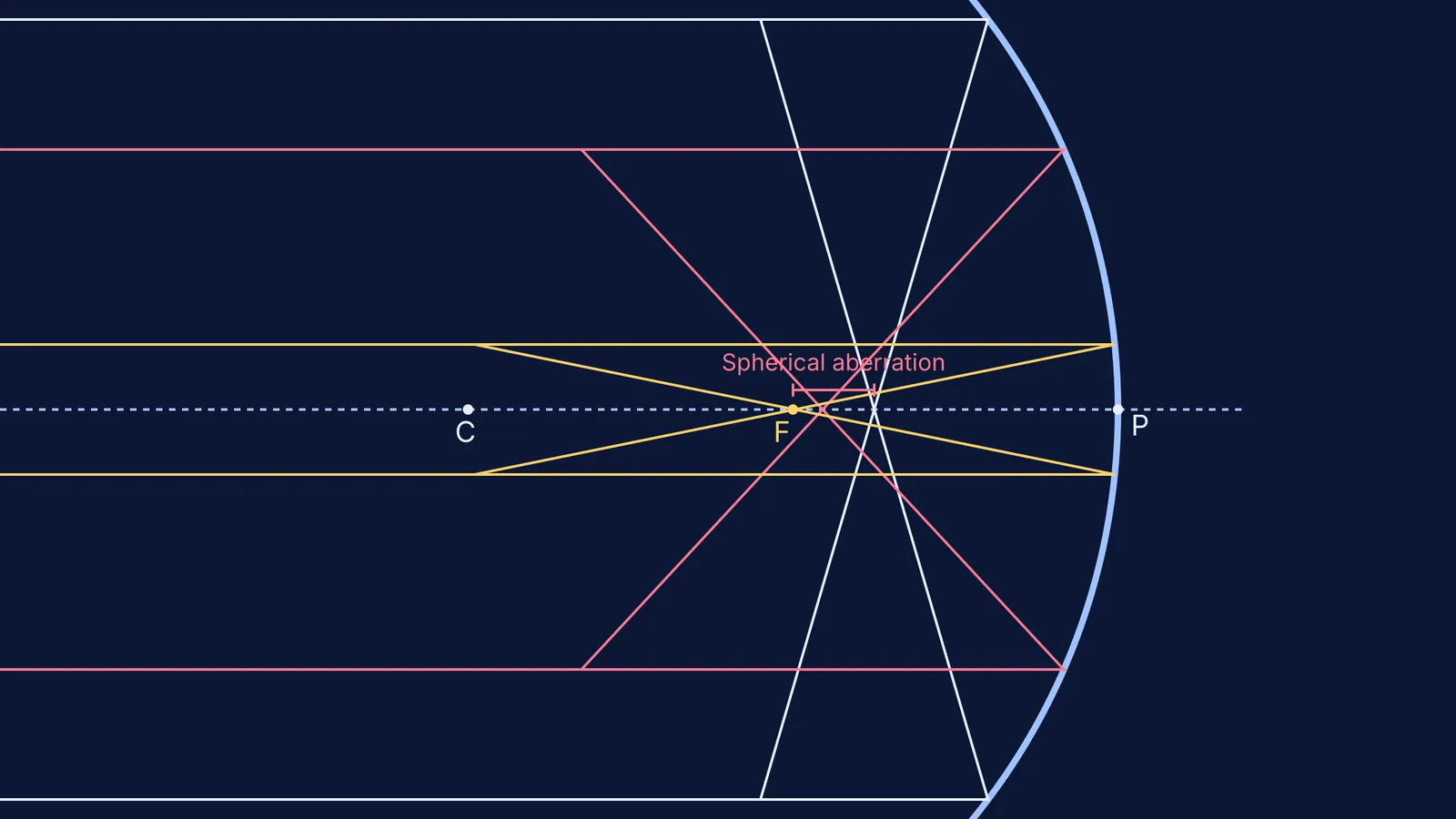
The assumption that MF ≈ PF breaks down when rays strike the mirror far from the axis. These are called marginal rays.
Without the paraxial approximation, exact geometry shows a different result. In the isosceles triangle CMF, splitting the triangle down the middle to use the sine rule reveals that the exact distance from the center of curvature to the focal intersection point is CF = R / (2 cos θ).
Since the focal length for a marginal ray (let's call it f_m) is the remaining distance from the pole P, we subtract this from the total radius R:
f_m = R − R / (2 cos θ)
As the angle θ grows larger, the value of cos θ drops below 1. For example, if a ray hits at a steep 60-degree angle, cos(60°) is 0.5. This means the fraction R / (2 cos θ) evaluates to R. The distance CF becomes R, placing the marginal focus exactly on the pole of the mirror.
Consequently, as the angle increases, the distance CF increases. The marginal focus is pushed further away from C and closer to the mirror's surface.
What is spherical aberration in mirrors?
Because marginal rays focus closer to the pole than paraxial rays, a spherical mirror cannot bring a wide beam of light to a single, sharp point. The resulting blur is called spherical aberration.
This is why reflecting telescopes, which need to gather as much light as possible over a wide aperture, do not use spherical mirrors. Instead, they use parabolic mirrors, which reflect all incoming parallel rays to exactly the same focus regardless of how far they strike from the axis.
Visualising these crossing rays can be tricky when sketching by hand. The Fermi Simulation Lab offers interactive simulations for the ideas that are easier to see than to read, allowing you to trace rays dynamically. If you get stuck on the trigonometry behind optics, Fermi's AI tutor teaches rather than answers, holding a line of reasoning to guide you through derivations. You can also explore the core formulas in the Fermi Concept Library.
To see how the paraxial focus creates real and virtual images, review our guide to Concave mirror images for all six object positions, Class 10. If you are tackling harder problems, we also have a walkthrough on a Lens and mirror set apart: tracing the image through both.


