On this page
Sodium carbonate, sold as washing soda and soda ash, is made from two cheap raw materials: salt and limestone. The method textbooks teach is the Solvay (ammonia-soda) process, which the Belgian chemist Ernest Solvay developed into its modern form during the 1860s, according to the Wikipedia entry on the Solvay process. For the story of the man himself, read our piece on how Ernest Solvay built the ammonia-soda process.
The chemistry comes from the s-block chapter of the NCERT Class 11 Chemistry textbook. One line in it keeps turning up as a short-answer question: why can't potassium carbonate be made the same way? The answer is one solubility fact.
What are the steps of the Solvay process?
These are the equations in the NCERT s-block chapter, in the order a plant runs them.
Saturate concentrated sodium chloride solution (brine) with ammonia.
Pass in carbon dioxide to form ammonium carbonate: 2NH₃ + H₂O + CO₂ → (NH₄)₂CO₃
More carbon dioxide gives ammonium hydrogencarbonate: (NH₄)₂CO₃ + H₂O + CO₂ → 2NH₄HCO₃
It swaps ions with the salt, and sodium hydrogencarbonate crystals separate: NH₄HCO₃ + NaCl → NH₄Cl + NaHCO₃
Filter off the crystals and heat them: 2NaHCO₃ → Na₂CO₃ + CO₂ + H₂O
Recover the ammonia by treating the ammonium chloride solution with slaked lime: 2NH₄Cl + Ca(OH)₂ → 2NH₃ + CaCl₂ + 2H₂O
The carbon dioxide and lime come from heating limestone, CaCO₃ → CaO + CO₂, which NCERT describes later in the same chapter. Add everything up and the ammonia cancels, leaving the overall change 2NaCl + CaCO₃ → Na₂CO₃ + CaCl₂, as the Wikipedia summary of the process shows. Calcium chloride is the main by-product.
Why does NaHCO₃ crystallise out of the solution?
After step 3 the tower holds four ions: Na⁺, NH₄⁺, Cl⁻ and HCO₃⁻. They could pair up as four different salts, and the least soluble one comes out as a solid first. NCERT says the process takes advantage of "the low solubility of sodium hydrogencarbonate" (NCERT Class 11, s-block chapter).
Compare the four candidates:
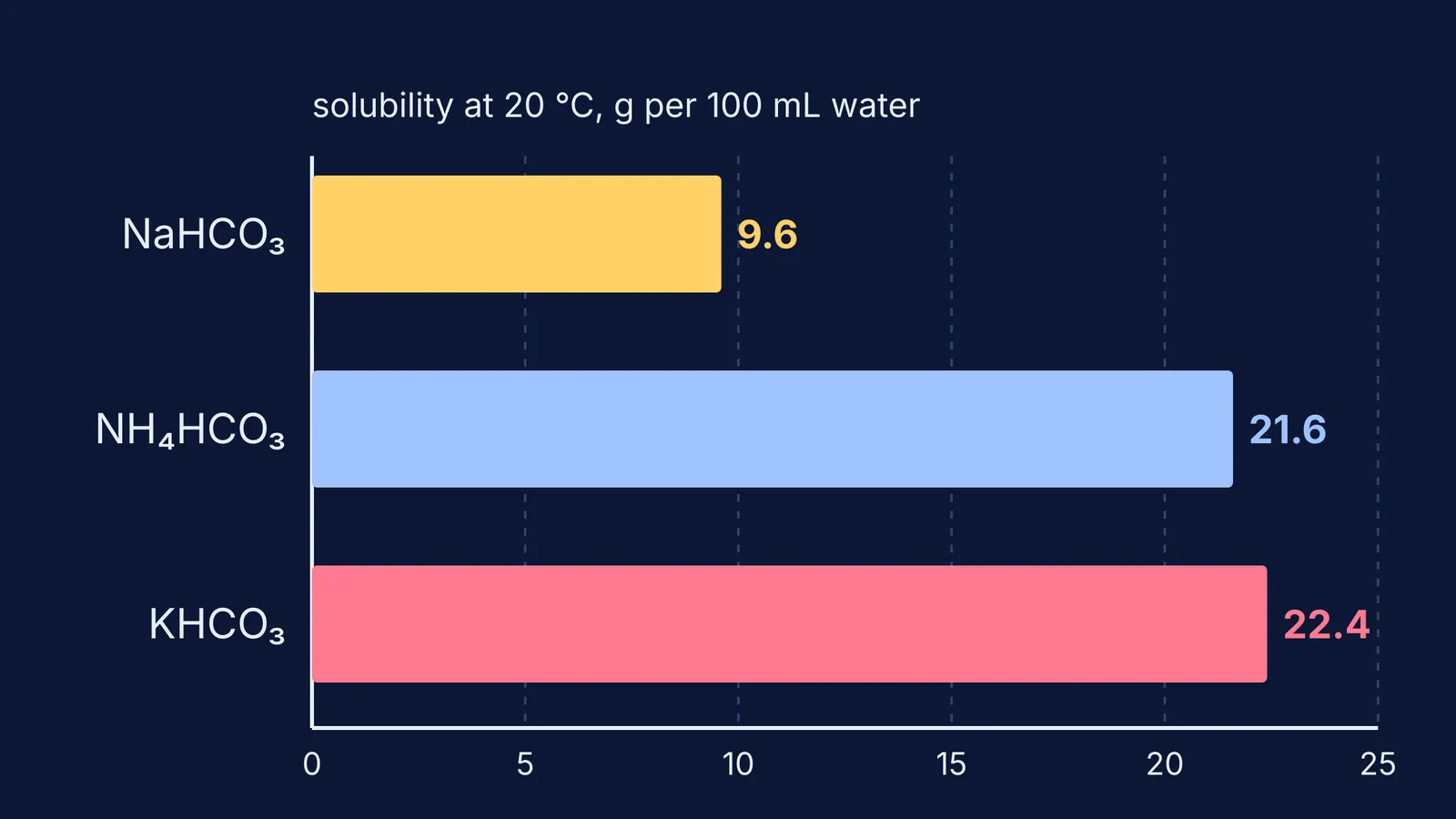
NaHCO₃: 9.6 g per 100 g of water at 20 °C (PubChem, sodium bicarbonate).
NH₄HCO₃: 21.6 g per 100 mL at 20 °C (Wikipedia, ammonium bicarbonate).
NaCl: 36.0 g per 100 g of water at 273 K (NCERT).
NH₄Cl: 383 g per litre at 25 °C, about 38 g per 100 mL (Wikipedia, ammonium chloride).
The sources use slightly different units and temperatures, but the ranking is clear: sodium hydrogencarbonate is less than half as soluble as the next salt, so it crystallises. That solid is the whole point: you can filter it and heat it in step 5.
Why can't K₂CO₃ be made by the Solvay process?
NCERT's answer: the process "cannot be extended to the manufacture of potassium carbonate because potassium hydrogencarbonate is too soluble to be precipitated by the addition of ammonium hydrogencarbonate to a saturated solution of potassium chloride" (NCERT Class 11, s-block chapter).
The numbers show why. Potassium hydrogencarbonate dissolves to 22.4 g per 100 mL at 20 °C (Wikipedia, potassium bicarbonate), against 9.6 g per 100 mL for sodium hydrogencarbonate on the same basis (Wikipedia, sodium bicarbonate). That is more than twice as soluble. In the potassium version of the tower, KHCO₃ is no longer clearly the least soluble salt: it is close to NH₄HCO₃ at 21.6 g per 100 mL (Wikipedia), and KCl dissolves to 33.97 g per 100 mL (Wikipedia, potassium chloride). Without a clean KHCO₃ precipitate, there is nothing to filter and nothing to heat into carbonate.
Treat these figures as a ranking, not an exact prediction, because a crowded mixture of ions shifts each salt's solubility. Potassium carbonate is made commercially another way, by reacting potassium hydroxide with carbon dioxide: 2KOH + CO₂ → K₂CO₃ + H₂O (Wikipedia, potassium carbonate).
How do you write this answer in an exam?
A full-mark answer to "Why can't K₂CO₃ be prepared by the Solvay process?" has three parts:
The key step: the process depends on the hydrogencarbonate precipitating when NH₄HCO₃ meets saturated chloride solution.
The contrast: NaHCO₃ has low solubility and crystallises; KHCO₃ is too soluble to precipitate.
The consequence: with no solid to separate, there is nothing to heat into K₂CO₃.
Mistakes to avoid:
Writing that Na₂CO₃ precipitates in the tower. It is NaHCO₃; the carbonate forms only on heating.
Forgetting ammonia recovery.
Leaving step 6 unbalanced.
If solubility itself feels shaky, the Fermi Concept Library gives each chemistry concept its own lesson and its place in the map. For practice, the Fermi Problem Library has worked problems with a step-by-step solver that explains the reasoning rather than printing an answer.
Next, follow the soda ash into the lab with our guide to preparing washing soda by recrystallisation, and compare the uses of sodium carbonate and sodium hydrogencarbonate.