

On this page
Baking soda and washing soda sound like cousins, and chemically they are. One is sodium hydrogencarbonate, the other is sodium carbonate holding ten water molecules in its crystals. It is a Class 10 topic, and questions usually come from three directions: the two equations, why the formula has 10H₂O, and the uses. Here is all of it in one place, with a mass calculation you can check yourself.
How is washing soda prepared from baking soda?
It takes two steps: heat, then recrystallise.
Step 1: heat the baking soda. Sodium hydrogencarbonate breaks down into sodium carbonate, water and carbon dioxide: 2NaHCO₃ → Na₂CO₃ + H₂O + CO₂, as the Wikipedia article on sodium carbonate sets out. The water and carbon dioxide leave as vapour and gas, so what stays behind is a white powder of anhydrous sodium carbonate, also called soda ash.
Sodium bicarbonate starts decomposing when heated above 50 °C and is fully decomposed at 270 °C, according to the OECD screening dataset quoted on PubChem's sodium bicarbonate record. That is why baking soda gives off gas in a hot oven.
Step 2: recrystallise the sodium carbonate. Dissolve the soda ash in water and let it crystallise. The crystals that form trap ten water molecules per formula unit: Na₂CO₃ + 10H₂O → Na₂CO₃·10H₂O. That decahydrate is washing soda, also known as sal soda, as PubChem's sodium carbonate decahydrate record lists.
Why does washing soda have ten water molecules?
The ten water molecules are water of crystallisation. They are not wetness on the surface; they are part of the crystal itself, which is why the formula has a whole number. If this idea feels shaky, our explainer on finding the water of crystallisation in a hydrate formula works through it from heating data.
Temperature decides which hydrate you get. The decahydrate forms from water solutions crystallising between −2.1 and 32.0 °C, according to the Wikipedia article on sodium carbonate. Above that range, other hydrates form instead.
The crystals are not stable in open air. Sodium carbonate decahydrate readily effloresces to form the monohydrate, says the same Wikipedia article, and PubChem describes it as a transparent solid that effloresces in air. Clear crystals left out in dry air lose water and turn powdery. Our post on deliquescent, efflorescent and hygroscopic substances shows how to keep these three words apart.
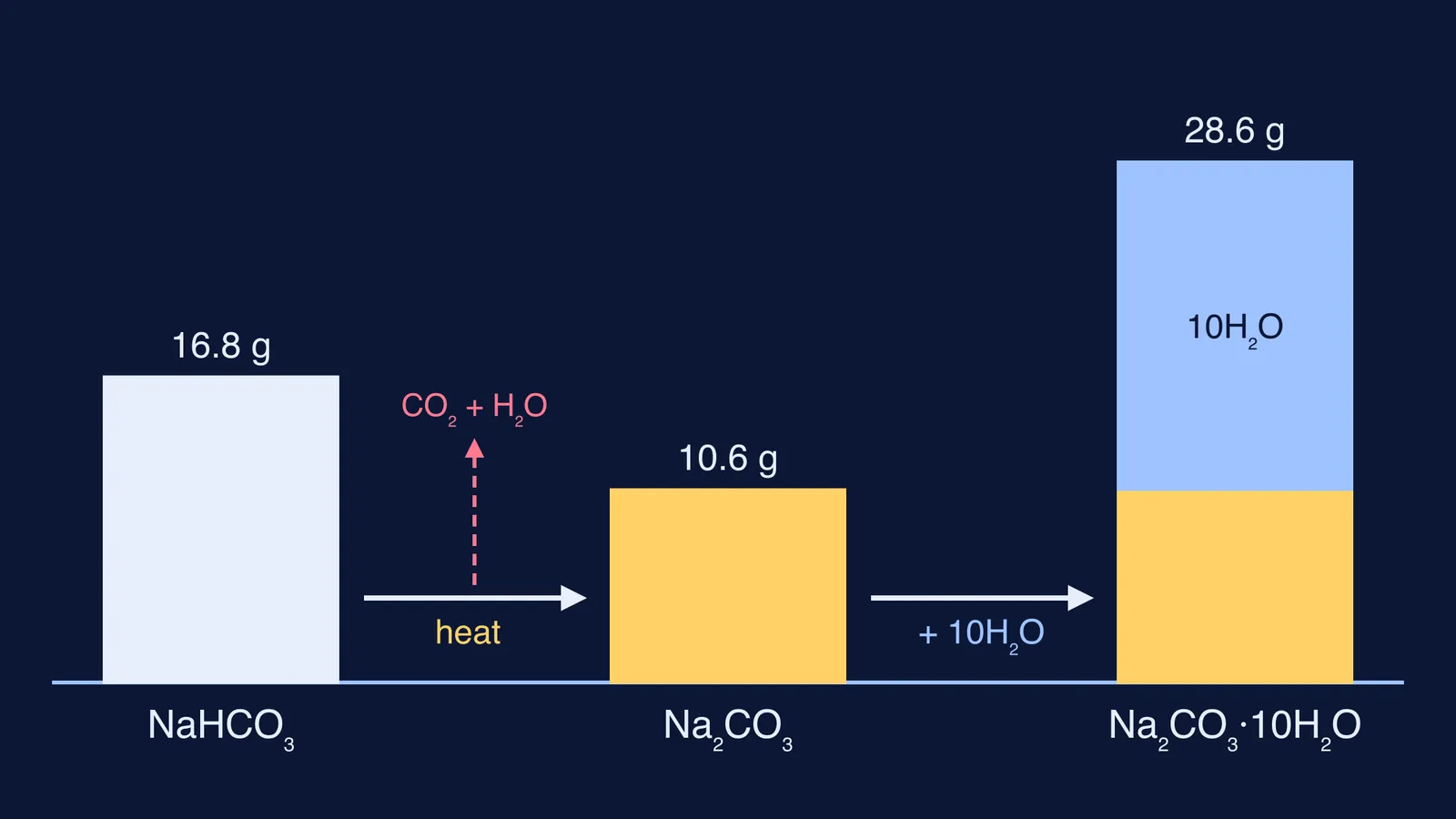
How much washing soda do you get from 16.8 g of baking soda?
A worked example makes both steps concrete. The molar masses come from PubChem: sodium bicarbonate 84.007 g/mol and sodium carbonate 105.988 g/mol (PubChem compound properties), and sodium carbonate decahydrate 286.14 g/mol (PubChem).
Moles of NaHCO₃: 16.8 ÷ 84.007 = 0.200 mol.
The equation says 2 mol NaHCO₃ give 1 mol Na₂CO₃, so you get 0.100 mol Na₂CO₃.
Mass of soda ash: 0.100 × 105.988 = 10.6 g. The other 6.2 g left as water vapour and carbon dioxide, so the solid lost about 37% of its mass.
Each mole of Na₂CO₃ becomes one mole of Na₂CO₃·10H₂O, so you get 0.100 × 286.14 = 28.6 g of washing soda.
Water in the crystals: 28.6 − 10.6 = 18.0 g, which is about 63% of the mass of washing soda.
That last number surprises most students: by mass, washing soda is mostly water. If you lose track of the mole ratio in step 2, the Fermi Problem Library has worked problems with a step-by-step solver that explains the reasoning rather than printing an answer.
What is washing soda used for?
PubChem's sodium carbonate record lists these among its uses:
Making glass.
Detergents and cleansers.
Pulp and paper production.
Making other sodium compounds.
Water treatment.
It also softens hard water. Carbonate ions react with the calcium and magnesium ions that make water hard, and these form insoluble precipitates, as the Wikipedia article on sodium carbonate explains. For a side-by-side of formulas, pH and uses, see our comparison of washing soda and baking soda.
Exam checklist before you write the answer
Write both equations, and balance the first one with 2NaHCO₃.
Name the products correctly: sodium carbonate (soda ash) after heating, sodium carbonate decahydrate (washing soda) after recrystallising.
Give at least three uses: glass, detergents, paper, water treatment, softening hard water.
If asked about the formula, explain that 10H₂O is water of crystallisation.
To revise the salts around this one, the Fermi Concept Library covers every concept in chemistry, each with its own lesson and its place in the map.


