

On this page
When you leave washing soda crystals or caustic soda pellets on a watch glass, room air is not an inert backdrop. It contains water molecules that exert a partial vapour pressure (p_air). Whether an exposed chemical solid remains unchanged, loses structural water, absorbs moisture, or dissolves into a puddle depends on how its equilibrium vapour pressure compares with p_air.
Moisture exchange is driven by chemical potential gradients. As atmospheric chemist Scot T. Martin showed in his review of aqueous particle transitions (Martin, 2000), crystals and ambient water vapour seek thermodynamic equilibrium. If water's chemical potential in the solid differs from that in ambient air, spontaneous transfer continues until equilibrium is reached. This connects directly with concepts in our Class 10 acids, bases, and salts revision guide.
Why do deliquescent salts turn into liquid puddles?
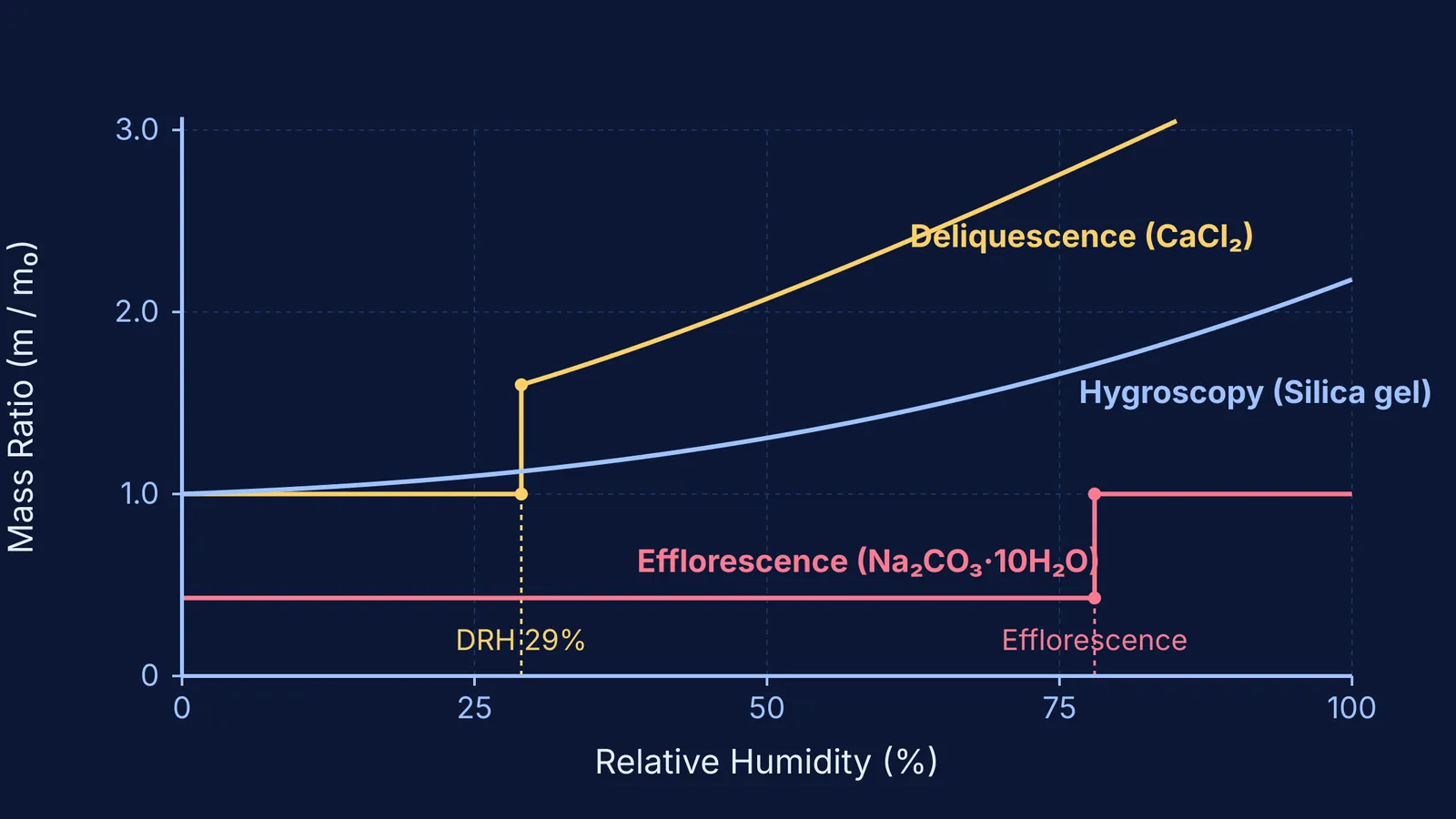
Deliquescence occurs when a solid absorbs atmospheric moisture until it dissolves completely into an aqueous solution. This happens because the compound is highly soluble, and the vapour pressure of its saturated solution (p_solution) is lower than the partial pressure of ambient water vapour (p_air). Water vapour condenses continuously onto the crystal, dissolving adjacent solid while maintaining a saturated solution until the entire solid liquefies.
Every deliquescent salt has a Deliquescence Relative Humidity (DRH), the threshold above which liquefaction begins. As compiled by Lewis Greenspan at the National Bureau of Standards (Greenspan, 1977), the equilibrium relative humidity at 25 °C is 32.8% for magnesium chloride (MgCl₂) and 75.3% for sodium chloride (NaCl). Solid calcium chloride (CaCl₂) liquefies above approximately 29% relative humidity, while sodium hydroxide (NaOH) deliquesces at just 9% relative humidity (Martin, 2000).
How does efflorescence strip water from hydrated crystals?
Efflorescence is the spontaneous loss of water of crystallisation from a hydrated salt to the atmosphere, causing crystals to crumble into powder. It occurs when the aqueous vapour pressure of the hydrate (p_hydrate) exceeds the partial pressure of water vapour in ambient air (p_air). Water molecules evaporate from the lattice to reduce this chemical potential difference.
Washing soda, or sodium carbonate decahydrate (Na₂CO₃·10H₂O), contains 10 water molecules of crystallisation per formula unit (NCERT Textbook, Chapter 2). When exposed to dry air at 25 °C, it effloresces by losing 9 water molecules to form white sodium carbonate monohydrate (Na₂CO₃·H₂O):
Na₂CO₃·10H₂O → Na₂CO₃·H₂O + 9H₂O
At 25 °C, the dissociation vapour pressure of sodium carbonate decahydrate is higher than the typical partial pressure of water vapour in air. It effloresces spontaneously to form the monohydrate unless the ambient relative humidity is unusually high. Similarly, copper(II) sulphate pentahydrate (CuSO₄·5H₂O), which contains 5 water molecules of crystallisation (NCERT Textbook, Chapter 2), effloresces when exposed to dry air. These vapour pressure boundaries link directly to Raoult's law for liquid mixtures and vapour pressure lowering.
What distinguishes hygroscopic materials from deliquescent salts?
A hygroscopic substance attracts and holds moisture from the environment without dissolving into a liquid solution. All deliquescent compounds are hygroscopic, but deliquescence is the extreme case where high solubility and low vapour pressure cause complete liquefaction.
Hygroscopic substances take up moisture through distinct mechanisms:
Surface physical adsorption: Silica gel features an amorphous network of silicon dioxide that adsorbs water into internal pores through capillary condensation without changing shape.
Chemical absorption: Quicklime (calcium oxide, CaO) reacts with moisture to form solid calcium hydroxide (Ca(OH)₂), releasing heat while remaining a dry powder.
Liquid absorption: Concentrated sulphuric acid (H₂SO₄) absorbs moisture to become dilute, serving as an effective laboratory desiccant.
How can you test for these substances in chemistry exams?
To classify an unfamiliar substance in exams or laboratory practicals, apply this three-step test:
Compare vapour pressure against air: If p_hydrate > p_air, the substance is efflorescent and loses water of crystallisation to form a powdery lower hydrate or anhydrous solid.
Check for liquefaction: If the substance absorbs water (p_substance < p_air), observe whether it dissolves into a liquid pool. If it liquefies (like CaCl₂, MgCl₂, or NaOH), it is deliquescent.
Check for solid retention or dilution: If it absorbs moisture while remaining solid (like silica gel or CaO), or is a liquid that dilutes (like concentrated H₂SO₄), classify it as hygroscopic.
In laboratory qualitative analysis, as described in our systematic salt analysis laboratory guide, noting whether a salt effloresces or deliquesces offers an immediate clue about hydration states and cation identity.
When preparing for exams, understanding the thermodynamic logic behind these definitions replaces rote memorisation. The Fermi Concept Library contains every concept in physics, chemistry, biology, mathematics and computing, each with its own lesson and its place in the map. For numerical and conceptual practice, the Fermi Problem Library provides worked problems with a step-by-step solver that explains the reasoning rather than printing an answer.


