On this page
Open a kitchen cupboard in many Indian homes and you may find both: a small packet of baking soda for dhokla and pakoras, and a bag of washing soda near the buckets. Both are sodium salts of carbonic acid, but they behave very differently. Here is the Class 10 chemistry, a worked calculation and a quick way to tell them apart.
What are the formulas of washing soda and baking soda?
Baking soda is sodium hydrogencarbonate, NaHCO₃, which the NCERT Class 10 chapter on acids, bases and salts calls "a mild non-corrosive basic salt".
Washing soda is sodium carbonate decahydrate, Na₂CO₃·10H₂O: sodium carbonate with ten molecules of water of crystallisation in every formula unit, as the same NCERT chapter shows.
How is washing soda made from baking soda?
The NCERT chapter starts from common salt. Baking soda is made by NaCl + H₂O + CO₂ + NH₃ → NH₄Cl + NaHCO₃. For the industrial version, read how Ernest Solvay's process makes washing soda.
Washing soda then takes two more steps:
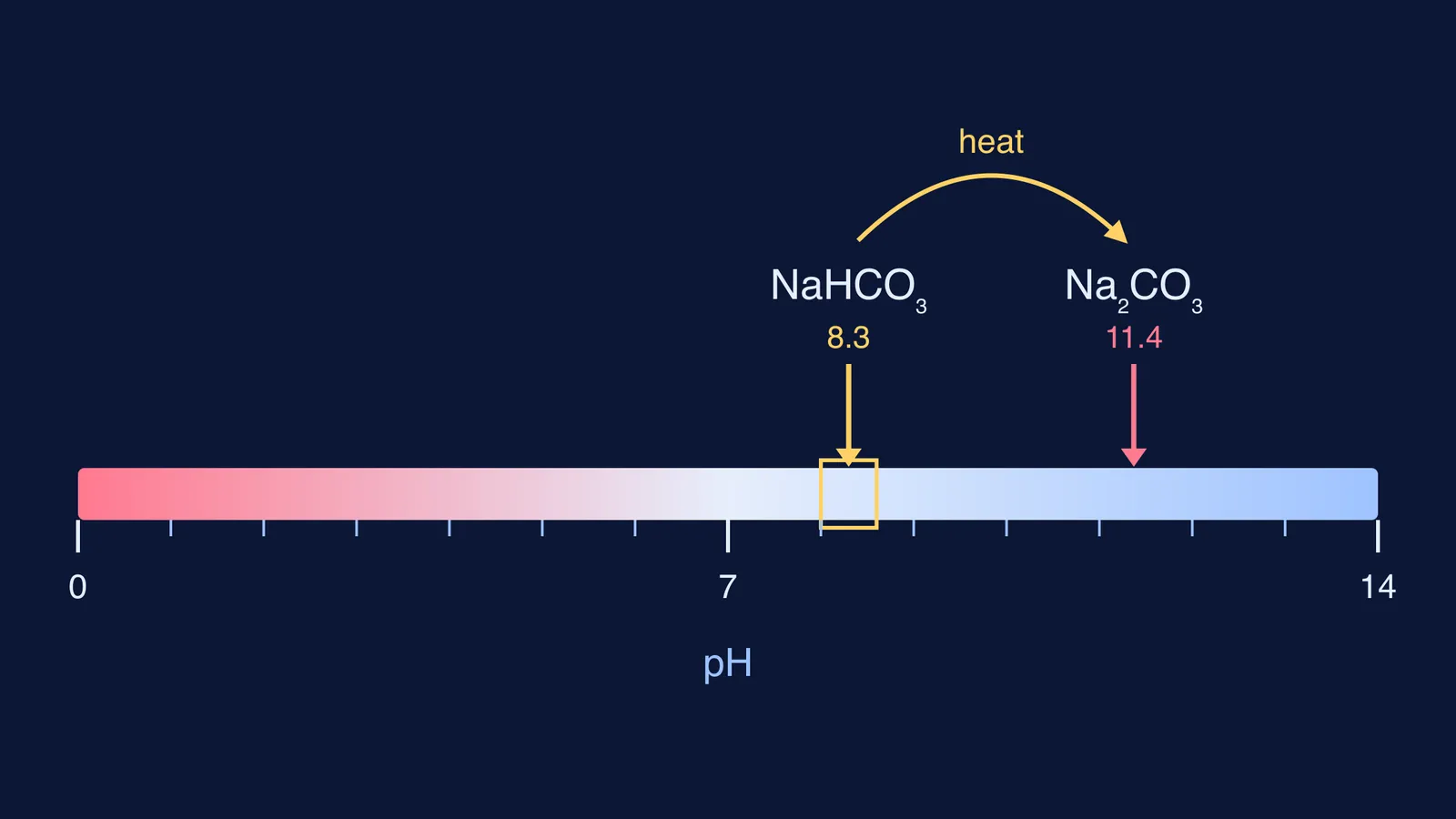
Heat baking soda: 2NaHCO₃ → Na₂CO₃ + H₂O + CO₂
Recrystallise the sodium carbonate from water: Na₂CO₃ + 10H₂O → Na₂CO₃·10H₂O
Sodium bicarbonate starts decomposing when heated above 50 °C and decomposes completely at 270 °C, according to OECD screening data listed on PubChem. Sodium carbonate is far more stable: PubChem gives its decomposition temperature as above 400 °C. That gap is why gentle heating turns one into the other and not back.
How much washing soda does 8.4 g of baking soda make?
PubChem gives molar masses of 84.01 g/mol for sodium hydrogencarbonate and 105.99 g/mol for sodium carbonate; round them to 84 and 106, and use H₂O = 18 and CO₂ = 44.
Moles of NaHCO₃ = 8.4 ÷ 84 = 0.10 mol.
The equation is 2 : 1, so Na₂CO₃ formed = 0.050 mol × 106 = 5.3 g.
Mass lost = 8.4 − 5.3 = 3.1 g, made of 2.2 g of CO₂ (0.050 × 44) and 0.9 g of water (0.050 × 18). That is a 36.9% loss in mass.
Recrystallised as Na₂CO₃·10H₂O (molar mass 106 + 180 = 286), the 0.050 mol becomes 14.3 g of washing soda crystals.
So 8.4 g of baking soda ends up as 14.3 g of washing soda, and about 63% of each washing soda crystal's mass (180 out of 286) is water. For more mole and mass practice, the Fermi Problem Library has worked problems with a step-by-step solver that explains the reasoning rather than printing an answer.
What is the pH of baking soda and washing soda solutions?
A 1% solution of sodium hydrogencarbonate has a pH of 8.0 to 8.6, per the EU food-additive specification for E 500(ii) listed on PubChem; a freshly prepared 0.1 M solution has a pH of 8.3 at 25 °C, per the Merck Index data on the same page.
A 1% (by weight) sodium carbonate solution has a pH of 11.37 at 25 °C, per the Kirk-Othmer encyclopedia data on PubChem.
Because pH is a log scale, a gap of about three units at the same 1% strength means the washing soda solution has roughly a thousand times more hydroxide ions. The carbonate ion, CO₃²⁻, pulls a proton off water readily. The hydrogencarbonate ion, HCO₃⁻, can act as both acid and base, so it settles near pH 8; see why the pH of sodium bicarbonate is ½(pKa1 + pKa2).
What are the household uses of baking soda and washing soda?
The NCERT chapter lists these uses.
Baking soda (NaHCO₃):
Faster cooking and crisp pakoras in the kitchen.
Baking powder, a mixture of baking soda and tartaric acid; the CO₂ released makes cakes and bread soft and spongy.
An ingredient in antacids, because it neutralises excess stomach acid.
Soda-acid fire extinguishers.
Washing soda (Na₂CO₃·10H₂O):
Glass, soap and paper industries.
Making other sodium compounds such as borax.
Cleaning at home.
Removing permanent hardness of water.
How do you tell baking soda and washing soda apart?
A four-step check for exam answers and the school lab:
Read the question's clue. "Softening hard water" or "cleaning agent" points to washing soda; "antacid", "baking powder" or "fire extinguisher" points to baking soda.
Test the pH. A few drops of universal indicator give a colour near 8 for baking soda and near 11 for washing soda.
Heat a pinch in a dry test tube. Baking soda gives off CO₂, which turns lime water milky; washing soda crystals mostly lose water, since sodium carbonate keeps its CO₂ until above 400 °C.
Use a salt test. Our post on the magnesium sulphate test for carbonate and bicarbonate shows how to separate the two ions in solution.
If amphiprotic ions or water of crystallisation still feel shaky, the Fermi Concept Library gives every chemistry concept its own lesson and its place in the map.
Next, redo the worked example with 4.2 g and check that every mass halves while the percentages stay the same.