On this page
In salt analysis, many confirmatory tests for anions are wet tests: you add a reagent to a solution and watch for a precipitate or a colour. That works only if the anion is actually in solution, and only if nothing else in the tube reacts with your reagent first. The sodium carbonate extract (often called the soda extract) solves both problems in one step.
What is a sodium carbonate extract?
It is the liquid you get after boiling your salt with excess sodium carbonate and water, then removing the solid. One B.Sc. lab manual from Seethalakshmi Ramaswami College gives the semimicro version: about 50 mg of the substance, about three times that amount of solid sodium carbonate and 5 mL of distilled water, boiled and centrifuged, with the clear liquid used for the anion tests. With larger amounts, a filter paper does the same job as the centrifuge.
Why boil an insoluble salt with Na2CO3?
The reaction is a swap of partners (double decomposition). Sodium carbonate is soluble, and sodium salts of the common anions are soluble too. Many metal carbonates are not. OpenStax Chemistry 2e states that the carbonates of the alkaline earth metals and lead(II) are not soluble and precipitate when a soluble alkali metal carbonate solution is mixed with solutions of their salts.
So for a salt of a metal M with anion X, boiling with soda drives this exchange:
the metal leaves the solution as solid MCO3
the anion stays in solution as Na2X or NaX
the large excess of carbonate pushes the exchange forward
That gives you two wins at once. First, an anion locked in a salt that will not dissolve in water is brought into solution. Second, metal ions that could react with your test reagents are removed. A solubility table from The Hong Kong Polytechnic University shows why that matters: lead sulphate and calcium sulphate are listed as insoluble, so a lead or calcium ion left in the tube could throw down its own precipitate and confuse your reading.
Worked example: lead chloride
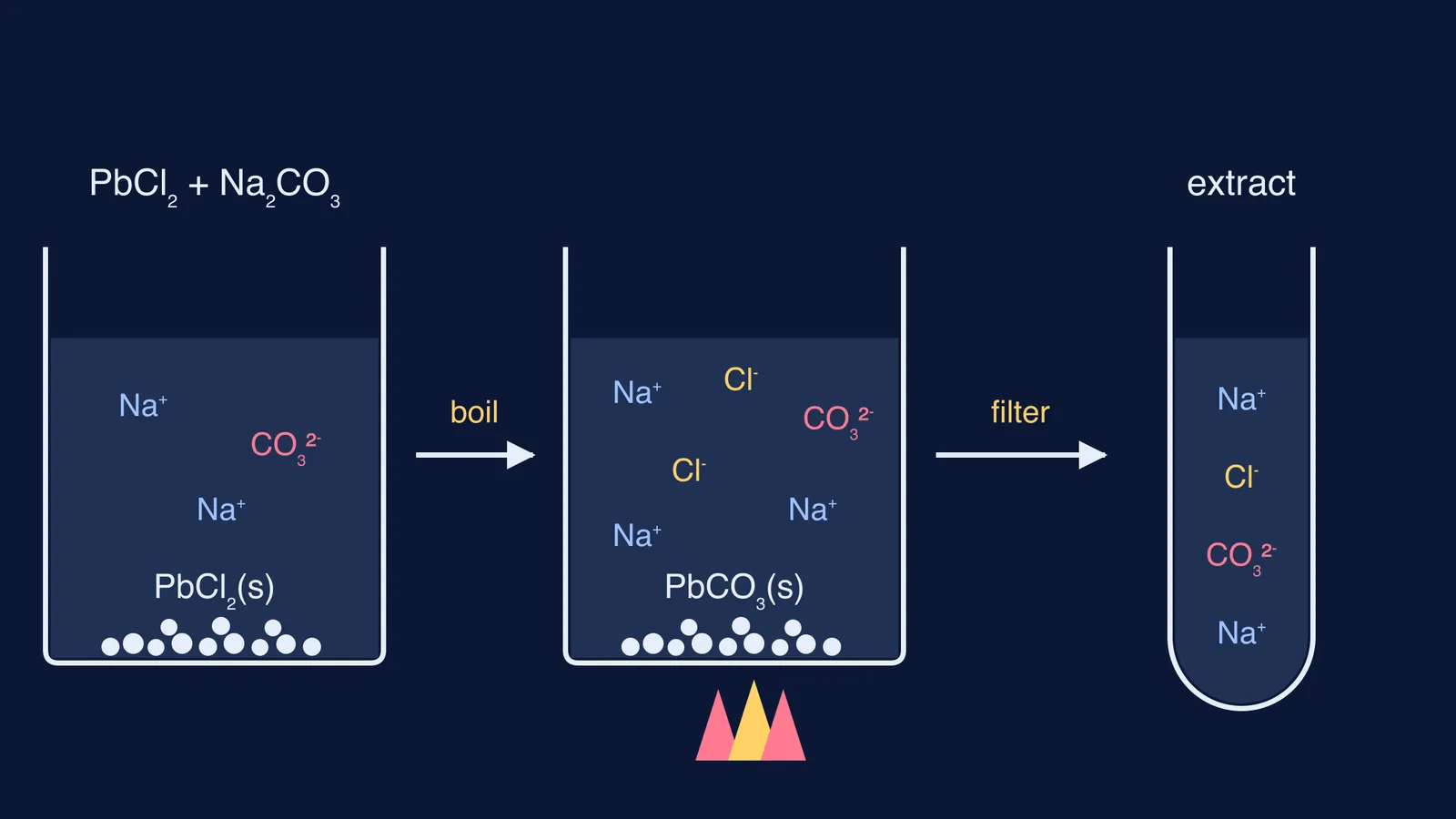
Suppose your salt is lead chloride. The same PolyU table lists lead chloride as insoluble, so you cannot count on a plain water extract to bring the chloride into solution.
Boil the salt with excess Na2CO3 and water. Pb2+ meets CO3 2- and forms white PbCO3, which stays as a solid.
Chloride stays in the liquid as NaCl. Filter or centrifuge; the clear liquid is your extract.
Take a portion and acidify it with dilute nitric acid, boil and cool, then add silver nitrate. The Seethalakshmi Ramaswami College manual lists a curdy white precipitate, completely soluble in ammonium hydroxide, as confirming chloride.
Report the cation from a separate solution of the original salt, not from this extract.
If you want the full sequence of halide observations, our post on the silver nitrate test for chloride, bromide and iodide sets them side by side.
Why must you acidify the extract before each test?
The extract is full of leftover carbonate. The PolyU table lists silver carbonate, barium carbonate and calcium carbonate as insoluble, so adding AgNO3 or BaCl2 straight to the extract would give a white precipitate from carbonate alone. Acid removes it, because carbonates react with acids to give carbon dioxide and water, as OpenStax explains.
The acid must not add the ion you are testing for. The college manual pairs them like this:
halides: dilute nitric acid, then silver nitrate (HCl would add chloride)
sulphate: dilute HCl, then barium chloride (H2SO4 would add sulphate)
oxalate or fluoride: dilute acetic acid, then calcium chloride
The same logic appears in organic analysis; see why you add nitric acid before silver nitrate in the Lassaigne test.
A quick checklist for practical day
Use the water extract if the salt dissolves; switch to the soda extract if it does not, or if the cation is likely to interfere.
Use excess Na2CO3, boil properly and filter until the liquid is clear.
Acidify every portion, with an acid that does not contain the anion you are looking for.
Add acid until fizzing stops, so no carbonate is left to fake a precipitate.
For where this step sits in the whole scheme, from dry tests to the final report, read our guide to the salt analysis practical. If you keep picking the wrong acid or the wrong order, the Fermi Problem Library has worked problems with a step-by-step solver that explains the reasoning rather than printing an answer. If the gap is solubility itself, the Fermi Concept Library gives each chemistry concept its own lesson.