

On this page
When you test for anions in the chemistry lab, treating a carbonate (CO₃²⁻) or a bicarbonate (HCO₃⁻) with dilute acid produces the exact same preliminary result. In both cases, you will observe a brisk effervescence of carbon dioxide gas that turns lime water milky. Because their preliminary acid reactions are indistinguishable to the naked eye, Salt analysis in the chemistry practical: a systematic approach requires a specific confirmatory reagent to tell them apart with absolute certainty. This is a common source of confusion for students during their board examinations, as the initial observations lead to the same generic conclusion. You need a secondary test to confidently narrow down the identity of the anion.
Magnesium sulphate (MgSO₄) provides this definitive test. The test relies on a fundamental chemical principle: the magnesium salts of carbonates and bicarbonates have vastly different solubilities at room temperature. This physical difference allows you to separate the two possibilities by simply looking at whether a solid forms when the chemicals are mixed. By exploiting this straightforward precipitation reaction, you can quickly determine the exact composition of the sample without relying on complex analytical instruments. It is a reliable and time-tested procedure used in laboratories worldwide. These foundational concepts are introduced early when learning about Acids, bases and salts in Class 10: indicators, pH and common salts, but they become critical tools when you reach advanced qualitative analysis in senior secondary chemistry.
How does the magnesium sulphate test work in the cold?
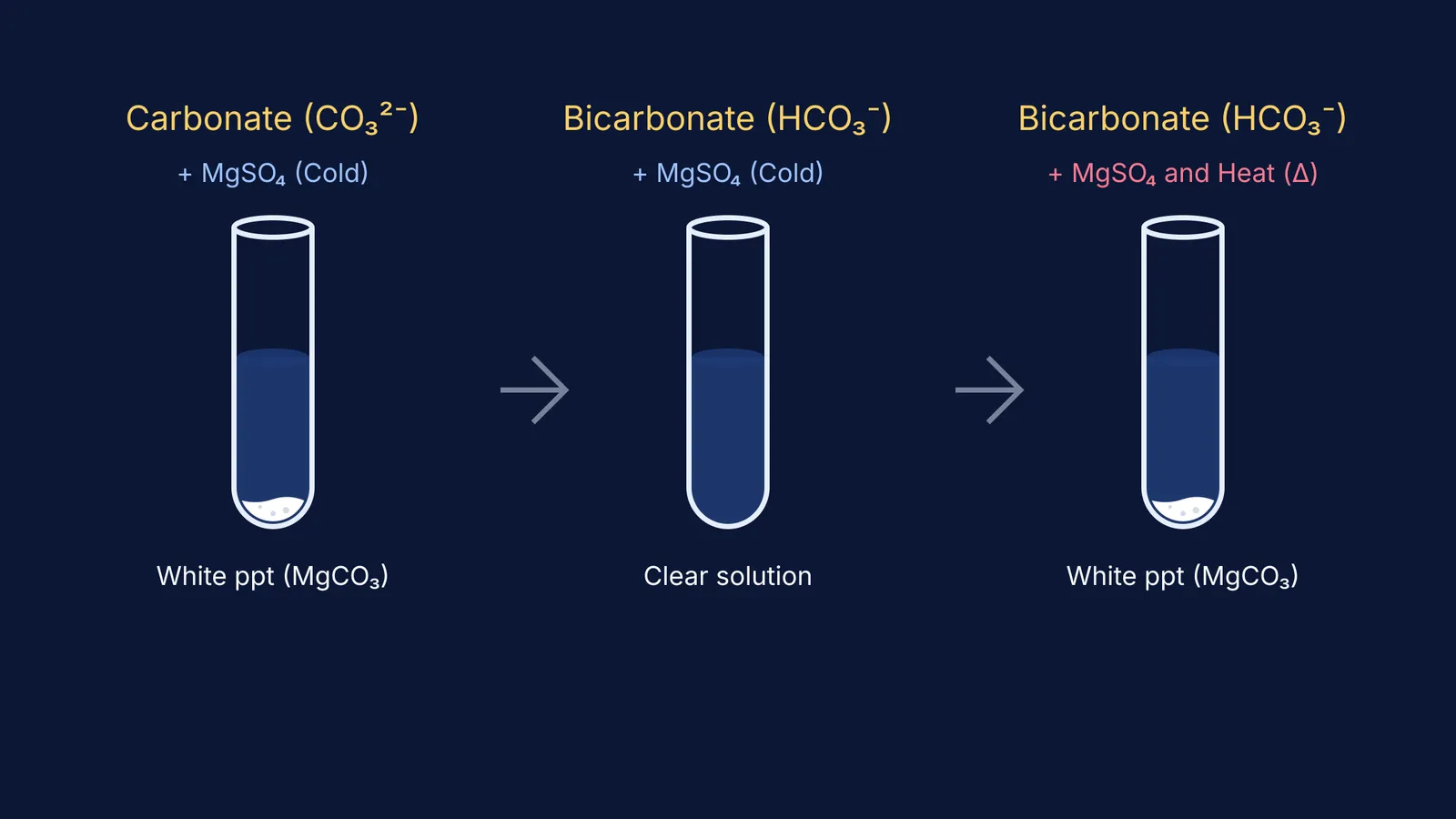
To begin the test, you must dissolve your unknown salt in water to make a clear aqueous solution. According to the NCERT Class 12 laboratory manual, adding a few drops of aqueous magnesium sulphate solution yields two distinct outcomes when performed at room temperature in the cold.
If your unknown salt is a soluble carbonate (such as sodium carbonate), a white precipitate of magnesium carbonate forms immediately. The magnesium ions bind strongly to the carbonate ions, creating an insoluble solid lattice that falls out of the solution. This immediate precipitation is a visual confirmation that does not require any additional heating or waiting time. The chemical equation for this rapid reaction is shown below: Na₂CO₃ + MgSO₄ → MgCO₃ ↓ + Na₂SO₄
If your unknown salt is a bicarbonate (such as sodium bicarbonate), the solution remains completely clear. No precipitate forms because magnesium bicarbonate is highly soluble in water at room temperature. The hydration energy of the bicarbonate complex is enough to keep the ions dissolved. This lack of an immediate reaction is precisely what distinguishes the bicarbonate from the carbonate. The chemical equation representing the formation of this soluble complex is as follows: 2NaHCO₃ + MgSO₄ → Mg(HCO₃)₂ + Na₂SO₄
What happens to bicarbonate on boiling?
If your initial test tube remained clear, you must confirm the presence of bicarbonate by heating it. When you boil the clear solution of magnesium bicarbonate, you supply enough thermal energy to break the compound apart. This critical step effectively shifts the chemical equilibrium and forces a reaction that would not otherwise occur in the cold.
This thermal decomposition forces the dissolved magnesium bicarbonate to release water and carbon dioxide gas, leaving behind insoluble magnesium carbonate as a white solid. Mg(HCO₃)₂ → MgCO₃ ↓ + H₂O + CO₂ ↑
If you are brushing up on solubility rules or precipitation reactions for your board exams, the Fermi Concept Library contains detailed lessons on ionic equilibrium to help you map these rules step by step. Understanding how these metal ions behave in solution is just as important as mastering the ICSE analytical chemistry: NaOH and NH4OH tests for metal ions.
How should you perform the test in an exam?
When performing this procedure in your practical exam, follow this exact sequence to avoid false positives and ensure accurate grading:
Dissolve a small pinch of the unknown salt in distilled water. Never use dilute acids for this specific step, as an acidic environment will prevent the precipitate from forming.
Add a few drops of aqueous magnesium sulphate solution into the test tube.
Observe the cold reaction immediately. If a thick white solid appears, record the anion as carbonate.
If the solution remains clear, place the test tube over a Bunsen burner or in a boiling water bath.
If a white solid forms only after boiling, along with tiny bubbles of escaping gas, record the anion as bicarbonate.
Always use distilled water to prepare your original salt solution. Tap water often contains dissolved calcium and magnesium ions that could prematurely react with your salt, ruining your results before you even add the reagent.
To test your understanding of ionic equilibrium, try a few practice questions in the Fermi Problem Library.


