

On this page
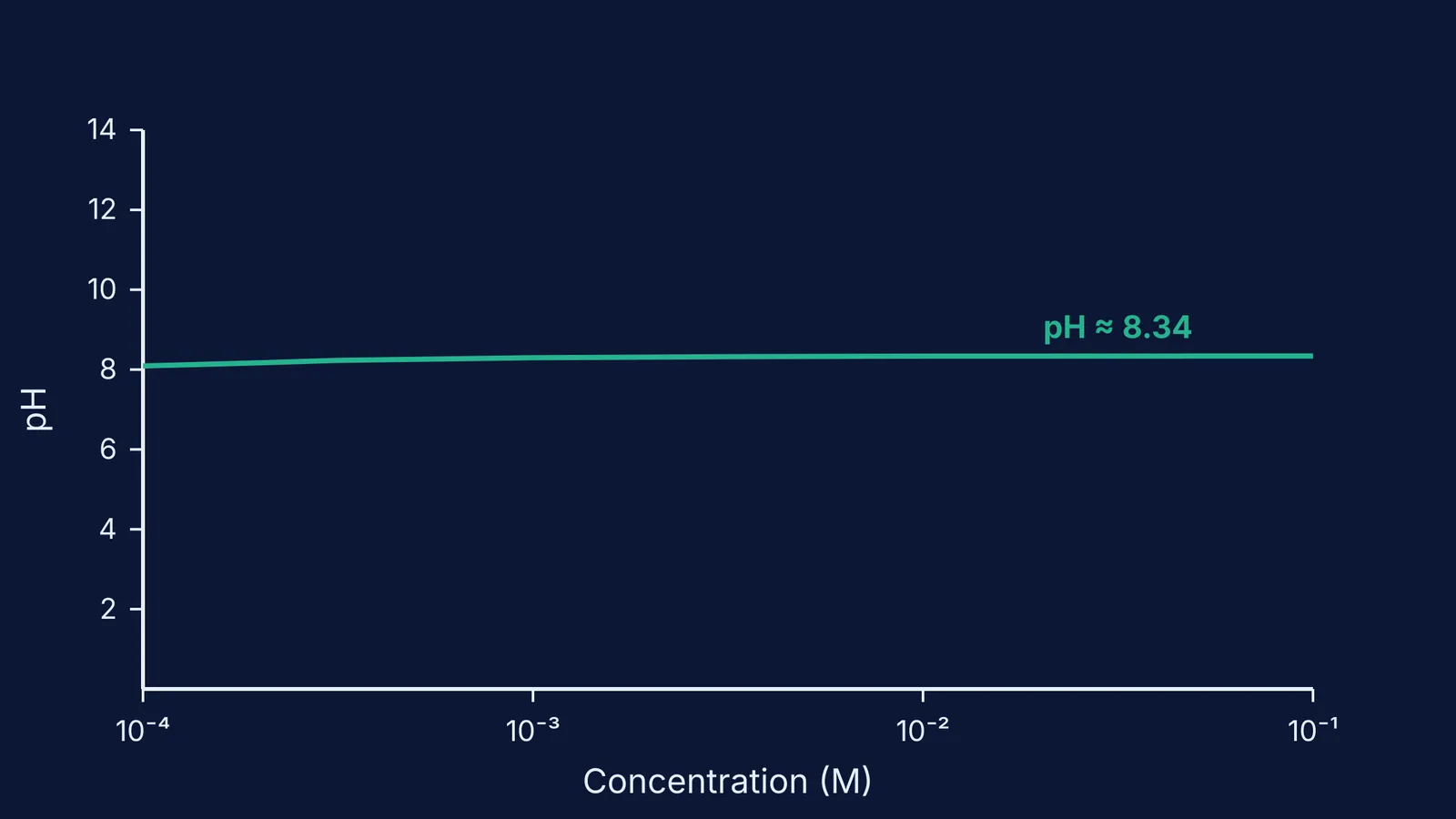
When you dissolve a weak acid in water, its pH depends on how much you dissolve. Dilute it, and the pH drifts closer to neutral. But if you dissolve baking soda (sodium bicarbonate, NaHCO₃) in water, something unusual happens: whether you make a highly concentrated solution or a much weaker one, the pH stays stubbornly flat at around 8.34 (Carbonic acid - Wikipedia).
This happens because the bicarbonate ion, HCO₃⁻, is an amphiprotic species—it can act as both an acid and a base (Bicarbonate - Wikipedia). Its pH does not depend on its concentration, but only on the equilibrium constants of its parent polyprotic acid, carbonic acid (H₂CO₃).
How does an amphiprotic ion act as both an acid and a base?
Bicarbonate is the intermediate species of carbonic acid. In water, it undergoes two competing reactions simultaneously, constantly acting as both a proton donor and a proton acceptor.
First, it can act as an acid (dissociation), donating a proton to water: HCO₃⁻ + H₂O ⇌ CO₃²⁻ + H₃O⁺ This reaction pushes the solution to become more acidic, governed by the second acid dissociation constant, Kₐ₂.
Second, it can act as a base (hydrolysis), stealing a proton from water: HCO₃⁻ + H₂O ⇌ H₂CO₃ + OH⁻ This reaction pushes the solution to become more basic. This is governed by the base dissociation constant K_b, which relates to Kₐ₁ through Conjugate acid-base pairs: Ka × Kb = Kw and what it tells you.
In a pure solution of an amphiprotic salt, the balance between these two reactions determines the final pH. If you are struggling to picture how these two equilibria balance each other out across a reaction vessel, the Fermi Simulation Lab lets you run the competing reactions side-by-side and watch the pH stabilise.
Why does concentration drop out of the pH equation?
To find the exact pH, chemists set up a charge balance and a mass balance for all the species in the solution. We can derive an exact expression for the hydrogen ion concentration, [H⁺], where C is the concentration of the salt and K_w is the auto-ionisation constant of water: [H⁺] = √((Kₐ₁Kₐ₂C + Kₐ₁K_w) / (Kₐ₁ + C))
In standard laboratory conditions, two things are almost always true. First, the salt concentration is much larger than the first dissociation constant (C ≫ Kₐ₁). Second, the amount of H⁺ produced by the salt's second dissociation overwhelms the tiny amount produced naturally by water (Kₐ₂C ≫ K_w).
Because of these two conditions, the + Kₐ₁ and + Kₐ₁K_w terms become mathematically negligible. The equation simplifies dramatically, crossing out C entirely: [H⁺] ≈ √(Kₐ₁Kₐ₂)
Taking the negative logarithm of both sides gives the standard formula—using the scale introduced by Søren Sørensen and why pH counts in powers of ten: pH ≈ ½(pKₐ₁ + pKₐ₂)
How do you calculate the pH of sodium bicarbonate?
To find the pH of a sodium bicarbonate solution, the formula uses pKₐ₁ and pKₐ₂ of carbonic acid. Carbonic acid is a diprotic acid with the following dissociation constants at 25 °C (Carbonic acid - Wikipedia):
pKₐ₁ = 6.35
pKₐ₂ = 10.33
Plugging these into our simplified formula: pH = ½(6.35 + 10.33) pH = ½(16.68) = 8.34
This result tells you that a solution of sodium bicarbonate will always be slightly basic, regardless of whether you dissolve a pinch or a spoonful in a beaker. The basic hydrolysis (stealing a proton to form H₂CO₃) outpaces the acidic dissociation (donating a proton to form CO₃²⁻).
If you are working through equilibrium problems and keep getting tangled in the quadratic formulas for polyprotic acids, the Fermi Concept Library breaks down exactly when you can use these simplifying approximations and when you must solve the full equation from scratch.
When does the simplified pH approximation fail?
The formula pH = ½(pKₐ₁ + pKₐ₂) is a reliable shortcut, but it has boundaries. If you dilute the bicarbonate solution heavily, the auto-ionisation of water (K_w) can no longer be ignored because Kₐ₂C stops being much greater than K_w. At these higher dilutions, the pH will drift from 8.34 towards neutral 7.0. (Keep in mind that Neutral pH is not always 7: how Kw changes with temperature, so this specific neutral point applies at standard room temperature).
Similarly, if you are working with an amphiprotic salt where Kₐ₁ is unusually large (meaning it is a relatively strong weak acid), the assumption C ≫ Kₐ₁ might fail, and you will have to use the full square-root equation. In all other cases, you can confidently average the two pKₐ values and skip the concentration entirely.


