On this page
NCERT writes Fehling's test as RCHO + 2Cu²⁺ + 5OH⁻ → RCOO⁻ + Cu₂O + 3H₂O. Read literally, one glucose molecule should reduce two copper(II) ions. But when food labs measure the sugar in honey, jaggery or syrup with Fehling's solution, they do not use that ratio at all. They use a table, and the table says one hexose molecule uses up nearly five Cu²⁺. Here is how the titration works, where the "five" comes from, and how to calculate sugar and sucrose in honey from a burette reading.
What is the Lane–Eynon method?
Hermann von Fehling designed his blue reagent as a measuring tool, as our post on who invented Fehling's solution explains. The version still used today was published by J. H. Lane and L. Eynon in 1923, and it appears in food standards such as the Codex method for honey and FSSAI's own manuals.
The procedure, in outline:
Fehling's A is copper(II) sulphate solution, 69.28 g of CuSO₄·5H₂O per litre (the Codex method; the Japan Customs Lane–Eynon method writes the same thing as 34.639 g per 500 mL). Fehling's B is alkaline sodium potassium tartrate.
Exactly 5 mL of A and 5 mL of B go into a flask and are brought to the boil.
The sugar solution runs in from a burette while the liquid keeps boiling. Red Cu₂O forms as the blue fades.
Near the end, a few drops of methylene blue are added. Once all the Cu²⁺ is used, the first drop of extra sugar reduces methylene blue to its colourless form, and the blue colour disappears.
The flask must keep boiling. Air re-oxidises the reduced methylene blue, and the steam keeps air out. Standard methods also fix the boiling time, because the result depends on it.
How many Cu²⁺ does one glucose molecule really reduce?
Let us count, using numbers from a published method. The copper in the flask is:
Molar mass of CuSO₄·5H₂O = 249.68 g/mol.
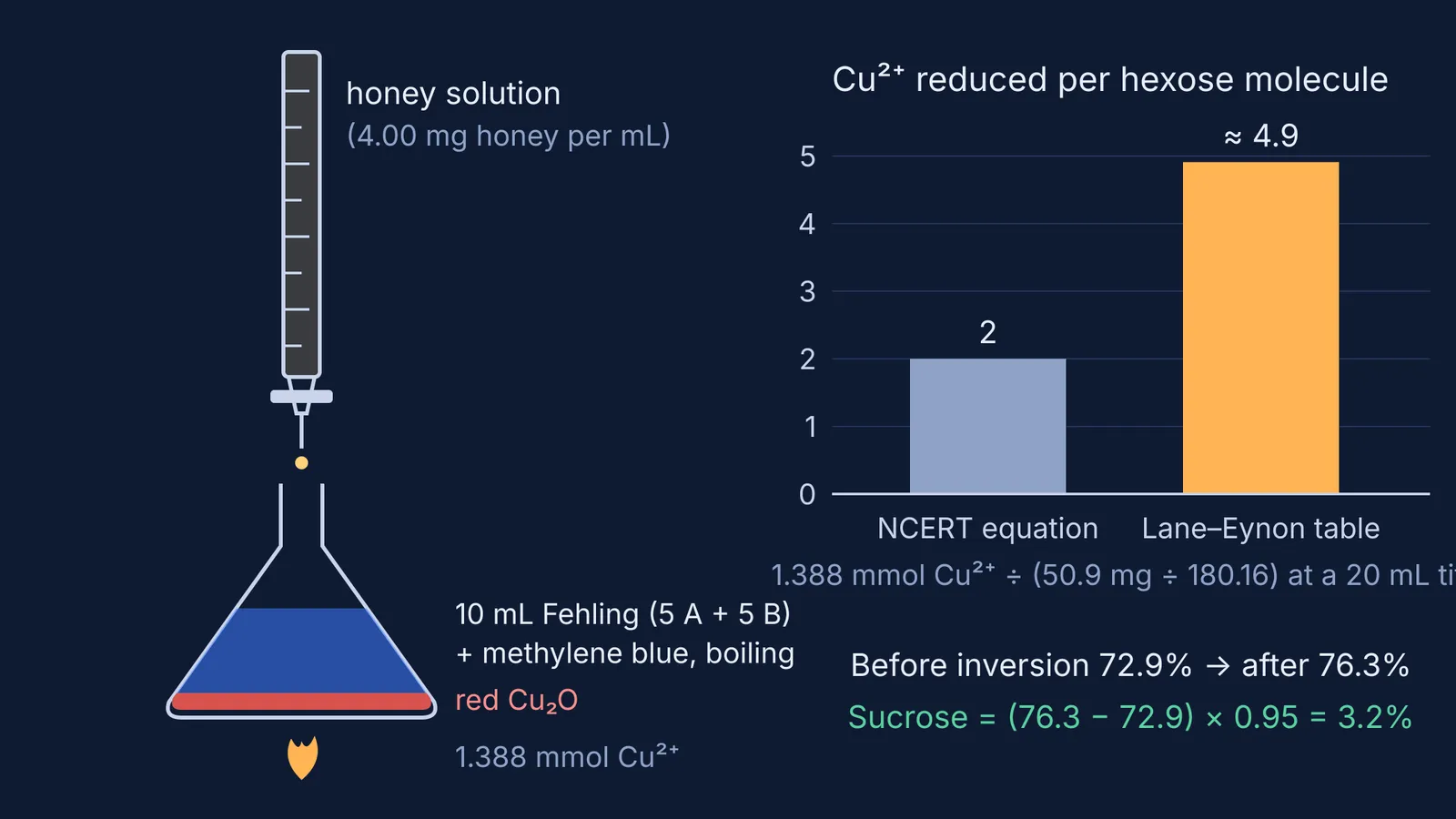
Cu²⁺ in 5 mL of Fehling's A = 5 × 69.28 ÷ 249.68 = 1.388 mmol.
The Japan Customs method standardises the reagent with a solution of invert sugar (equal moles of glucose and fructose) containing 2.5 mg per mL, and expects a titre of 20.36 mL. Its Lane–Eynon table agrees: at a 20 mL titre, 10 mL of Fehling's solution is reduced by 50.9 mg of invert sugar.
Moles of hexose = 50.9 ÷ 180.16 = 0.283 mmol.
Cu²⁺ per hexose = 1.388 ÷ 0.283 = 4.9.
So the measured ratio is close to five, not two. The table shows it is not even fixed: the sugar needed rises from about 50.4 mg at a 15 mL titre to about 52.6 mg at 50 mL, so the ratio drifts from about 5.0 to 4.8.
Why so many? In hot alkali a sugar does not just lose its –CHO group to become one carboxylate. It isomerises, and its carbon chain breaks into smaller pieces, several of which can reduce Cu²⁺ too. One university lab guide describes the reaction as "quantitative but non-stoichiometric", because the sugar is oxidised to a number of different species. How much copper is used depends on alkali strength, temperature and boiling time. That is why the number five is an empirical result, not a balanced equation.
Why does the method use a table instead of the equation?
Because no single equation describes what happens. Lane and Eynon measured how much of each sugar reduces 10 mL of the reagent under fixed conditions, and wrote the results down. Full tables, such as those used with AOAC method 923.09, give separate columns for invert sugar, glucose, fructose and other sugars, because each reduces a slightly different amount of copper. The titre is kept between about 15 and 50 mL, the range the table covers. Labs also check their Fehling's solution against a standard sugar solution and apply a small correction factor.
The NCERT equation is still right about what is oxidised and what is reduced. It is just not a counting rule for the hot titration.
Worked example: how much sugar is in this honey?
Sample numbers, chosen so the titres fall inside the table's range.
(a) Reducing sugar before inversion
2.00 g of honey is dissolved and made up to 500 mL, so each mL holds 4.00 mg of honey. Titrating 10 mL of Fehling's solution needs 17.4 mL of this solution.
Honey used = 17.4 × 4.00 = 69.6 mg.
From the table, a 17.4 mL titre lies between 298 mg/100 mL (17 mL) and 282 mg/100 mL (18 mL). Interpolating gives 291.6 mg per 100 mL.
Invert sugar in the titre = 17.4 × 291.6 ÷ 100 = 50.7 mg.
Reducing sugar = 50.7 ÷ 69.6 × 100 = 72.9% (as invert sugar).
Now try the NCERT ratio instead. 1.388 mmol Cu²⁺ ÷ 2 = 0.694 mmol of sugar = 125 mg. That would put 125 mg of sugar in 69.6 mg of honey, or 180%. The impossible answer is the clearest proof that the 2:1 ratio does not hold here.
(b) After inversion
A second portion is warmed with acid to hydrolyse its sucrose, neutralised, and made up so it again holds 4.00 mg of honey per mL. The titre is now 16.6 mL.
Honey used = 16.6 × 4.00 = 66.4 mg.
Table: between 316 (16 mL) and 298 (17 mL), giving 305.2 mg per 100 mL.
Invert sugar = 16.6 × 305.2 ÷ 100 = 50.7 mg.
Total sugar after inversion = 50.7 ÷ 66.4 × 100 = 76.3%.
(c) Sucrose
Sucrose is not a reducing sugar (see reducing and non-reducing sugars), so it shows up only after inversion. One sucrose (342.30 g/mol) gives one glucose plus one fructose (360.31 g/mol together), so 1 g of invert sugar came from 342.30 ÷ 360.31 = 0.95 g of sucrose.
Sucrose = (76.3 − 72.9) × 0.95 = 3.2%.
The Codex method uses exactly this 0.95 factor for apparent sucrose. If inversion itself is new to you, our post on why sucrose hydrolysis is called inversion covers the optical rotation side.
Does this honey meet FSSAI's standard?
The current FSSAI standard for honey.pdf) asks for at least 65.0% total reducing sugars and at most 5.0% sucrose for most honeys, a fructose to glucose ratio between 0.95 and 1.50, and at most 20% moisture. Our sample, at 72.9% and 3.2%, passes the two sugar limits. The fructose to glucose ratio cannot come from Fehling's titration alone, since both sugars reduce copper; labs need a second method that tells glucose and fructose apart.
If the copper bookkeeping or the interpolation step is where you got lost, the Fermi Problem Library has worked problems with a step-by-step solver that explains the reasoning.
Quick checklist
10 mL Fehling's (5 mL A + 5 mL B) holds 1.388 mmol Cu²⁺.
About 51 mg of invert sugar reduces it, so roughly 5 Cu²⁺ per hexose, not 2.
The ratio is empirical and changes with titre, sugar and boiling time; always use the table.
Keep the flask boiling; methylene blue marks the end point.
Sucrose = (after − before inversion) × 0.95.