On this page
Most Class 12 chemistry students meet a deep blue liquid that turns brick red when it is warmed with the right compound. That liquid is Fehling's solution, and it carries the name of the chemist who worked it out in the 1840s. Here is who he was, what the reagent contains, and a step-by-step way to use it in board and entrance exam questions.
Who invented Fehling's solution?
Fehling's solution was devised by the German chemist Hermann von Fehling, who was born in Lübeck in 1812 (Hermann von Fehling, Wikipedia). He trained in a pharmacy, studied mainly chemistry in Heidelberg from 1835 to 1837, did research under Justus von Liebig at Giessen, and taught chemistry in Stuttgart from 1839 until he retired in 1883 (University of Stuttgart history). It was Liebig who recommended him for the Stuttgart post (Wikipedia).
His key paper appeared in 1849 in Annalen der Chemie und Pharmacie, titled “Die quantitative Bestimmung von Zucker und Stärkmehl mittelst Kupfervitriol”, roughly “the quantitative determination of sugar and starch by means of copper sulfate” (the 1849 paper, DOI record). The University of Stuttgart's timeline also lists an 1848 work on measuring sugar in urine, which is why you will sometimes see 1848 quoted (University of Stuttgart).
The detail most textbooks skip is that Fehling built a measuring tool, not just a colour test. The liquid being tested was added to a measured amount of the blue solution until the colour changed, and Fehling's calibration table turned that volume into a sugar content. Its first use was measuring sugar in the urine of diabetes patients (University of Stuttgart). Today the reagent is mainly used the other way round, as a quick yes-or-no test for sugars and aldehydes. (This is chemistry history, not a home test: questions about blood sugar belong with a doctor.)
What is in Fehling's solution A and B?
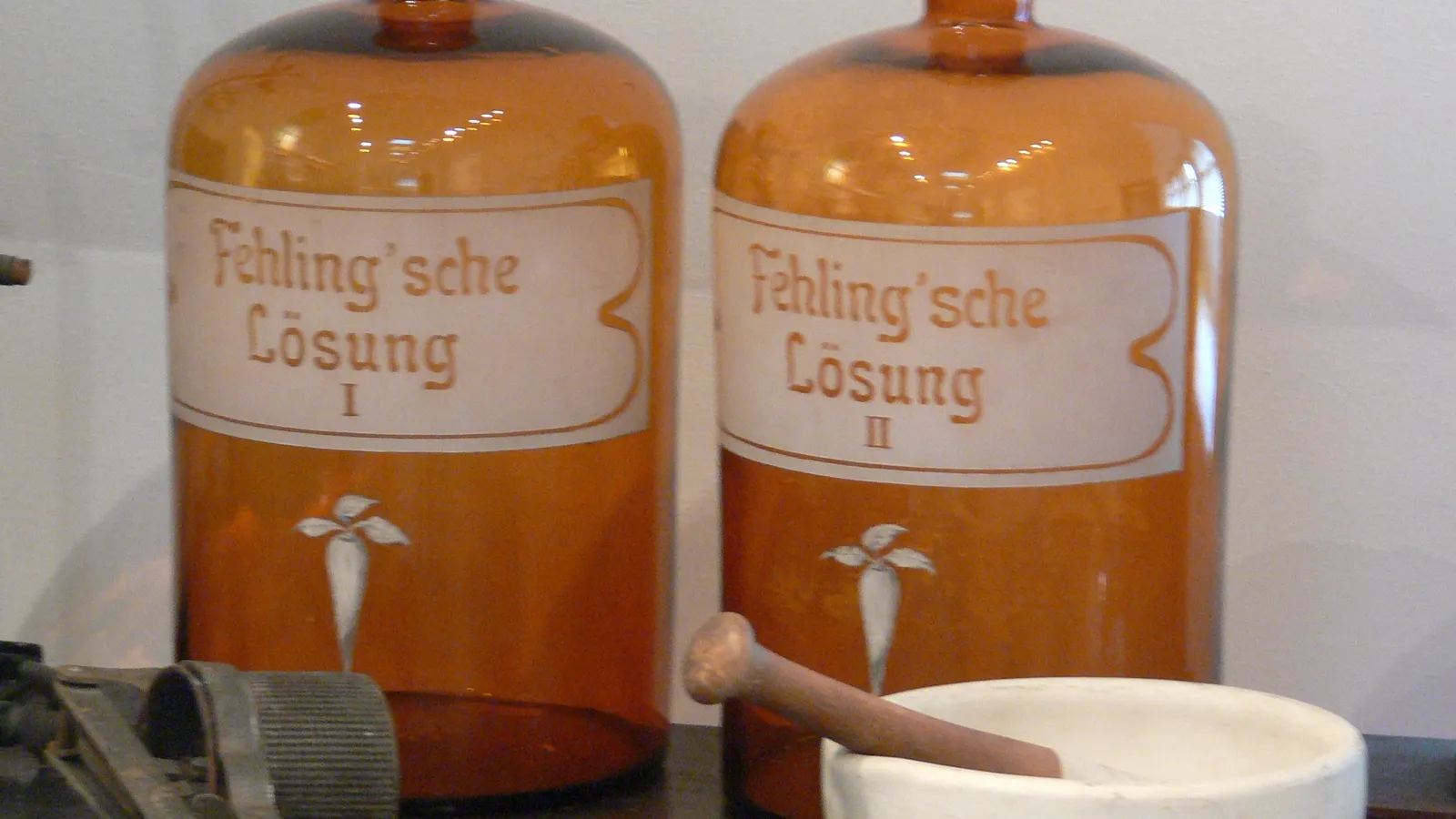
Fehling's reagent is two solutions that are mixed in equal amounts just before the test (NCERT Class 12 Chemistry, Unit 8; colours from Fehling's solution, Wikipedia):
Fehling solution A: aqueous copper(II) sulphate, deep blue.
Fehling solution B: sodium potassium tartrate (Rochelle salt) made alkaline with sodium hydroxide, colourless.
They are stored apart because the copper(II) complex formed when they are mixed is not stable and slowly decomposes (Wikipedia). The tartrate has a homely origin: Rochelle salt, also called Seignette's salt, is made from raw tartar, a by-product of wine making (University of Stuttgart).
How does Fehling's test work?
When an aldehyde is heated with Fehling's reagent, it is oxidised to a carboxylate anion and a reddish brown precipitate forms (NCERT Class 12 Chemistry, Unit 8). NCERT writes the reaction as:
R–CHO + 2Cu²⁺ + 5OH⁻ → RCOO⁻ + Cu₂O + 3H₂O
The red-brown solid is copper(I) oxide, Cu₂O (Wikipedia).
Which compounds give a positive Fehling's test?
Run through these questions in order before you predict a result:
Is there a –CHO group on an alkyl chain, as in ethanal? Positive (NCERT).
Is the –CHO attached straight to a benzene ring, as in benzaldehyde? NCERT says aromatic aldehydes do not respond to this test.
Is it a ketone? Negative, unless it is an α-hydroxy ketone (Wikipedia).
Is it a sugar? Aldoses such as glucose are positive; ketoses such as fructose are positive too, because the base in the reagent converts them to aldoses; maltose is positive (same source). Sucrose is a non-reducing sugar and does not react (Reducing sugar, Wikipedia).
Is it formic acid? Positive (Wikipedia).
How do you use Fehling's test in an exam question?
Say you are given four unlabelled bottles: ethanal, benzaldehyde, propanone and a sucrose solution. Using only tests from the NCERT chapter (NCERT Unit 8):
Warm a sample of each with Fehling's reagent. Only ethanal gives the red-brown precipitate.
Warm the other three with Tollens' reagent. Aldehydes give a silver mirror, so benzaldehyde is now identified.
Run the iodoform test on the last two. Propanone has a CH₃CO group and gives the yellow iodoform precipitate; sucrose does not.
NCERT's Example 8.4 runs the same logic backwards: a compound C₈H₈O reduces neither Tollens' nor Fehling's reagent, yet gives the iodoform test, so it is a methyl ketone, which the chapter identifies as acetophenone.
If questions like Example 8.4 keep tripping you up, the Fermi Problem Library has worked problems with a step-by-step solver that explains the reasoning rather than printing an answer. If the gap is further back, in oxidation states or carbonyl groups, the Fermi Concept Library gives each chemistry concept its own lesson and its place in the map.
Next time you see a test tube turn from blue to brick red, remember that the colour change began as a way of putting a number on sugar.