

On this page
In an aqueous solution, sugar molecules interact with light. When you shine plane-polarised light through a solution of sucrose (common table sugar), the light wave rotates to the right.
This optical property is not permanent. If you boil that solution with a few drops of acid, the sucrose molecule splits. The resulting solution no longer rotates light to the right; instead, it rotates it to the left. Chemists call this phenomenon the inversion of cane sugar.
Here is exactly how the chemistry works, why the rotation flips, and how to spot this concept in your exam paper.
What happens during sucrose hydrolysis?
Sucrose is a disaccharide made of two simple sugars bonded together by a glycosidic linkage. When you add water and an acid catalyst (or an enzyme like invertase), that bond breaks.
This chemical breakdown is called hydrolysis. One molecule of sucrose (C₁₂H₂₂O₁₁) splits into one molecule of glucose (C₆H₁₂O₆) and one molecule of fructose (C₆H₁₂O₆).
The products are an equimolar mixture—you get exactly equal amounts of glucose and fructose. While you might recognise these sugars from biology, in chemistry, their structural differences lead to a sharp physical change in how they bend light. For more on how sugar structures behave, you can read about reducing and non-reducing sugars.
Why is sucrose hydrolysis called inversion of sugar?
The name "inversion" comes directly from the optical rotation of the sugars involved.
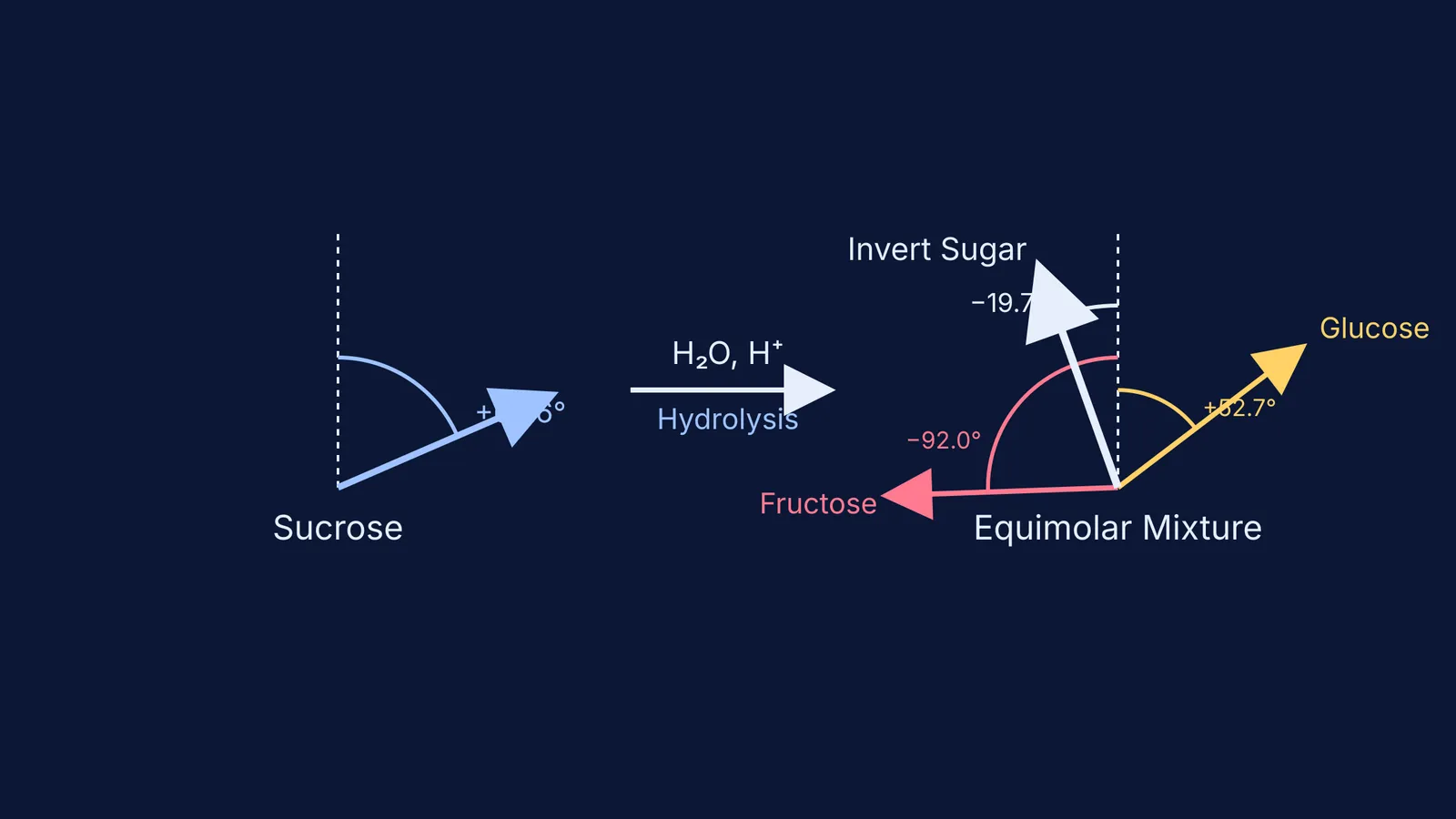
Sucrose is dextrorotatory, meaning it rotates plane-polarised light to the right. The specific rotation of sucrose is +66.6° (Wikipedia).
When sucrose hydrolyses, it yields two new sugars, each with its own optical rotation:
D-glucose is dextrorotatory with a specific rotation of +52.7° (Wikipedia).
D-fructose is heavily laevorotatory, rotating light to the left by −92.0° (Wikipedia).
Because the mixture contains equal parts of glucose and fructose, the net optical rotation is the average of their individual rotations. The strong laevorotation of fructose (−92.0°) overpowers the dextrorotation of glucose (+52.7°).
As a result, the final mixture rotates light to the left by approximately −19.7° (Wikipedia). The sign of the rotation "inverts" from positive to negative as the reaction proceeds. Because of this flip, the reaction is called the inversion of sugar, and the resulting glucose-fructose mixture is sold commercially as invert sugar.
How do you solve exam questions on sugar inversion?
Inversion of sugar is a standard topic in board exams and competitive tests like JEE and NEET because it combines biomolecules with chemical kinetics.
If you are struggling to picture how optical rotation works or why a molecule is chiral, the Fermi Concept Library covers every concept in chemistry, each with its own lesson and its place in the map.
When you see a question about sucrose hydrolysis, follow this checklist to ensure you do not drop marks:
Identify the kinetics: Sucrose hydrolysis takes place in a large excess of water, meaning the concentration of water barely changes. Therefore, it follows pseudo first-order kinetics.
Watch the signs: Exam numericals will give you the rotation at time t = 0 (which is positive) and at the end of the reaction when t = ∞ (which is negative). If your final reading is positive, the reaction is incomplete.
Use the angle formula: For a first-order reaction monitored by a polarimeter, the rate constant k is given by k = (1/t) ln [ (R₀ − R_∞) / (R_t − R_∞) ], where R is the optical rotation at a given time.


